 Preview · the opening mission
Read this to the class:
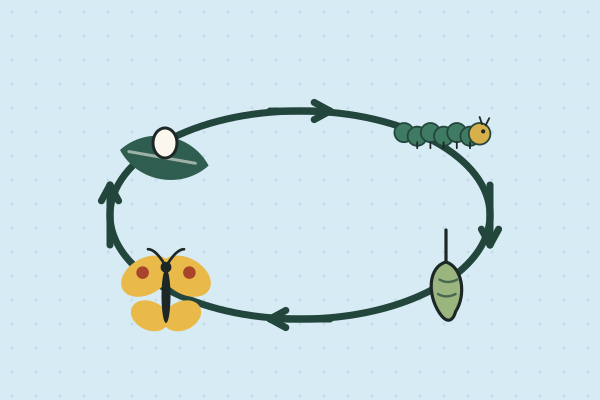
On the school wall, Imani found a small green caterpillar. A few weeks later, it had gone, and a butterfly sat on the same leaf. "It just grew wings," said her brother. "No," said her friend, "it turned into something else." A grasshopper nearby looked like a tiny adult. A tadpole in the pond looked like a little fish. Does every animal grow up the same way? Your team's job: work out the life of one animal from clues, draw it as a wheel, and compare it with the others.
Teams of three, with three jobs that rotate: Reader (reads the clues aloud), Artist (draws the stages) and Checker (makes sure the stages are in order and each one has a label).
Look inside the PDF
Sample pages, stamped “preview”. The download is the clean, full lesson.
In the full lesson PDF
- Predict (5–10 min)
- Hunt (20 min)
- Reveal (10–15 min)
- Act (10 min)
- Background for the teacher
- Assessment
- Student sheet
- Worksheet: Label it
- Worksheet: Try it at home
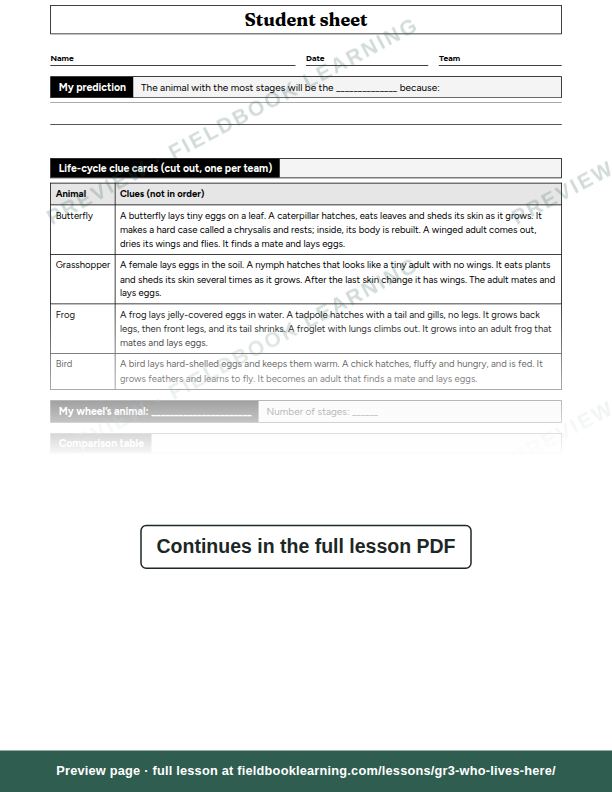
On the student sheet
- My prediction
- Life-cycle clue cards (cut out, one per team)
- My wheel's animal: ______________________
- Comparison table
- What every life cycle has
- Our riddle
- Label it
- Try it at home
US Letter, prints cleanly in black and white. The student sheet is on its own page, ready to photocopy.
Free with an account (any 3 lessons), or US$19 / C$25 for all 4 lessons in this unit.
What students show by the end
- Orders and models a life cycle
- Compares cycles
- Names what is common
From the lesson’s rubric, which scores each one as not yet, getting there or got it.
Questions teachers ask
How long does “Does every animal grow up the same way?” take?
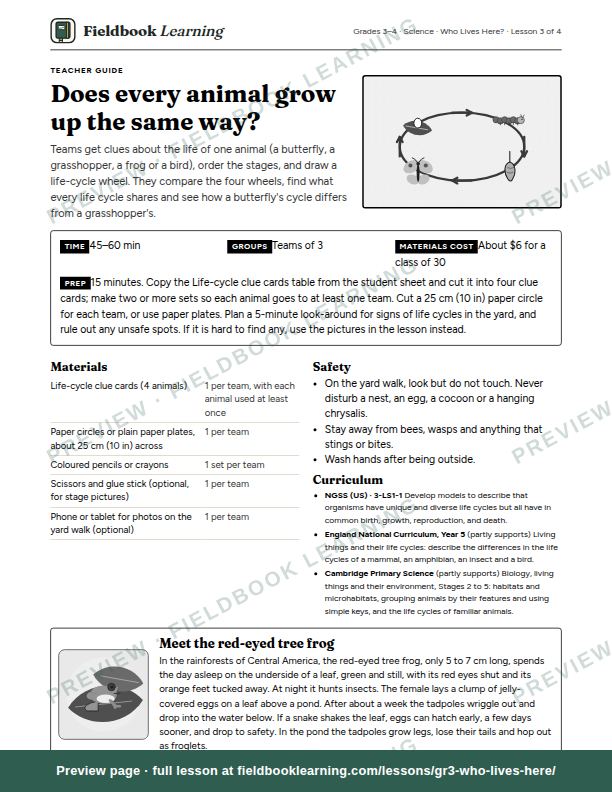
45–60 min. Group size: teams of 3.
How much prep does it need?
15 minutes. Copy the Life-cycle clue cards table from the student sheet and cut it into four clue cards; make two or more sets so each animal goes to at least one team. Cut a 25 cm (10 in) paper circle for each team, or use paper plates. Plan a 5-minute look-around for signs of life cycles in the yard, and rule out any unsafe spots. If it is hard to find any, use the pictures in the lesson instead.
What materials do I need?
Life-cycle clue cards (4 animals); paper circles or plain paper plates, about 25 cm (10 in) across; coloured pencils or crayons; scissors and glue stick (optional, for stage pictures); phone or tablet for photos on the yard walk (optional). Cost: about $6 for a class of 30.
Which curriculum standards does it cover?
NGSS (US): 3-LS1-1. It also matches England National Curriculum, Year 5 and Cambridge Primary Science.
What’s in the lesson PDF?
A teacher guide that walks you through predict, hunt, reveal, act, background for the teacher and assessment, then a student sheet (“My prediction”; “Life-cycle clue cards (cut out, one per team)”; “My wheel's animal: ______________________”; “Comparison table”; “What every life cycle has”; “Our riddle”; “Label it” and “Try it at home”) on its own page, ready to photocopy. It’s US Letter and prints cleanly in black and white.
Can I try it for free?
Yes. A free account includes any 3 full lessons of your choice, and this can be one of them. After that, this unit is US$19 (C$25) for all 4 lessons, yours to keep, or every lesson is US$79 (C$109) a year.