 Preview · the opening mission
Read this to the class:
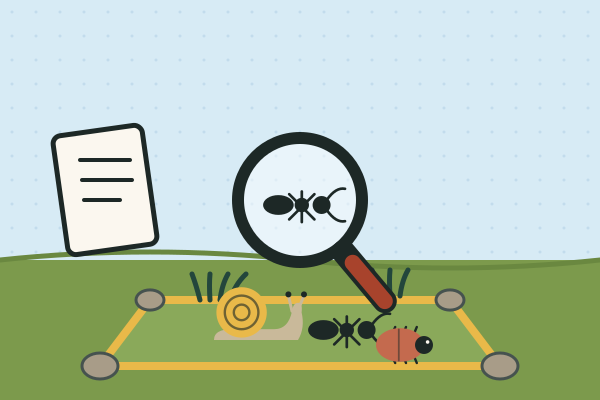
At Hillcrest School, the head teacher wants to turn one corner of the yard into a wild patch, with a little shade and some plants. A parent says, "Why bother? Nothing lives in our yard anyway." The head teacher is not sure. Nobody has ever really looked. Scientists would not guess. They would count. Your team's job: find out who lives in two spots in our schoolyard, count them without hurting a single one, and report back.
Teams of three, with three jobs that rotate at the second spot: Spotter (looks closely with the hand lens and calls out what is in the square), Recorder (writes the tally) and Sketcher (draws or photographs anything the team cannot name).
Look inside the PDF
Sample pages, stamped “preview”. The download is the clean, full lesson.
In the full lesson PDF
- Predict (5–10 min)
- Hunt (20 min)
- Reveal (10–15 min)
- Act (10 min)
- Background for the teacher
- Assessment
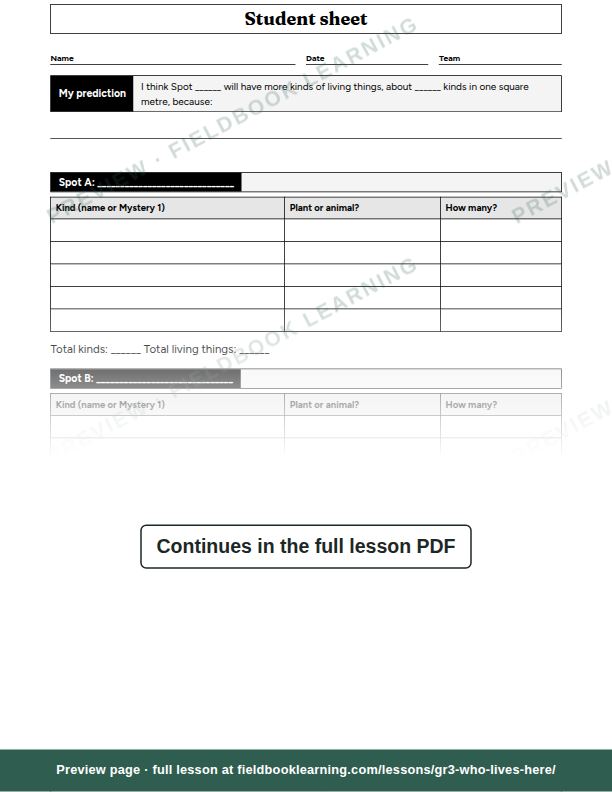
- Student sheet
- Worksheet: Label it
- Worksheet: Try it at home
On the student sheet
- My prediction
- Spot A: ______________________________
- Spot B: ______________________________
- Living, once living or never alive?
- Draw a Mystery creature
- What we found
- Note to the head teacher
- Label it
- Try it at home
US Letter, prints cleanly in black and white. The student sheet is on its own page, ready to photocopy.
Free with an account (any 3 lessons), or US$19 / C$25 for all 4 lessons in this unit.
What students show by the end
- Surveys fairly
- Sorts living, once living and never alive
- Compares and explains
From the lesson’s rubric, which scores each one as not yet, getting there or got it.
Questions teachers ask
How long does “Who lives in our schoolyard?” take?
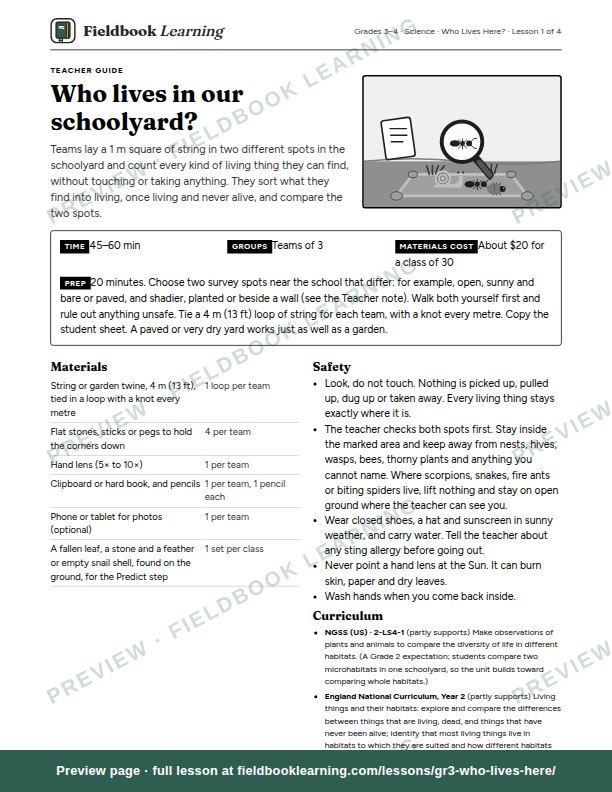
45–60 min. Group size: teams of 3.
How much prep does it need?
20 minutes. Choose two survey spots near the school that differ: for example, open, sunny and bare or paved, and shadier, planted or beside a wall (see the Teacher note). Walk both yourself first and rule out anything unsafe. Tie a 4 m (13 ft) loop of string for each team, with a knot every metre. Copy the student sheet. A paved or very dry yard works just as well as a garden.
What materials do I need?
String or garden twine, 4 m (13 ft), tied in a loop with a knot every metre; flat stones, sticks or pegs to hold the corners down; hand lens (5× to 10×); clipboard or hard book, and pencils; phone or tablet for photos (optional); a fallen leaf, a stone and a feather or empty snail shell, found on the ground, for the Predict step. Cost: about $20 for a class of 30.
Which curriculum standards does it cover?
NGSS (US): 2-LS4-1 (partly). It also matches England National Curriculum, Year 2; England National Curriculum, Year 4 and Cambridge Primary Science.
What’s in the lesson PDF?
A teacher guide that walks you through predict, hunt, reveal, act, background for the teacher and assessment, then a student sheet (“My prediction”; “Spot A: ______________________________”; “Spot B: ______________________________”; “Living, once living or never alive?”; “Draw a Mystery creature”; “What we found”; “Note to the head teacher”; “Label it” and “Try it at home”) on its own page, ready to photocopy. It’s US Letter and prints cleanly in black and white.
Can I try it for free?
Yes. A free account includes any 3 full lessons of your choice, and this can be one of them. After that, this unit is US$19 (C$25) for all 4 lessons, yours to keep, or every lesson is US$79 (C$109) a year.