 Preview · the opening mission
Read this to the class:
In the schoolyard, Dalia found a small black creature with long legs on a web. "An insect!" she said. Her friend Kofi counted its legs and shook his head. "That's not an insect." They argued all the way to lunch. Someone has to settle it. A scientist would not argue about looks. She would check features. Your team's job: sort sixteen animals into groups using features, and find out where a spider belongs.
Teams of three, with three rotating jobs: Sorter (moves the cards), Checker (reads the clues aloud) and Recorder (writes each group name and its deciding clue).
Look inside the PDF
Sample pages, stamped “preview”. The download is the clean, full lesson.
In the full lesson PDF
- Predict (5–10 min)
- Hunt (20 min)
- Reveal (10–15 min)
- Act (10 min)
- Background for the teacher
- Assessment
- Student sheet
- Worksheet: Label it
- Worksheet: Try it at home
On the student sheet
- My prediction
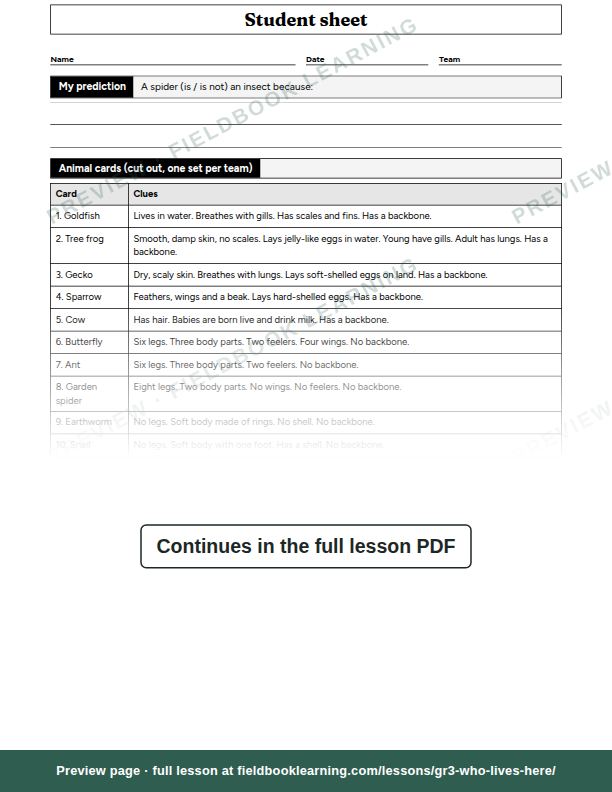
- Animal cards (cut out, one set per team)
- My sorting record
- My yes-or-no key
- Field-guide page
- Label it
- Try it at home
US Letter, prints cleanly in black and white. The student sheet is on its own page, ready to photocopy.
Free with an account (any 3 lessons), or US$19 / C$25 for all 4 lessons in this unit.
What students show by the end
- Sorts by features
- Handles tricky cases
- Separates insects from spiders
From the lesson’s rubric, which scores each one as not yet, getting there or got it.
Questions teachers ask
How long does “Is a spider an insect?” take?
45–60 min. Group size: teams of 3.
How much prep does it need?
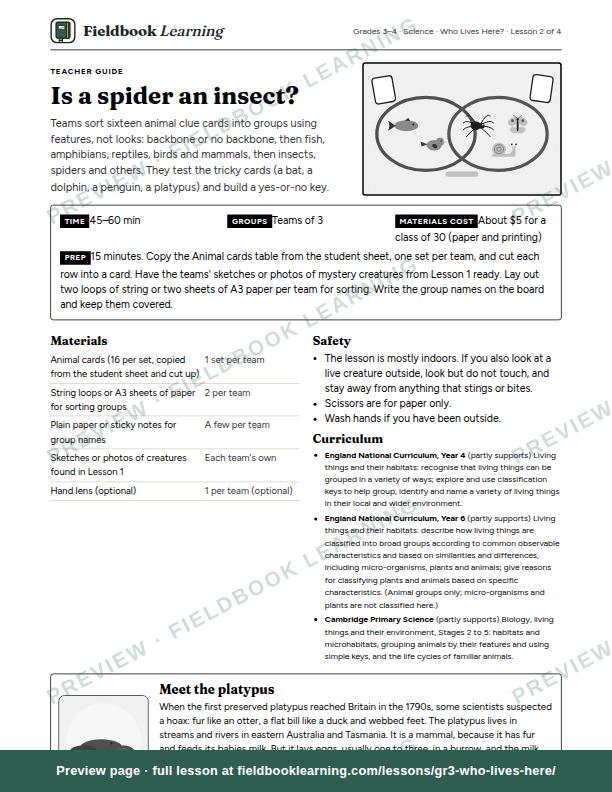
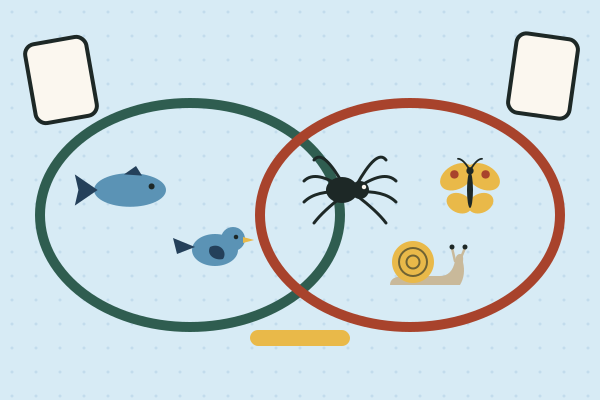
15 minutes. Copy the Animal cards table from the student sheet, one set per team, and cut each row into a card. Have the teams' sketches or photos of mystery creatures from Lesson 1 ready. Lay out two loops of string or two sheets of A3 paper per team for sorting. Write the group names on the board and keep them covered.
What materials do I need?
Animal cards (16 per set, copied from the student sheet and cut up); string loops or A3 sheets of paper for sorting groups; plain paper or sticky notes for group names; sketches or photos of creatures found in Lesson 1; hand lens (optional). Cost: about $5 for a class of 30 (paper and printing).
Which curriculum standards does it cover?
It matches England National Curriculum, Year 4; England National Curriculum, Year 6 and Cambridge Primary Science.
What’s in the lesson PDF?
A teacher guide that walks you through predict, hunt, reveal, act, background for the teacher and assessment, then a student sheet (“My prediction”; “Animal cards (cut out, one set per team)”; “My sorting record”; “My yes-or-no key”; “Field-guide page”; “Label it” and “Try it at home”) on its own page, ready to photocopy. It’s US Letter and prints cleanly in black and white.
Can I try it for free?
Yes. A free account includes any 3 full lessons of your choice, and this can be one of them. After that, this unit is US$19 (C$25) for all 4 lessons, yours to keep, or every lesson is US$79 (C$109) a year.