 Preview · the opening mission
Read this to the class:
Nadia ran the whole way to school because she was late. When she sat down, her heart was thumping so hard she could feel it in her neck, and she was breathing fast. Her friend Tomas, who had walked, felt nothing at all. "Your heart is going to burst!" said Tomas. Nadia's teacher laughed and said it was doing exactly what it should. Your team's job: measure what a heart does when the body works hard, and find out why it speeds up.
Teams of three, with three jobs that rotate after each round: Jumper (exercises), Timer (watches the clock and says "start" and "stop"), Recorder (writes every count).
Look inside the PDF
Sample pages, stamped “preview”. The download is the clean, full lesson.
In the full lesson PDF
- Predict (5–10 min)
- Hunt (20 min)
- Reveal (10–15 min)
- Act (10 min)
- Background for the teacher
- Assessment
- Student sheet
- Worksheet: Label it
- Worksheet: Try it at home
On the student sheet
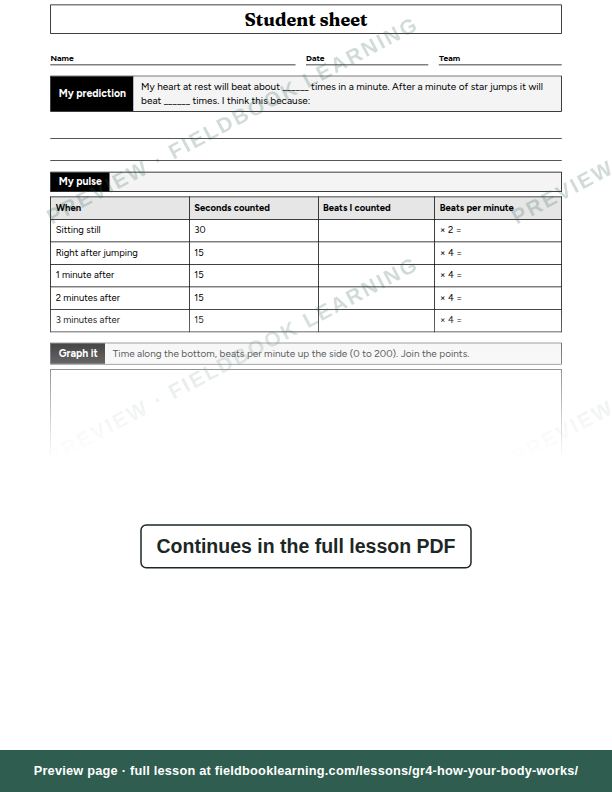
- My prediction
- My pulse
- Graph it
- What I found
- Note to Tomas
- Label it
- Try it at home
US Letter, prints cleanly in black and white. The student sheet is on its own page, ready to photocopy.
Free with an account (any 3 lessons), or US$19 / C$25 for all 4 lessons in this unit.
What students show by the end
- Measures a pulse
- Reads the pattern
- Explains the cause
From the lesson’s rubric, which scores each one as not yet, getting there or got it.
Questions teachers ask
How long does “Why does your heart beat faster when you run?” take?
45–60 min. Group size: teams of 3.
How much prep does it need?
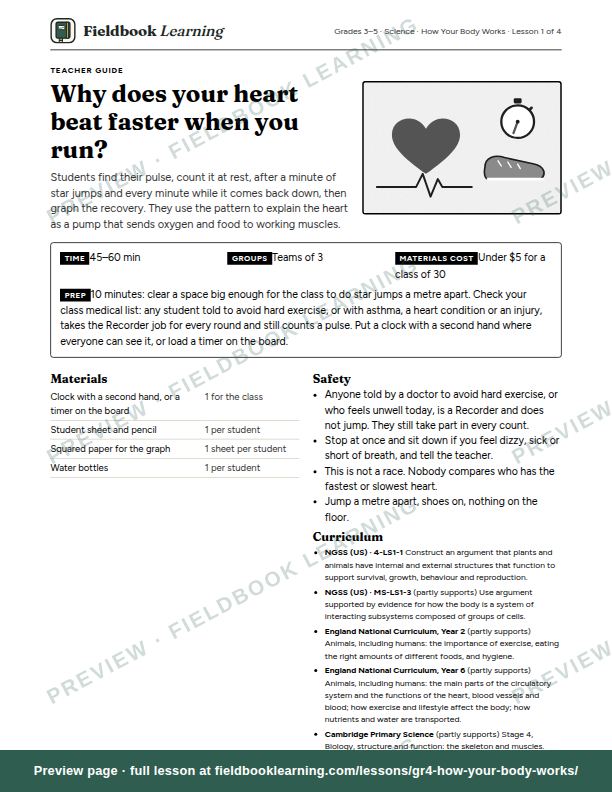
10 minutes: clear a space big enough for the class to do star jumps a metre apart. Check your class medical list: any student told to avoid hard exercise, or with asthma, a heart condition or an injury, takes the Recorder job for every round and still counts a pulse. Put a clock with a second hand where everyone can see it, or load a timer on the board.
What materials do I need?
Clock with a second hand, or a timer on the board; student sheet and pencil; squared paper for the graph; water bottles. Cost: under $5 for a class of 30.
Which curriculum standards does it cover?
NGSS (US): 4-LS1-1 and MS-LS1-3 (partly). It also matches England National Curriculum, Year 2; England National Curriculum, Year 6 and Cambridge Primary Science.
What’s in the lesson PDF?
A teacher guide that walks you through predict, hunt, reveal, act, background for the teacher and assessment, then a student sheet (“My prediction”, “My pulse”, “Graph it”, “What I found”, “Note to Tomas”, “Label it” and “Try it at home”) on its own page, ready to photocopy. It’s US Letter and prints cleanly in black and white.
Can I try it for free?
Yes. A free account includes any 3 full lessons of your choice, and this can be one of them. After that, this unit is US$19 (C$25) for all 4 lessons, yours to keep, or every lesson is US$79 (C$109) a year.