 Preview · the opening mission
Read this to the class:
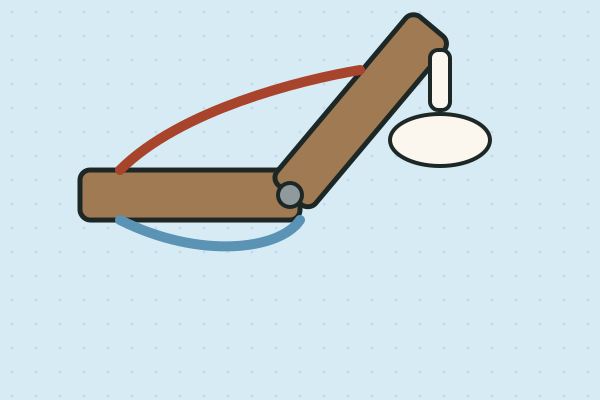
Mei watched her baby brother try to pick up a cup. His arm wobbled, his elbow bent, and the cup went flying. "Why can he move his fingers but not control his arm yet?" she asked. Her uncle flexed his arm and showed her the bump of muscle. "That's what lifts it," he said. "So what puts it back down?" asked Mei. Her uncle wasn't sure. Your team's job: build an elbow that bends and straightens, and work out how many muscles it takes.
Teams of three, with three jobs that rotate after each part: Builder (assembles the model), Puller (works the strings), Recorder (writes and draws).
Look inside the PDF
Sample pages, stamped “preview”. The download is the clean, full lesson.
In the full lesson PDF
- Predict (5–10 min)
- Hunt (20 min)
- Reveal (10–15 min)
- Act (10 min)
- Background for the teacher
- Assessment
- Student sheet
- Worksheet: Label it
- Worksheet: Try it at home
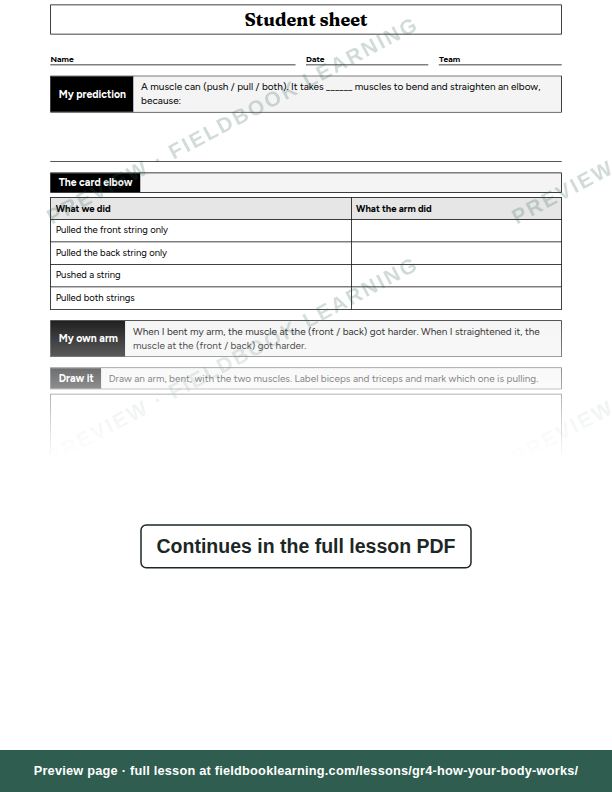
On the student sheet
- My prediction
- The card elbow
- My own arm
- Draw it
- Answer to Mei
- Label it
- Try it at home
US Letter, prints cleanly in black and white. The student sheet is on its own page, ready to photocopy.
Free with an account (any 3 lessons), or US$19 / C$25 for all 4 lessons in this unit.
What students show by the end
- Builds and tests the model
- Links model to body
- Explains muscle pairs
From the lesson’s rubric, which scores each one as not yet, getting there or got it.
Questions teachers ask
How long does “How does your arm bend?” take?
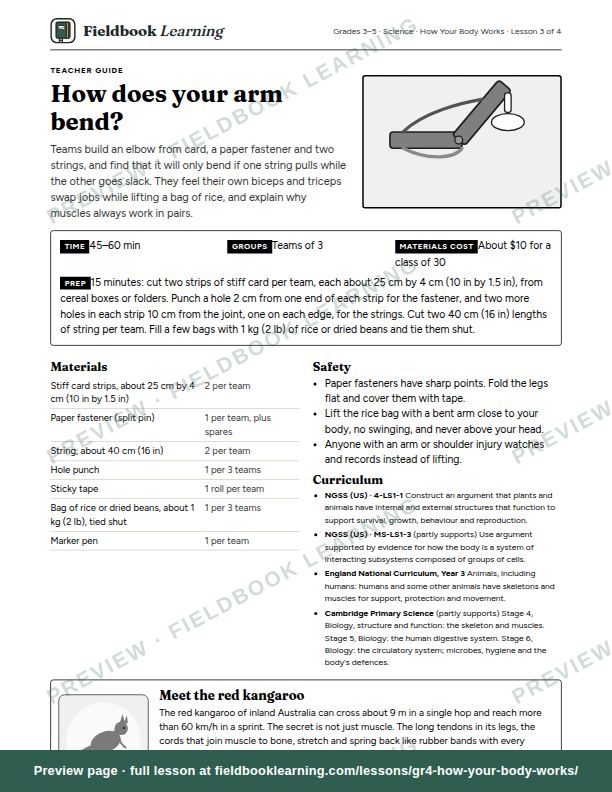
45–60 min. Group size: teams of 3.
How much prep does it need?
15 minutes: cut two strips of stiff card per team, each about 25 cm by 4 cm (10 in by 1.5 in), from cereal boxes or folders. Punch a hole 2 cm from one end of each strip for the fastener, and two more holes in each strip 10 cm from the joint, one on each edge, for the strings. Cut two 40 cm (16 in) lengths of string per team. Fill a few bags with 1 kg (2 lb) of rice or dried beans and tie them shut.
What materials do I need?
Stiff card strips, about 25 cm by 4 cm (10 in by 1.5 in); paper fastener (split pin); string, about 40 cm (16 in); hole punch; sticky tape; bag of rice or dried beans, about 1 kg (2 lb), tied shut; and 1 more. Cost: about $10 for a class of 30.
Which curriculum standards does it cover?
NGSS (US): 4-LS1-1 and MS-LS1-3 (partly). It also matches England National Curriculum, Year 3 and Cambridge Primary Science.
What’s in the lesson PDF?
A teacher guide that walks you through predict, hunt, reveal, act, background for the teacher and assessment, then a student sheet (“My prediction”, “The card elbow”, “My own arm”, “Draw it”, “Answer to Mei”, “Label it” and “Try it at home”) on its own page, ready to photocopy. It’s US Letter and prints cleanly in black and white.
Can I try it for free?
Yes. A free account includes any 3 full lessons of your choice, and this can be one of them. After that, this unit is US$19 (C$25) for all 4 lessons, yours to keep, or every lesson is US$79 (C$109) a year.