 Preview · the opening mission
Read this to the class:
Jordan's grandpa says, "A watched pot never boils." Jordan's cousin typed a question into an AI chatbot and got this answer: "Yes! Adding salt to water makes it boil faster, which is why cooks salt their pasta water." Jordan wants to know who is right. Nobody has actually checked. Your team's job: time the water yourselves and decide which claims hold up.
Show both claim cards. Teams of three, with jobs that rotate: Timer (runs the stopwatch), Recorder (writes the results), Checker (makes sure each run was fair and notes anything odd).
Tell students: an AI chatbot writes text that sounds likely, based on patterns in lots of writing. It doesn't test anything, and it can be wrong while sounding sure. So we check it like any other claim.
Look inside the PDF
Sample pages, stamped “preview”. The download is the clean, full lesson.
In the full lesson PDF
- Predict (5–10 min)
- Hunt (20 min)
- Reveal (10–15 min)
- Act (10 min)
- Background for the teacher
- Assessment
- Student sheet
On the student sheet
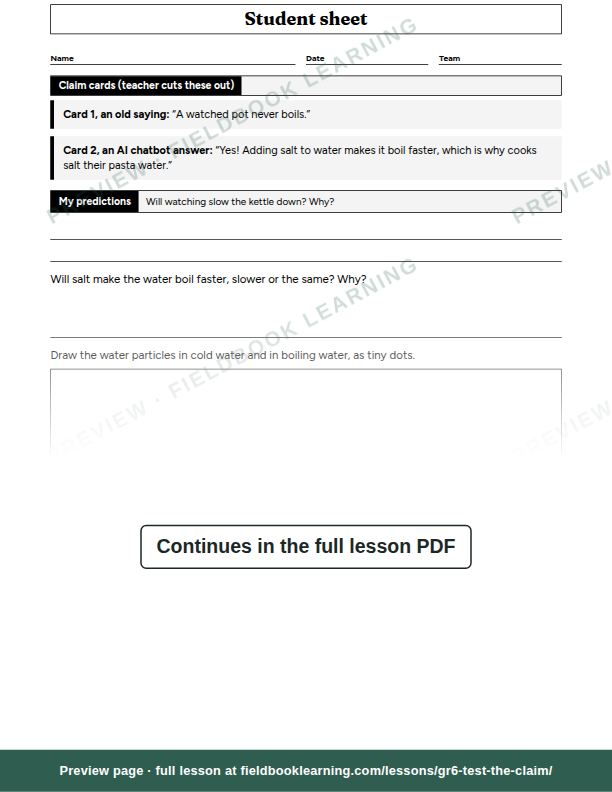
- Claim cards (teacher cuts these out)
- My predictions
- Our results
- What we kept the same, and what wasn't perfectly fair
- My CER
- Grade the AI answer
- Reply to Jordan
- Exit ticket
US Letter, prints cleanly in black and white. The student sheet is on its own page, ready to photocopy.
Free with an account (any 3 lessons), or US$19 / C$25 for all 3 lessons in this unit.
What students show by the end
- Uses data as evidence
- Judges a small difference
- Evaluates the AI answer
From the lesson’s rubric, which scores each one as not yet, getting there or got it.
Questions teachers ask
How long does “Does salt make water boil faster?” take?
45–60 min. Group size: teams of 3.
How much prep does it need?
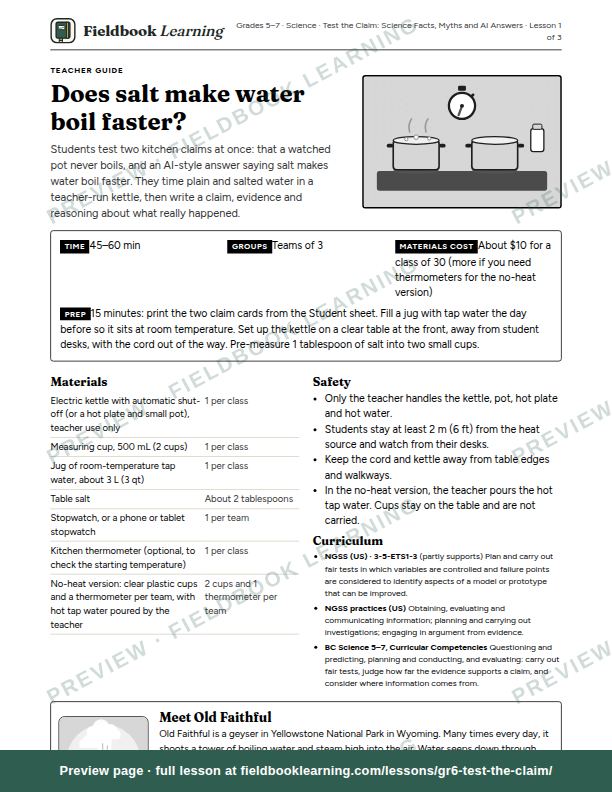
15 minutes: print the two claim cards from the Student sheet. Fill a jug with tap water the day before so it sits at room temperature. Set up the kettle on a clear table at the front, away from student desks, with the cord out of the way. Pre-measure 1 tablespoon of salt into two small cups.
What materials do I need?
Electric kettle with automatic shut-off (or a hot plate and small pot), teacher use only; measuring cup, 500 mL (2 cups); jug of room-temperature tap water, about 3 L (3 qt); table salt; stopwatch, or a phone or tablet stopwatch; kitchen thermometer (optional, to check the starting temperature); and 1 more. Cost: about $10 for a class of 30 (more if you need thermometers for the no-heat version).
Which curriculum standards does it cover?
NGSS (US): 3-5-ETS1-3 (partly). It also matches NGSS practices (US) and BC Science 5–7, Curricular Competencies.
What’s in the lesson PDF?
A teacher guide that walks you through predict, hunt, reveal, act, background for the teacher and assessment, then a student sheet (“Claim cards (teacher cuts these out)”; “My predictions”; “Our results”; “What we kept the same, and what wasn't perfectly fair”; “My CER”; “Grade the AI answer”; “Reply to Jordan” and “Exit ticket”) on its own page, ready to photocopy. It’s US Letter and prints cleanly in black and white.
Can I try it for free?
Yes. A free account includes any 3 full lessons of your choice, and this can be one of them. After that, this unit is US$19 (C$25) for all 3 lessons, yours to keep, or every lesson is US$79 (C$109) a year.