 Preview · the opening mission
Read this to the class:
Sam's family is out of paper towels. At the store, one package says "Twice as absorbent!" in big letters and costs almost double. Sam's dad looks it up and finds four different answers. They all talk about the same towel, and they don't agree on how sure to be. Your team's job: decide which source deserves the most trust, then test the towels yourselves.
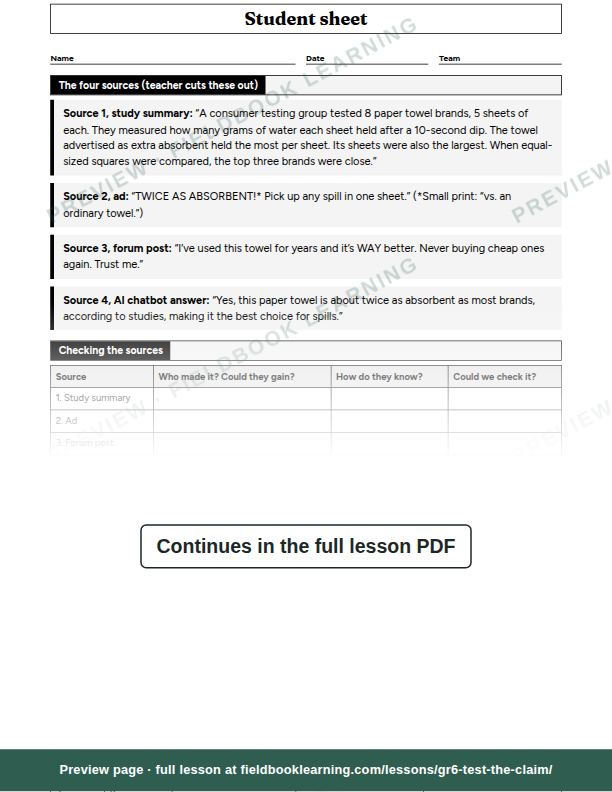
Hand out the four source cards. Explain that the sources were written for this lesson and brand names are left out on purpose. Teams of three, with jobs that rotate: Dipper (handles the towels), Timer (calls the seconds), Recorder (writes and weighs).
Look inside the PDF
Sample pages, stamped “preview”. The download is the clean, full lesson.
In the full lesson PDF
- Predict (5–10 min)
- Hunt (20 min)
- Reveal (10–15 min)
- Act (10 min)
- Background for the teacher
- Assessment
- Student sheet
On the student sheet
- The four sources (teacher cuts these out)
- Checking the sources
- My prediction
- Our results
- My CER
- My note to Sam's dad
- Exit ticket
US Letter, prints cleanly in black and white. The student sheet is on its own page, ready to photocopy.
Free with an account (any 3 lessons), or US$19 / C$25 for all 3 lessons in this unit.
What students show by the end
- Evaluates sources
- Runs a fair test
- Argues from evidence
From the lesson’s rubric, which scores each one as not yet, getting there or got it.
Questions teachers ask
How long does “Which source should we trust?” take?
50–60 min. Group size: teams of 3.
How much prep does it need?
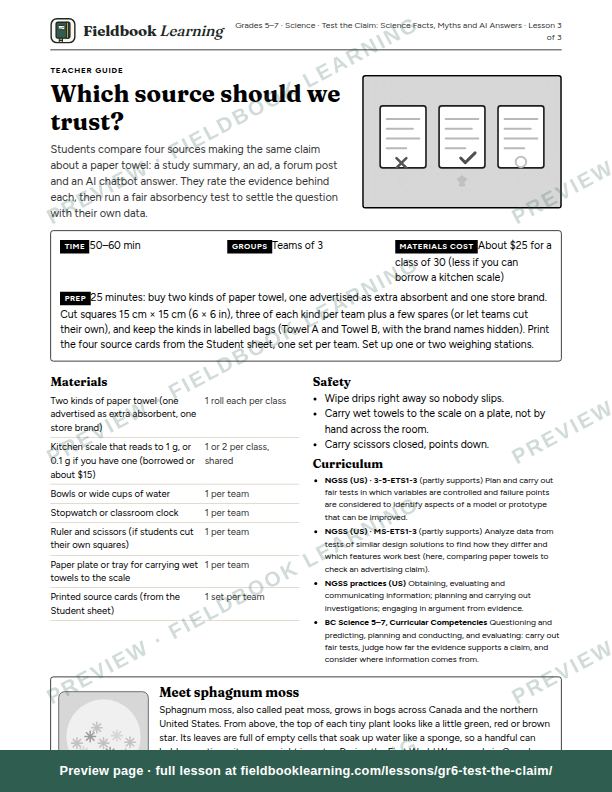
25 minutes: buy two kinds of paper towel, one advertised as extra absorbent and one store brand. Cut squares 15 cm × 15 cm (6 × 6 in), three of each kind per team plus a few spares (or let teams cut their own), and keep the kinds in labelled bags (Towel A and Towel B, with the brand names hidden). Print the four source cards from the Student sheet, one set per team. Set up one or two weighing stations.
What materials do I need?
Two kinds of paper towel (one advertised as extra absorbent, one store brand); kitchen scale that reads to 1 g, or 0.1 g if you have one (borrowed or about $15); bowls or wide cups of water; stopwatch or classroom clock; ruler and scissors (if students cut their own squares); paper plate or tray for carrying wet towels to the scale; and 1 more. Cost: about $25 for a class of 30 (less if you can borrow a kitchen scale).
Which curriculum standards does it cover?
NGSS (US): 3-5-ETS1-3 (partly) and MS-ETS1-3 (partly). It also matches NGSS practices (US) and BC Science 5–7, Curricular Competencies.
What’s in the lesson PDF?
A teacher guide that walks you through predict, hunt, reveal, act, background for the teacher and assessment, then a student sheet (“The four sources (teacher cuts these out)”, “Checking the sources”, “My prediction”, “Our results”, “My CER”, “My note to Sam's dad” and “Exit ticket”) on its own page, ready to photocopy. It’s US Letter and prints cleanly in black and white.
Can I try it for free?
Yes. A free account includes any 3 full lessons of your choice, and this can be one of them. After that, this unit is US$19 (C$25) for all 3 lessons, yours to keep, or every lesson is US$79 (C$109) a year.