 Preview · the opening mission
Read this to the class:
A class in another school asked an AI chatbot three science questions. The answers came back fast and sounded completely sure. The class sent them to us with a note: "Are these right? How would we know?" Your team's job: test each answer and give it a grade.
Hand out the three answer cards. Teams of three, with jobs that rotate: Tester (handles the materials), Timer (watches the clock and calls times), Recorder (writes results and the grades).
Explain simply: an AI chatbot is a program that writes text by predicting which words are likely to come next, based on huge amounts of writing. It doesn't run experiments. It can be right, partly right, or confidently wrong, and you can't tell which by how sure it sounds. Nobody uses an AI tool today; the answers are on paper.
Look inside the PDF
Sample pages, stamped “preview”. The download is the clean, full lesson.
In the full lesson PDF
- Predict (5–10 min)
- Hunt (20 min)
- Reveal (10–15 min)
- Act (10 min)
- Background for the teacher
- Assessment
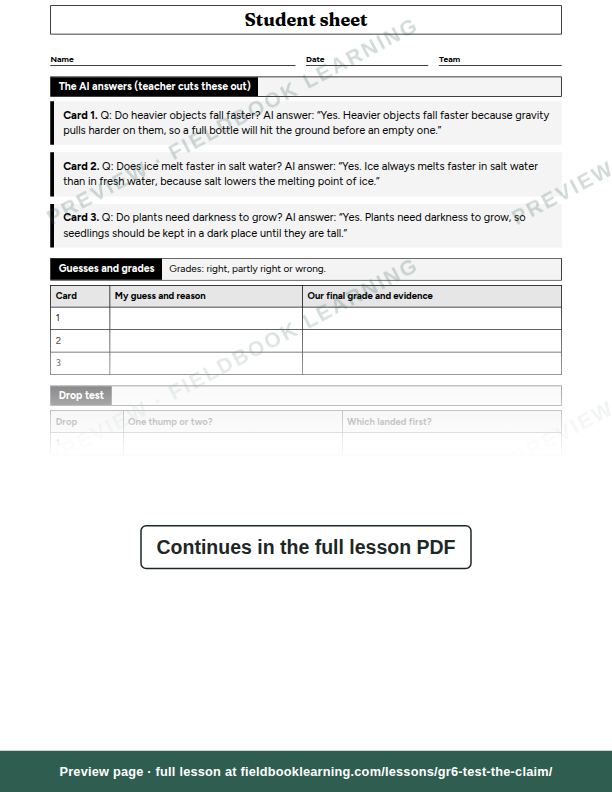
- Student sheet
On the student sheet
- The AI answers (teacher cuts these out)
- Guesses and grades
- Drop test
- Ice test
- Plant test plan
- Our CER for Card 2
- Exit ticket
US Letter, prints cleanly in black and white. The student sheet is on its own page, ready to photocopy.
Free with an account (any 3 lessons), or US$19 / C$25 for all 3 lessons in this unit.
What students show by the end
- Writes a fair test
- Grades with evidence
- Explains checking AI
From the lesson’s rubric, which scores each one as not yet, getting there or got it.
Questions teachers ask
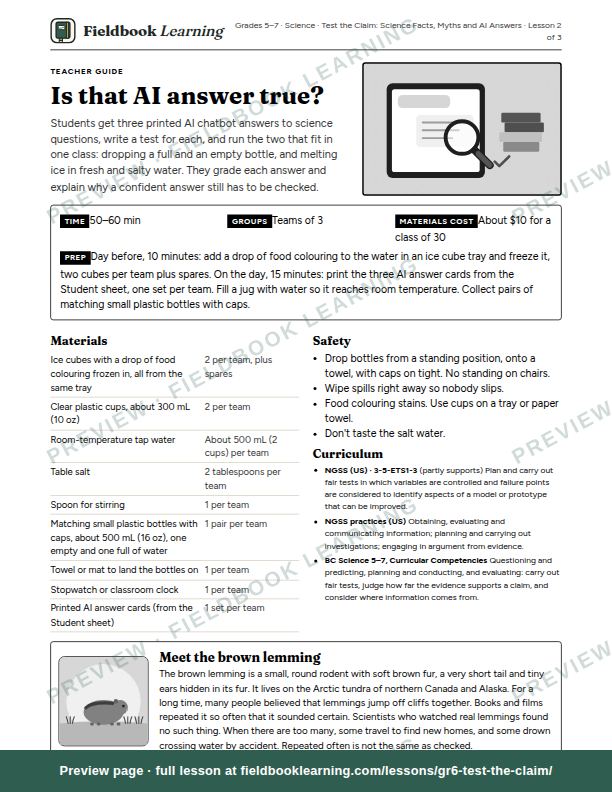
How long does “Is that AI answer true?” take?
50–60 min. Group size: teams of 3.
How much prep does it need?
Day before, 10 minutes: add a drop of food colouring to the water in an ice cube tray and freeze it, two cubes per team plus spares. On the day, 15 minutes: print the three AI answer cards from the Student sheet, one set per team. Fill a jug with water so it reaches room temperature. Collect pairs of matching small plastic bottles with caps.
What materials do I need?
Ice cubes with a drop of food colouring frozen in, all from the same tray; clear plastic cups, about 300 mL (10 oz); room-temperature tap water; table salt; spoon for stirring; matching small plastic bottles with caps, about 500 mL (16 oz), one empty and one full of water; and 3 more. Cost: about $10 for a class of 30.
Which curriculum standards does it cover?
NGSS (US): 3-5-ETS1-3 (partly). It also matches NGSS practices (US) and BC Science 5–7, Curricular Competencies.
What’s in the lesson PDF?
A teacher guide that walks you through predict, hunt, reveal, act, background for the teacher and assessment, then a student sheet (“The AI answers (teacher cuts these out)”, “Guesses and grades”, “Drop test”, “Ice test”, “Plant test plan”, “Our CER for Card 2” and “Exit ticket”) on its own page, ready to photocopy. It’s US Letter and prints cleanly in black and white.
Can I try it for free?
Yes. A free account includes any 3 full lessons of your choice, and this can be one of them. After that, this unit is US$19 (C$25) for all 3 lessons, yours to keep, or every lesson is US$79 (C$109) a year.