 Preview · the opening mission
Read this to the class:
At lunchtime, Aisha ran to the slide. "Ow!" The metal was too hot to touch. She took off her black cap to fan herself, and the cap felt hot too. Across the playground, Mr Okafor stood in a big white hat, in his own little patch of shade, looking cool. "Why is your hat better than mine?" asked Aisha. "Test it," he said, "and tell me." Your job: find out which materials keep the sun off, and build Aisha a better hat.
Children work in pairs with two jobs that swap after each part: the Timer counts and keeps the test fair, and the Toucher touches, looks and reports.
Look inside the PDF
Sample pages, stamped “preview”. The download is the clean, full lesson.
In the full lesson PDF
- Predict (5 min)
- Hunt (25 min)
- Reveal (10 min)
- Act (10 min)
- Background for the teacher
- Assessment
- Student sheet
- Worksheet: Label it
- Worksheet: Try it at home
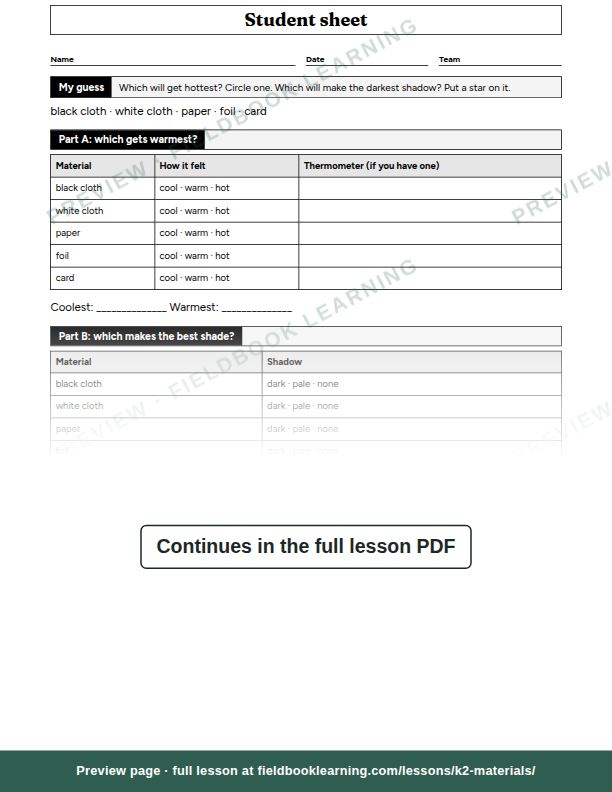
On the student sheet
- My guess
- Part A: which gets warmest?
- Part B: which makes the best shade?
- Part C: stretch, bend, squash
- Aisha's hat
- Label it
- Try it at home
US Letter, prints cleanly in black and white. The student sheet is on its own page, ready to photocopy.
Free with an account (any 3 lessons), or US$19 / C$25 for all 3 lessons in this unit.
What students show by the end
- Runs a fair test
- Explains the results
- Chooses with a reason
From the lesson’s rubric, which scores each one as not yet, getting there or got it.
Questions teachers ask
How long does “Which hat keeps the sun off?” take?
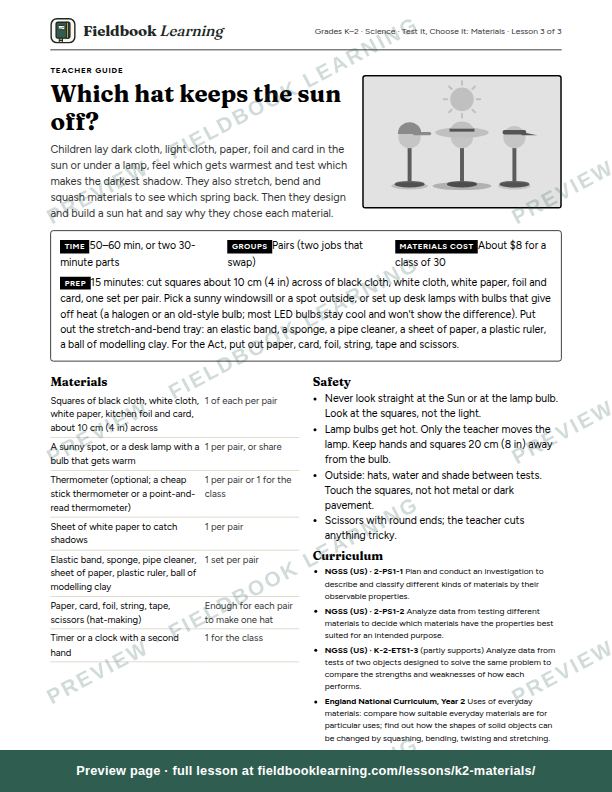
50–60 min, or two 30-minute parts. Group size: pairs (two jobs that swap).
How much prep does it need?
15 minutes: cut squares about 10 cm (4 in) across of black cloth, white cloth, white paper, foil and card, one set per pair. Pick a sunny windowsill or a spot outside, or set up desk lamps with bulbs that give off heat (a halogen or an old-style bulb; most LED bulbs stay cool and won't show the difference). Put out the stretch-and-bend tray: an elastic band, a sponge, a pipe cleaner, a sheet of paper, a plastic ruler, a ball of modelling clay. For the Act, put out paper, card, foil, string, tape and scissors.
What materials do I need?
Squares of black cloth, white cloth, white paper, kitchen foil and card, about 10 cm (4 in) across; a sunny spot, or a desk lamp with a bulb that gets warm; thermometer (optional; a cheap stick thermometer or a point-and-read thermometer); sheet of white paper to catch shadows; elastic band, sponge, pipe cleaner, sheet of paper, plastic ruler, ball of modelling clay; paper, card, foil, string, tape, scissors (hat-making); and 1 more. Cost: about $8 for a class of 30.
Which curriculum standards does it cover?
NGSS (US): 2-PS1-1, 2-PS1-2 and K-2-ETS1-3 (partly). It also matches England National Curriculum, Year 2; Cambridge Primary Science, Stage 1 and Cambridge Primary Science, Stage 2.
What’s in the lesson PDF?
A teacher guide that walks you through predict, hunt, reveal, act, background for the teacher and assessment, then a student sheet (“My guess”; “Part A: which gets warmest?”; “Part B: which makes the best shade?”; “Part C: stretch, bend, squash”; “Aisha's hat”; “Label it” and “Try it at home”) on its own page, ready to photocopy. It’s US Letter and prints cleanly in black and white.
Can I try it for free?
Yes. A free account includes any 3 full lessons of your choice, and this can be one of them. After that, this unit is US$19 (C$25) for all 3 lessons, yours to keep, or every lesson is US$79 (C$109) a year.