 Preview · the opening mission
Read this to the class:
A family went to the beach and a student filled a pocket with sand. Under a magnifier, the grains looked like tiny rounded pebbles. Then she noticed the big rocks at the end of the beach had smooth, rounded edges too. "Where does sand even come from?" she asked. Your team's job: find out how a hard, sharp rock can turn into small, rounded grains.
Teams of three, with rotating jobs: Shaker (shakes the jar), Timer (times each round and swaps Shakers every 30 seconds), Recorder (measures and writes).
Look inside the PDF
Sample pages, stamped “preview”. The download is the clean, full lesson.
In the full lesson PDF
- Predict (5–10 min)
- Hunt (20 min)
- Reveal (10–15 min)
- Act (10 min)
- Background for the teacher
- Assessment
- Student sheet
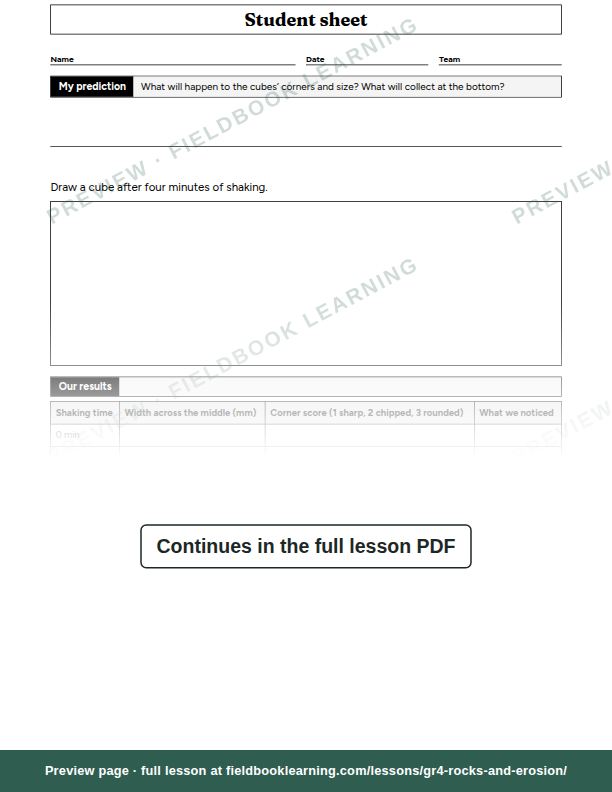
On the student sheet
- My prediction
- Our results
- Draw one cube from each time
- Ice straw: what happened to the plug?
- What we kept the same
- The life story of a grain of sand
- Exit ticket
US Letter, prints cleanly in black and white. The student sheet is on its own page, ready to photocopy.
Free with an account (any 3 lessons), or US$19 / C$25 for all 4 lessons in this unit.
What students show by the end
- Records changes over time
- Explains weathering
- Weathering vs. erosion
From the lesson’s rubric, which scores each one as not yet, getting there or got it.
Questions teachers ask
How long does “How do rocks become sand?” take?
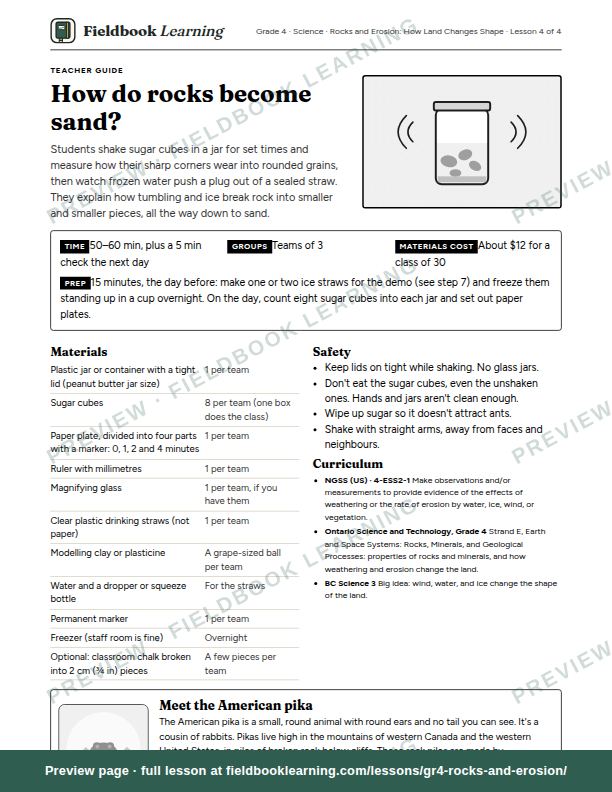
50–60 min, plus a 5 min check the next day. Group size: teams of 3.
How much prep does it need?
15 minutes, the day before: make one or two ice straws for the demo (see step 7) and freeze them standing up in a cup overnight. On the day, count eight sugar cubes into each jar and set out paper plates.
What materials do I need?
Plastic jar or container with a tight lid (peanut butter jar size); sugar cubes; paper plate, divided into four parts with a marker; ruler with millimetres; magnifying glass; clear plastic drinking straws (not paper); and 5 more. Cost: about $12 for a class of 30.
Which curriculum standards does it cover?
NGSS (US): 4-ESS2-1. It also matches Ontario Science and Technology, Grade 4 and BC Science 3.
What’s in the lesson PDF?
A teacher guide that walks you through predict, hunt, reveal, act, background for the teacher and assessment, then a student sheet (“My prediction”, “Our results”, “Draw one cube from each time”, “Ice straw: what happened to the plug?”, “What we kept the same”, “The life story of a grain of sand” and “Exit ticket”) on its own page, ready to photocopy. It’s US Letter and prints cleanly in black and white.
Can I try it for free?
Yes. A free account includes any 3 full lessons of your choice, and this can be one of them. After that, this unit is US$19 (C$25) for all 4 lessons, yours to keep, or every lesson is US$79 (C$109) a year.