 Preview · the opening mission
Read this to the class:
A Grade 4 student found a box of rocks in her grandfather's garage. Some were labelled, but the labels had fallen off. "They're all just grey rocks," her brother said. She wasn't so sure. Some felt heavy, some sparkled, some crumbled in her hand. Your team's job: find out if these rocks are really all the same, and prove which one is limestone.
Teams of three, with three jobs that rotate after each test: Tester (does the test), Checker (wipes the scratch and double-checks the result), Recorder (fills in the table).
Look inside the PDF
Sample pages, stamped “preview”. The download is the clean, full lesson.
In the full lesson PDF
- Predict (5–10 min)
- Hunt (20 min)
- Reveal (10–15 min)
- Act (10 min)
- Background for the teacher
- Assessment
- Student sheet
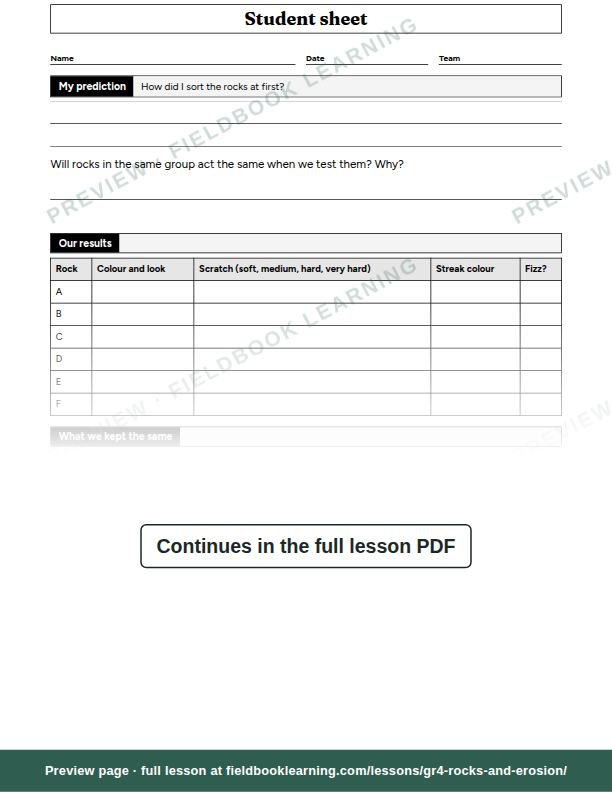
On the student sheet
- My prediction
- Our results
- What we kept the same
- Draw your rock groups after testing
- Label card: claim, evidence, reasoning
- Exit ticket
US Letter, prints cleanly in black and white. The student sheet is on its own page, ready to photocopy.
Free with an account (any 3 lessons), or US$19 / C$25 for all 4 lessons in this unit.
What students show by the end
- Carries out tests
- Classifies with evidence
- Uses CER
From the lesson’s rubric, which scores each one as not yet, getting there or got it.
Questions teachers ask
How long does “Are all rocks the same?” take?
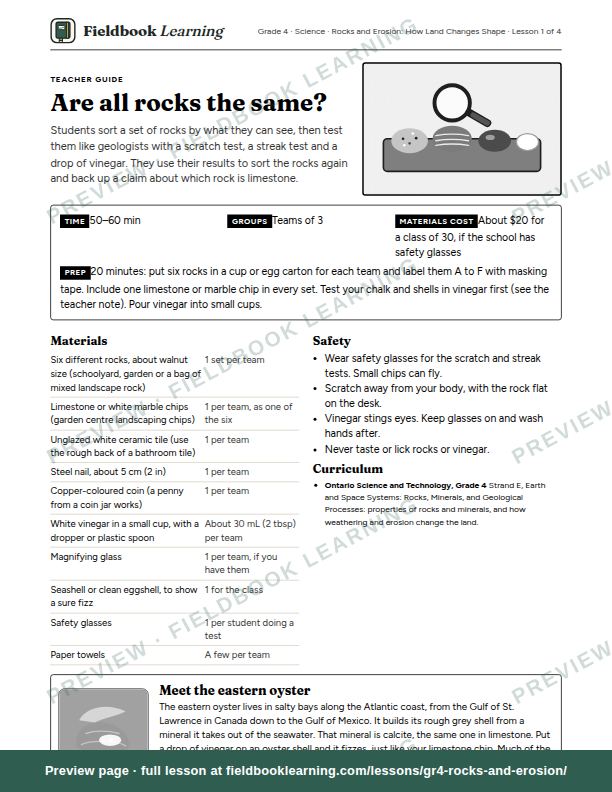
50–60 min. Group size: teams of 3.
How much prep does it need?
20 minutes: put six rocks in a cup or egg carton for each team and label them A to F with masking tape. Include one limestone or marble chip in every set. Test your chalk and shells in vinegar first (see the teacher note). Pour vinegar into small cups.
What materials do I need?
Six different rocks, about walnut size (schoolyard, garden or a bag of mixed landscape rock); limestone or white marble chips (garden centre landscaping chips); unglazed white ceramic tile (use the rough back of a bathroom tile); steel nail, about 5 cm (2 in); copper-coloured coin (a penny from a coin jar works); white vinegar in a small cup, with a dropper or plastic spoon; and 4 more. Cost: about $20 for a class of 30, if the school has safety glasses.
Which curriculum standards does it cover?
It matches Ontario Science and Technology, Grade 4.
What’s in the lesson PDF?
A teacher guide that walks you through predict, hunt, reveal, act, background for the teacher and assessment, then a student sheet (“My prediction”; “Our results”; “What we kept the same”; “Draw your rock groups after testing”; “Label card: claim, evidence, reasoning” and “Exit ticket”) on its own page, ready to photocopy. It’s US Letter and prints cleanly in black and white.
Can I try it for free?
Yes. A free account includes any 3 full lessons of your choice, and this can be one of them. After that, this unit is US$19 (C$25) for all 4 lessons, yours to keep, or every lesson is US$79 (C$109) a year.