 Preview · the opening mission
Read this to the class:
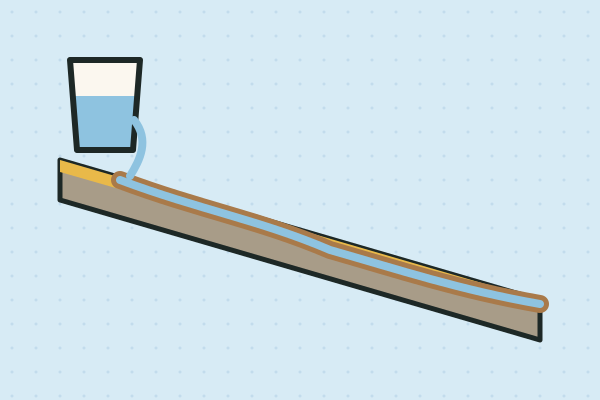
After a big rainstorm, the school caretaker found a new ditch running down the slope behind the soccer field. It was as deep as his hand. At the bottom, the path was covered in a fan of mud and sand. "Water did all that in one night?" he said. Some of the biggest canyons and valleys on Earth were carved the same way, just over a much longer time. Your team's job: find out whether the steepness of the land changes how much water can carve.
Teams of three, with jobs that rotate after each run: Rainmaker (holds the cup), Timer (watches the clock and calls out changes), Recorder (measures and writes).
Look inside the PDF
Sample pages, stamped “preview”. The download is the clean, full lesson.
In the full lesson PDF
- Predict (5–10 min)
- Hunt (20 min)
- Reveal (10–15 min)
- Act (10 min)
- Background for the teacher
- Assessment
- Student sheet
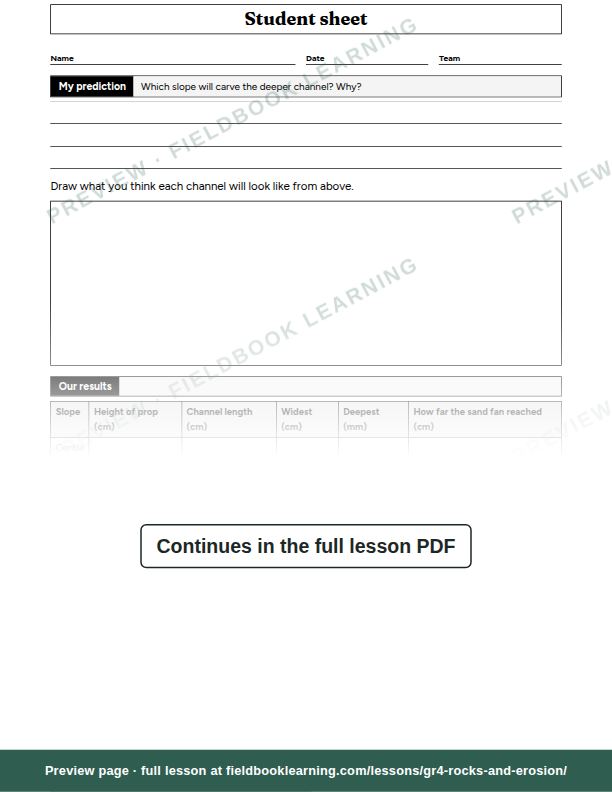
On the student sheet
- My prediction
- Our results
- Draw both channels from above
- What we changed, and what we kept the same
- A note to the caretaker: claim, evidence, reasoning
- Exit ticket
US Letter, prints cleanly in black and white. The student sheet is on its own page, ready to photocopy.
Free with an account (any 3 lessons), or US$19 / C$25 for all 4 lessons in this unit.
What students show by the end
- Measures carefully
- Explains erosion and deposition
- Uses CER
From the lesson’s rubric, which scores each one as not yet, getting there or got it.
Questions teachers ask
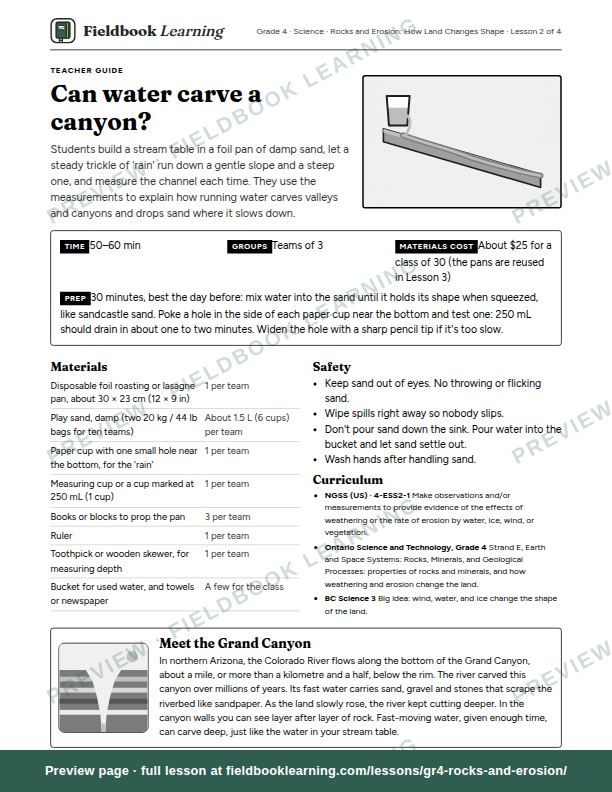
How long does “Can water carve a canyon?” take?
50–60 min. Group size: teams of 3.
How much prep does it need?
30 minutes, best the day before: mix water into the sand until it holds its shape when squeezed, like sandcastle sand. Poke a hole in the side of each paper cup near the bottom and test one: 250 mL should drain in about one to two minutes. Widen the hole with a sharp pencil tip if it's too slow.
What materials do I need?
Disposable foil roasting or lasagne pan, about 30 × 23 cm (12 × 9 in); play sand, damp (two 20 kg / 44 lb bags for ten teams); paper cup with one small hole near the bottom, for the 'rain'; measuring cup or a cup marked at 250 mL (1 cup); books or blocks to prop the pan; ruler; and 2 more. Cost: about $25 for a class of 30 (the pans are reused in Lesson 3).
Which curriculum standards does it cover?
NGSS (US): 4-ESS2-1. It also matches Ontario Science and Technology, Grade 4 and BC Science 3.
What’s in the lesson PDF?
A teacher guide that walks you through predict, hunt, reveal, act, background for the teacher and assessment, then a student sheet (“My prediction”; “Our results”; “Draw both channels from above”; “What we changed, and what we kept the same”; “A note to the caretaker: claim, evidence, reasoning” and “Exit ticket”) on its own page, ready to photocopy. It’s US Letter and prints cleanly in black and white.
Can I try it for free?
Yes. A free account includes any 3 full lessons of your choice, and this can be one of them. After that, this unit is US$19 (C$25) for all 4 lessons, yours to keep, or every lesson is US$79 (C$109) a year.