 Preview · the opening mission
Read this to the class:
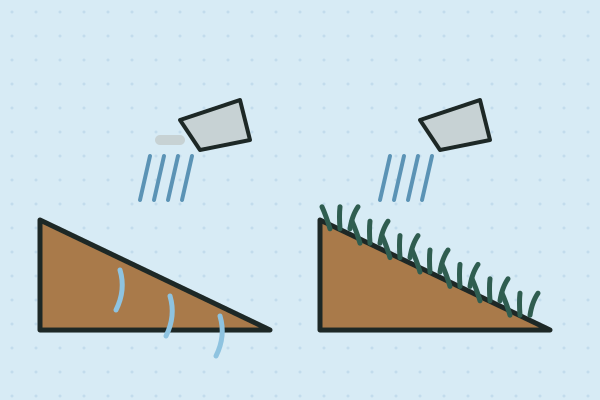
A town is building a new path behind the library. The workers dug into a hill and left a slope of bare dirt. After the first heavy rain, mud washed across the path and into the storm drain. The town has three ideas: cover the slope with straw or mulch, plant grass, or leave it and hope. Your team's job: test which cover keeps the most soil on the hill, and recommend one to the town.
Teams of three, with three rotating jobs: Builder (packs the hill and adds the cover), Rainmaker (holds the rain cup and times the rain), Recorder (measures and writes).
Look inside the PDF
Sample pages, stamped “preview”. The download is the clean, full lesson.
In the full lesson PDF
- Predict (5–10 min)
- Hunt (20 min)
- Reveal (10–15 min)
- Act (10 min)
- Background for the teacher
- Assessment
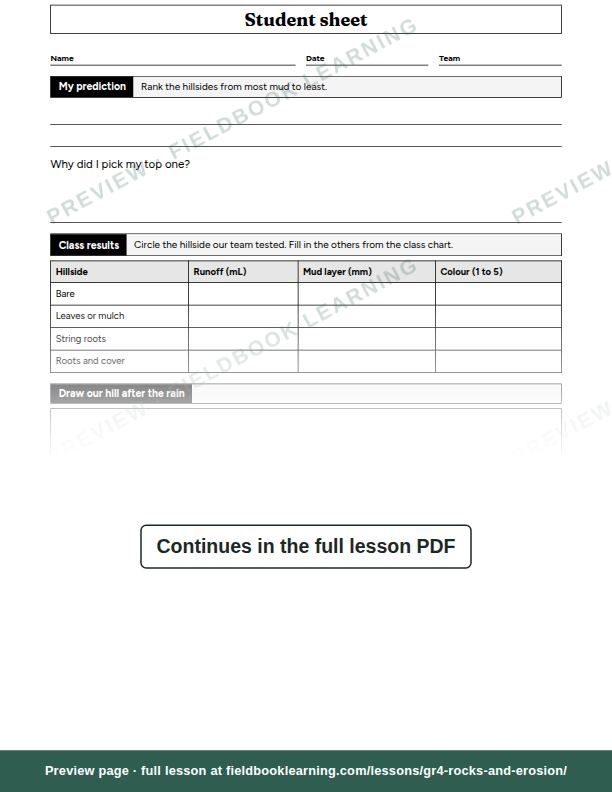
- Student sheet
On the student sheet
- My prediction
- Class results
- Draw our hill after the rain
- What we kept the same
- My recommendation to the town: claim, evidence, reasoning
- Exit ticket
US Letter, prints cleanly in black and white. The student sheet is on its own page, ready to photocopy.
Free with an account (any 3 lessons), or US$19 / C$25 for all 4 lessons in this unit.
What students show by the end
- Runs a fair test
- Explains how cover works
- Recommends with CER
From the lesson’s rubric, which scores each one as not yet, getting there or got it.
Questions teachers ask
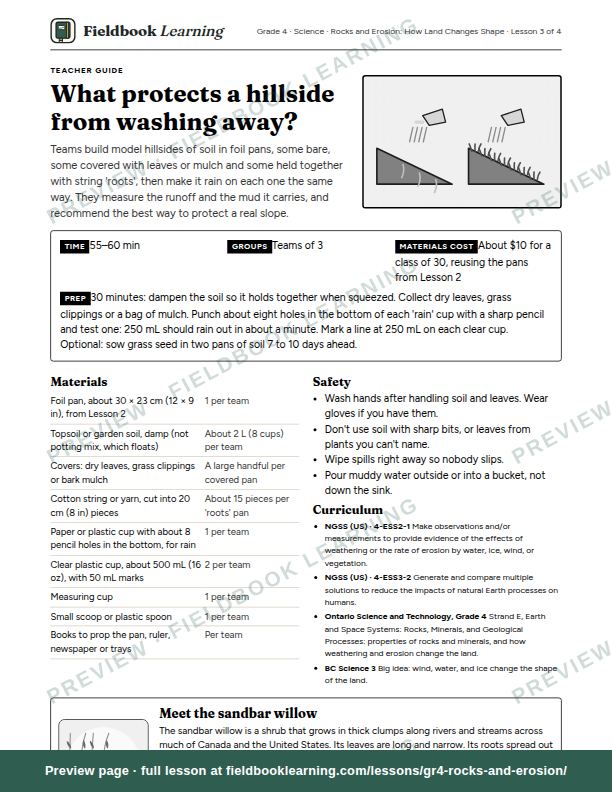
How long does “What protects a hillside from washing away?” take?
55–60 min. Group size: teams of 3.
How much prep does it need?
30 minutes: dampen the soil so it holds together when squeezed. Collect dry leaves, grass clippings or a bag of mulch. Punch about eight holes in the bottom of each 'rain' cup with a sharp pencil and test one: 250 mL should rain out in about a minute. Mark a line at 250 mL on each clear cup. Optional: sow grass seed in two pans of soil 7 to 10 days ahead.
What materials do I need?
Foil pan, about 30 × 23 cm (12 × 9 in), from Lesson 2; topsoil or garden soil, damp (not potting mix, which floats); covers; cotton string or yarn, cut into 20 cm (8 in) pieces; paper or plastic cup with about 8 pencil holes in the bottom, for rain; clear plastic cup, about 500 mL (16 oz), with 50 mL marks; and 3 more. Cost: about $10 for a class of 30, reusing the pans from Lesson 2.
Which curriculum standards does it cover?
NGSS (US): 4-ESS2-1 and 4-ESS3-2. It also matches Ontario Science and Technology, Grade 4 and BC Science 3.
What’s in the lesson PDF?
A teacher guide that walks you through predict, hunt, reveal, act, background for the teacher and assessment, then a student sheet (“My prediction”; “Class results”; “Draw our hill after the rain”; “What we kept the same”; “My recommendation to the town: claim, evidence, reasoning” and “Exit ticket”) on its own page, ready to photocopy. It’s US Letter and prints cleanly in black and white.
Can I try it for free?
Yes. A free account includes any 3 full lessons of your choice, and this can be one of them. After that, this unit is US$19 (C$25) for all 4 lessons, yours to keep, or every lesson is US$79 (C$109) a year.