 Preview · the opening mission
Read this to the class:
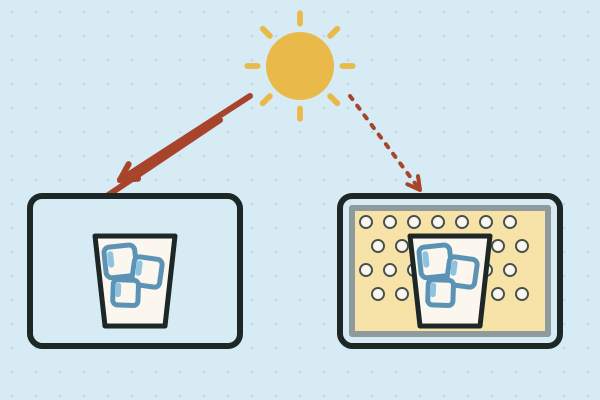
Class 4 is going to the beach. The bus leaves at eight, and lunch is at one. There is no fridge, and the teacher says the juice must stay cold. A parent says, "Just put the ice in a bag with the juice. It'll be fine." Another says, "Ice melts in the heat. Nothing can stop that." Your team's job: design a cool box that keeps ice frozen longer than a plain tub can.
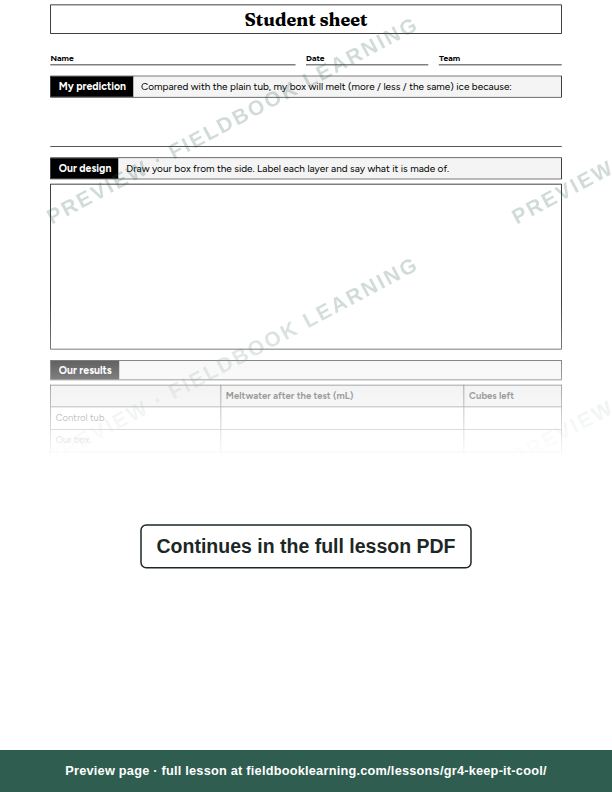
Teams of three, with rotating jobs: Lead (builds and handles the ice), Timer (watches the clock), Recorder (sketches, writes and measures).
Look inside the PDF
Sample pages, stamped “preview”. The download is the clean, full lesson.
In the full lesson PDF
- Predict (5–10 min)
- Hunt (about 40 min, plus 40 min of waiting)
- Reveal (10–15 min)
- Act (10–15 min)
- Background for the teacher
- Assessment
- Student sheet
- Worksheet: Label it
- Worksheet: Try it at home
On the student sheet
- My prediction
- Our design
- Our results
- What we kept the same, and what we changed
- Recommendation for the school trip
- One improvement
- Exit ticket
- Label it
- Try it at home
US Letter, prints cleanly in black and white. The student sheet is on its own page, ready to photocopy.
Free with an account (any 3 lessons), or US$19 / C$25 for all 4 lessons in this unit.
What students show by the end
- Plans and runs a fair test
- Uses evidence
- Explains and improves
From the lesson’s rubric, which scores each one as not yet, getting there or got it.
Questions teachers ask
How long does “Can you build a cool box that beats the heat?” take?
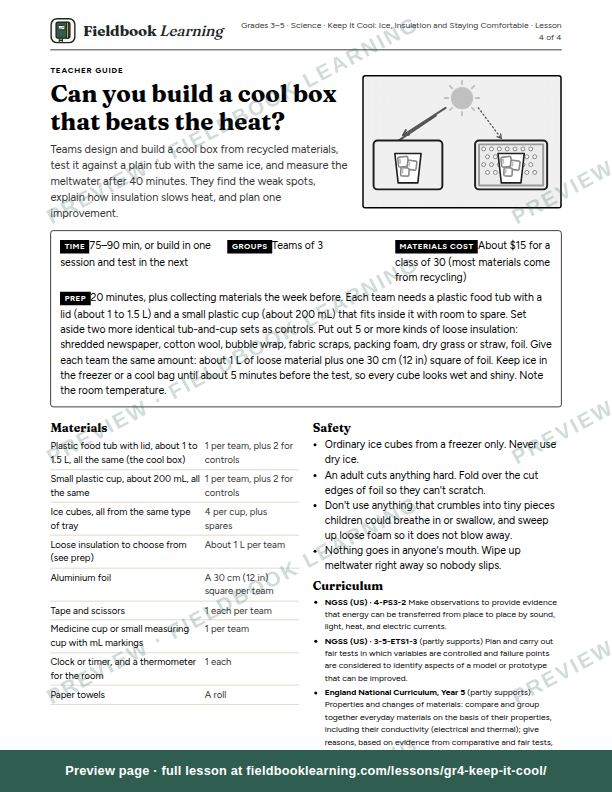
75–90 min, or build in one session and test in the next. Group size: teams of 3.
How much prep does it need?
20 minutes, plus collecting materials the week before. Each team needs a plastic food tub with a lid (about 1 to 1.5 L) and a small plastic cup (about 200 mL) that fits inside it with room to spare. Set aside two more identical tub-and-cup sets as controls. Put out 5 or more kinds of loose insulation: shredded newspaper, cotton wool, bubble wrap, fabric scraps, packing foam, dry grass or straw, foil. Give each team the same amount: about 1 L of loose material plus one 30 cm (12 in) square of foil. Keep ice in the freezer or a cool bag until about 5 minutes before the test, so every cube looks wet and shiny. Note the room temperature.
What materials do I need?
Plastic food tub with lid, about 1 to 1.5 L, all the same (the cool box); small plastic cup, about 200 mL, all the same; ice cubes, all from the same type of tray; loose insulation to choose from (see prep); aluminium foil; tape and scissors; and 3 more. Cost: about $15 for a class of 30 (most materials come from recycling).
Which curriculum standards does it cover?
NGSS (US): 4-PS3-2 and 3-5-ETS1-3 (partly). It also matches England National Curriculum, Year 5 and Cambridge Primary Science, Stages 4 and 6 (not endorsed by Cambridge).
What’s in the lesson PDF?
A teacher guide that walks you through predict, hunt, reveal, act, background for the teacher and assessment, then a student sheet (“My prediction”; “Our design”; “Our results”; “What we kept the same, and what we changed”; “Recommendation for the school trip”; “One improvement”; “Exit ticket”; “Label it” and “Try it at home”) on its own page, ready to photocopy. It’s US Letter and prints cleanly in black and white.
Can I try it for free?
Yes. A free account includes any 3 full lessons of your choice, and this can be one of them. After that, this unit is US$19 (C$25) for all 4 lessons, yours to keep, or every lesson is US$79 (C$109) a year.