 Preview · the opening mission
Read this to the class:
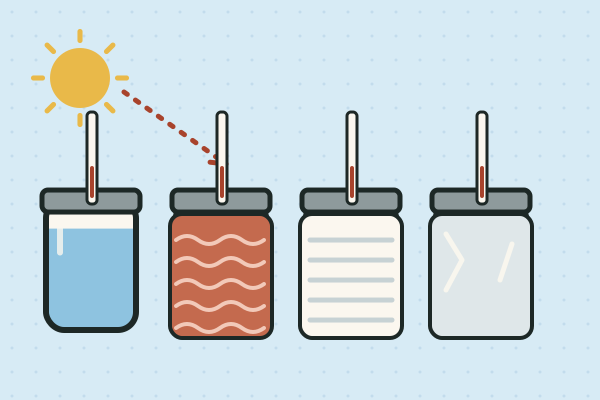
Amara's lunch bag sat in the sun on the school bus for an hour, and now her drink is warm. "I wish it had stayed cold," she says. Her friend Deng says, "Wrap it in a woolly sock." Someone else says foil, the shiny stuff round a baked potato. A third says, "Nothing will work. The heat is outside and you can't stop it." Your team's job: test which wrap keeps a cold drink cold longest.
Teams of three, with rotating jobs: Lead (wraps the jar and reads the thermometer), Timer (calls out every 5 minutes), Recorder (writes the readings).
A good wrap slows heat in either direction: the same wool would keep a hot soup hot. We test with chilled water, so nobody handles anything hot.
Look inside the PDF
Sample pages, stamped “preview”. The download is the clean, full lesson.
In the full lesson PDF
- Predict (5–10 min)
- Hunt (20 min)
- Reveal (10–15 min)
- Act (10 min)
- Background for the teacher
- Assessment
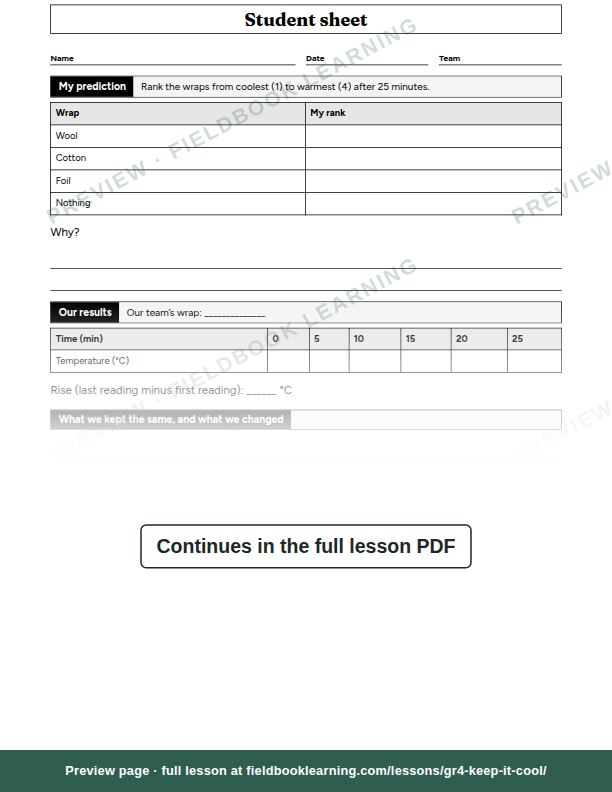
- Student sheet
- Worksheet: Label it
- Worksheet: Try it at home
On the student sheet
- My prediction
- Our results
- What we kept the same, and what we changed
- Advice for Amara
- Our better lunch bag
- Exit ticket
- Label it
- Try it at home
US Letter, prints cleanly in black and white. The student sheet is on its own page, ready to photocopy.
Free with an account (any 3 lessons), or US$19 / C$25 for all 4 lessons in this unit.
What students show by the end
- Collects data carefully
- Uses evidence
- Explains insulation
From the lesson’s rubric, which scores each one as not yet, getting there or got it.
Questions teachers ask
How long does “Which wrap keeps a drink coldest?” take?
50–60 min. Group size: teams of 3.
How much prep does it need?
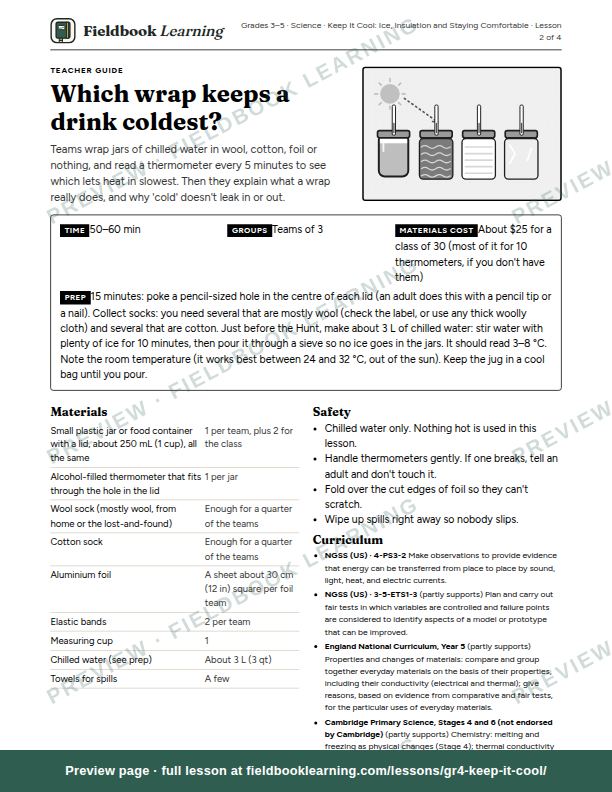
15 minutes: poke a pencil-sized hole in the centre of each lid (an adult does this with a pencil tip or a nail). Collect socks: you need several that are mostly wool (check the label, or use any thick woolly cloth) and several that are cotton. Just before the Hunt, make about 3 L of chilled water: stir water with plenty of ice for 10 minutes, then pour it through a sieve so no ice goes in the jars. It should read 3–8 °C. Note the room temperature (it works best between 24 and 32 °C, out of the sun). Keep the jug in a cool bag until you pour.
What materials do I need?
Small plastic jar or food container with a lid, about 250 mL (1 cup), all the same; alcohol-filled thermometer that fits through the hole in the lid; wool sock (mostly wool, from home or the lost-and-found); cotton sock; aluminium foil; elastic bands; and 3 more. Cost: about $25 for a class of 30 (most of it for 10 thermometers, if you don't have them).
Which curriculum standards does it cover?
NGSS (US): 4-PS3-2 and 3-5-ETS1-3 (partly). It also matches England National Curriculum, Year 5 and Cambridge Primary Science, Stages 4 and 6 (not endorsed by Cambridge).
What’s in the lesson PDF?
A teacher guide that walks you through predict, hunt, reveal, act, background for the teacher and assessment, then a student sheet (“My prediction”; “Our results”; “What we kept the same, and what we changed”; “Advice for Amara”; “Our better lunch bag”; “Exit ticket”; “Label it” and “Try it at home”) on its own page, ready to photocopy. It’s US Letter and prints cleanly in black and white.
Can I try it for free?
Yes. A free account includes any 3 full lessons of your choice, and this can be one of them. After that, this unit is US$19 (C$25) for all 4 lessons, yours to keep, or every lesson is US$79 (C$109) a year.