 Preview · the opening mission
Read this to the class:
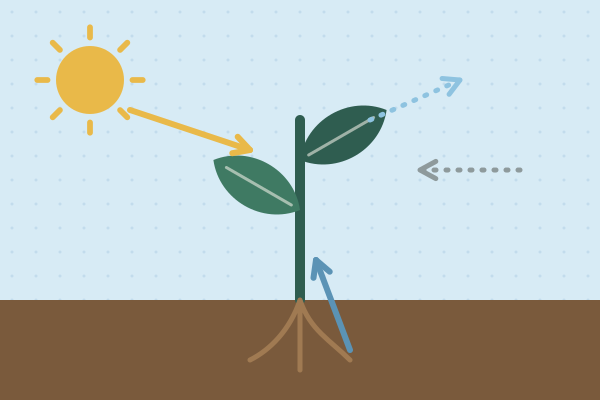
A Grade 5 class planted a tiny maple seed in a pot of soil. Years later it was a tree taller than the school, heavier than a car. A student asked, "Did the tree eat all that soil? Shouldn't there be a giant hole in the ground?" There wasn't. Your team's job: find out what a plant is really made of.
Teams of three, with three jobs that rotate: Lead (handles the syringe and disks), Timer (watches the clock and counts), Recorder (writes and draws).
Look inside the PDF
Sample pages, stamped “preview”. The download is the clean, full lesson.
In the full lesson PDF
- Predict (5–10 min)
- Hunt (20 min)
- Reveal (10–15 min)
- Act (10 min)
- Background for the teacher
- Assessment
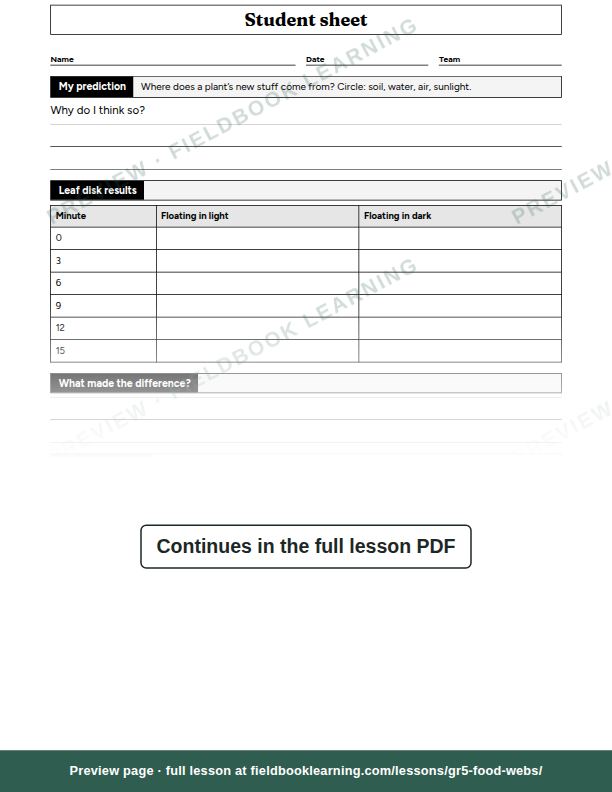
- Student sheet
On the student sheet
- My prediction
- Leaf disk results
- What made the difference?
- Beans with no soil
- Reply to the student
- Exit ticket
US Letter, prints cleanly in black and white. The student sheet is on its own page, ready to photocopy.
Free with an account (any 3 lessons), or US$19 / C$25 for all 4 lessons in this unit.
What students show by the end
- Uses data
- Explains food-making
- Claim, evidence, reasoning
From the lesson’s rubric, which scores each one as not yet, getting there or got it.
Questions teachers ask
How long does “Where does a plant get its food?” take?
50–60 min, plus 10 min to weigh seedlings two weeks later. Group size: teams of 3.
How much prep does it need?
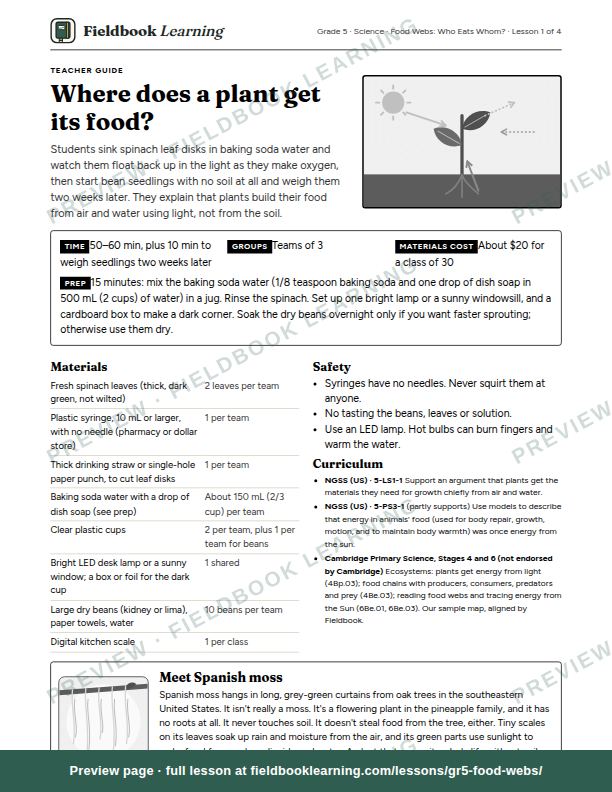
15 minutes: mix the baking soda water (1/8 teaspoon baking soda and one drop of dish soap in 500 mL (2 cups) of water) in a jug. Rinse the spinach. Set up one bright lamp or a sunny windowsill, and a cardboard box to make a dark corner. Soak the dry beans overnight only if you want faster sprouting; otherwise use them dry.
What materials do I need?
Fresh spinach leaves (thick, dark green, not wilted); plastic syringe, 10 mL or larger, with no needle (pharmacy or dollar store); thick drinking straw or single-hole paper punch, to cut leaf disks; baking soda water with a drop of dish soap (see prep); clear plastic cups; bright LED desk lamp or a sunny window; a box or foil for the dark cup; and 2 more. Cost: about $20 for a class of 30.
Which curriculum standards does it cover?
NGSS (US): 5-LS1-1 and 5-PS3-1 (partly). It also matches Cambridge Primary Science, Stages 4 and 6 (not endorsed by Cambridge).
What’s in the lesson PDF?
A teacher guide that walks you through predict, hunt, reveal, act, background for the teacher and assessment, then a student sheet (“My prediction”, “Leaf disk results”, “What made the difference?”, “Beans with no soil”, “Reply to the student” and “Exit ticket”) on its own page, ready to photocopy. It’s US Letter and prints cleanly in black and white.
Can I try it for free?
Yes. A free account includes any 3 full lessons of your choice, and this can be one of them. After that, this unit is US$19 (C$25) for all 4 lessons, yours to keep, or every lesson is US$79 (C$109) a year.