 Preview · the opening mission
Read this to the class:
The school wants to put in a new garden, and the principal asks a question: "Is there anything living out in that schoolyard, or is it just grass?" Some people say the yard is empty. Others say it's full of life we never notice. Your team's job: count what lives in one square metre, and find out which part of the yard is busiest.
Teams of three, with three jobs that rotate: Lead (searches and lifts, gently), Timer (keeps the 10-minute search on track), Recorder (tallies and draws).
Look inside the PDF
Sample pages, stamped “preview”. The download is the clean, full lesson.
In the full lesson PDF
- Predict (5–10 min)
- Hunt (20 min)
- Reveal (10–15 min)
- Act (10 min)
- Background for the teacher
- Assessment
- Student sheet
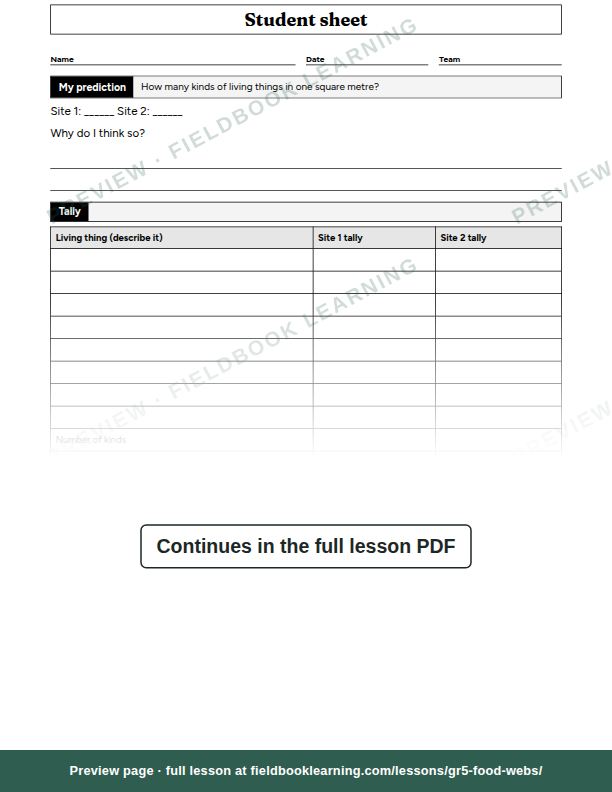
On the student sheet
- My prediction
- Tally
- Draw the most interesting thing we found
- Recommendation to the principal
- Exit ticket
US Letter, prints cleanly in black and white. The student sheet is on its own page, ready to photocopy.
Free with an account (any 3 lessons), or US$19 / C$25 for all 4 lessons in this unit.
What students show by the end
- Collects fair data
- Explains the difference
- Claim, evidence, reasoning
From the lesson’s rubric, which scores each one as not yet, getting there or got it.
Questions teachers ask
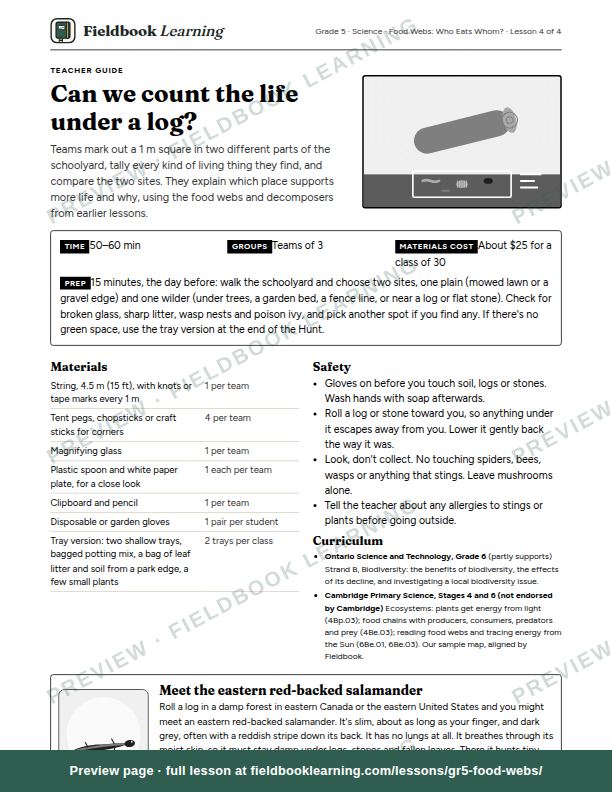
How long does “Can we count the life under a log?” take?
50–60 min. Group size: teams of 3.
How much prep does it need?
15 minutes, the day before: walk the schoolyard and choose two sites, one plain (mowed lawn or a gravel edge) and one wilder (under trees, a garden bed, a fence line, or near a log or flat stone). Check for broken glass, sharp litter, wasp nests and poison ivy, and pick another spot if you find any. If there's no green space, use the tray version at the end of the Hunt.
What materials do I need?
String, 4.5 m (15 ft), with knots or tape marks every 1 m; tent pegs, chopsticks or craft sticks for corners; magnifying glass; plastic spoon and white paper plate, for a close look; clipboard and pencil; disposable or garden gloves; and 1 more. Cost: about $25 for a class of 30.
Which curriculum standards does it cover?
It matches Ontario Science and Technology, Grade 6 and Cambridge Primary Science, Stages 4 and 6 (not endorsed by Cambridge).
What’s in the lesson PDF?
A teacher guide that walks you through predict, hunt, reveal, act, background for the teacher and assessment, then a student sheet (“My prediction”, “Tally”, “Draw the most interesting thing we found”, “Recommendation to the principal” and “Exit ticket”) on its own page, ready to photocopy. It’s US Letter and prints cleanly in black and white.
Can I try it for free?
Yes. A free account includes any 3 full lessons of your choice, and this can be one of them. After that, this unit is US$19 (C$25) for all 4 lessons, yours to keep, or every lesson is US$79 (C$109) a year.