 Preview · the opening mission
Read this to the class:
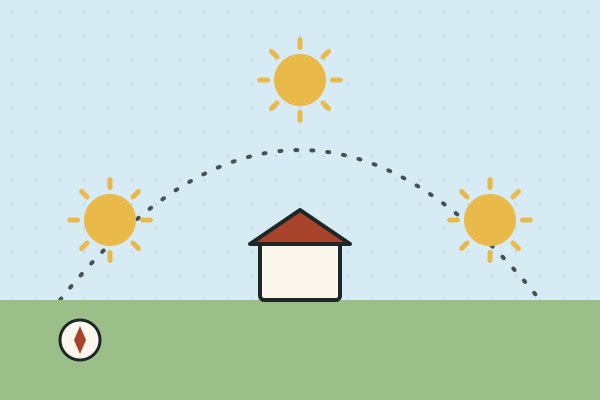
Every morning, Kofi's shadow walks to school beside him. In Accra, in Ghana, where he lives, it stretches out long and thin in front of him. At lunchtime he looks for it and it has almost vanished, a little dark puddle round his feet. By home time it is long again, but pointing the other way. His older sister says, "That's because the Sun moves across the sky." His grandmother says, "The Sun doesn't move. We do." Your team's job: track a shadow across the school day, find its pattern and decide who is right.
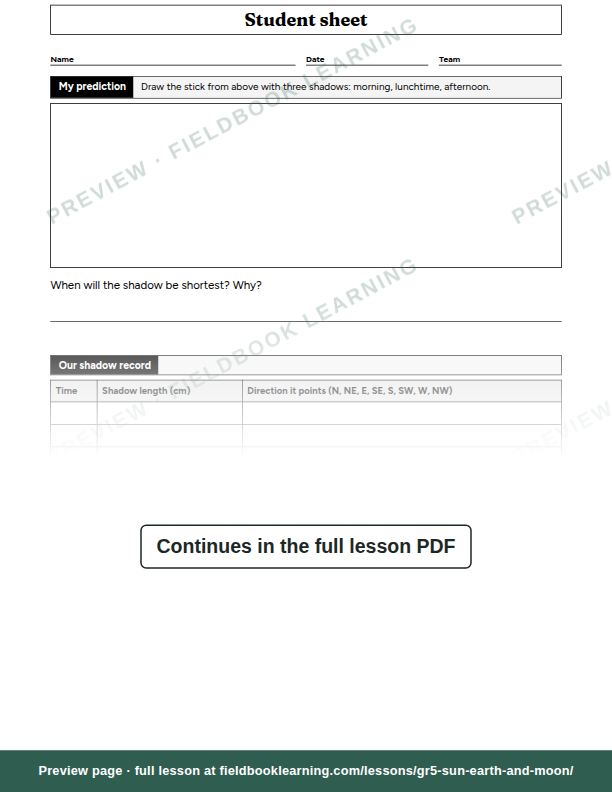
Teams of three, with three jobs that rotate at each marking: Marker (marks the tip of the shadow), Measurer (measures its length), Recorder (writes the time, length and direction).
Look inside the PDF
Sample pages, stamped “preview”. The download is the clean, full lesson.
In the full lesson PDF
- Predict (5–10 min)
- Hunt (20 min)
- Reveal (10–15 min)
- Act (10 min)
- Background for the teacher
- Assessment
- Student sheet
On the student sheet
- My prediction
- Our shadow record
- Graph it
- What we found
- Message to Cape Town
US Letter, prints cleanly in black and white. The student sheet is on its own page, ready to photocopy.
Free with an account (any 3 lessons), or US$19 / C$25 for all 5 lessons in this unit.
What students show by the end
- Collects shadow data
- Finds the pattern
- Explains the cause
From the lesson’s rubric, which scores each one as not yet, getting there or got it.
Questions teachers ask
How long does “Does the Sun really move across the sky?” take?
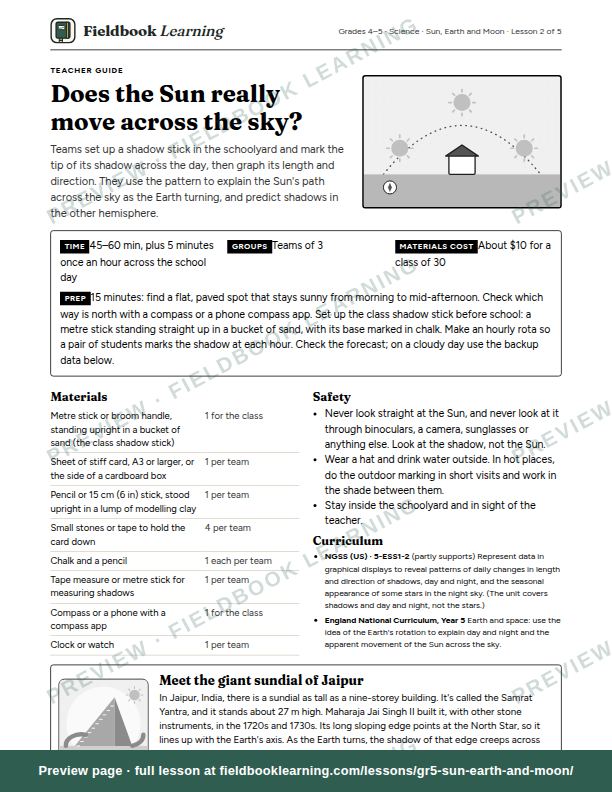
45–60 min, plus 5 minutes once an hour across the school day. Group size: teams of 3.
How much prep does it need?
15 minutes: find a flat, paved spot that stays sunny from morning to mid-afternoon. Check which way is north with a compass or a phone compass app. Set up the class shadow stick before school: a metre stick standing straight up in a bucket of sand, with its base marked in chalk. Make an hourly rota so a pair of students marks the shadow at each hour. Check the forecast; on a cloudy day use the backup data below.
What materials do I need?
Metre stick or broom handle, standing upright in a bucket of sand (the class shadow stick); sheet of stiff card, A3 or larger, or the side of a cardboard box; pencil or 15 cm (6 in) stick, stood upright in a lump of modelling clay; small stones or tape to hold the card down; chalk and a pencil; tape measure or metre stick for measuring shadows; and 2 more. Cost: about $10 for a class of 30.
Which curriculum standards does it cover?
NGSS (US): 5-ESS1-2 (partly). It also matches England National Curriculum, Year 5.
What’s in the lesson PDF?
A teacher guide that walks you through predict, hunt, reveal, act, background for the teacher and assessment, then a student sheet (“My prediction”, “Our shadow record”, “Graph it”, “What we found” and “Message to Cape Town”) on its own page, ready to photocopy. It’s US Letter and prints cleanly in black and white.
Can I try it for free?
Yes. A free account includes any 3 full lessons of your choice, and this can be one of them. After that, this unit is US$19 (C$25) for all 5 lessons, yours to keep, or every lesson is US$79 (C$109) a year.