 Preview · the opening mission
Read this to the class:
In a school science book, a girl in Nairobi named Wanjiru saw a picture of the Sun, the Earth and the Moon. They were all in a row on one page, the Sun about the size of a football and the Earth about the size of an orange, a hand's width away. Her teacher said, "That picture is wrong in two ways." Wanjiru also wondered something else: if the Sun is a star, why does it look so much bigger and brighter than all the others? Your team's job: build the Sun, Earth and Moon to the right sizes and the right distances, and use it to answer Wanjiru's question.
Teams of three, with three jobs that rotate between parts: Pacer (walks the distance), Counter (counts paces), Keeper (holds the Earth and Moon card and checks the numbers).
Look inside the PDF
Sample pages, stamped “preview”. The download is the clean, full lesson.
In the full lesson PDF
- Predict (5–10 min)
- Hunt (20 min)
- Reveal (10–15 min)
- Act (10 min)
- Background for the teacher
- Assessment
- Student sheet
- Worksheet: Try it at home
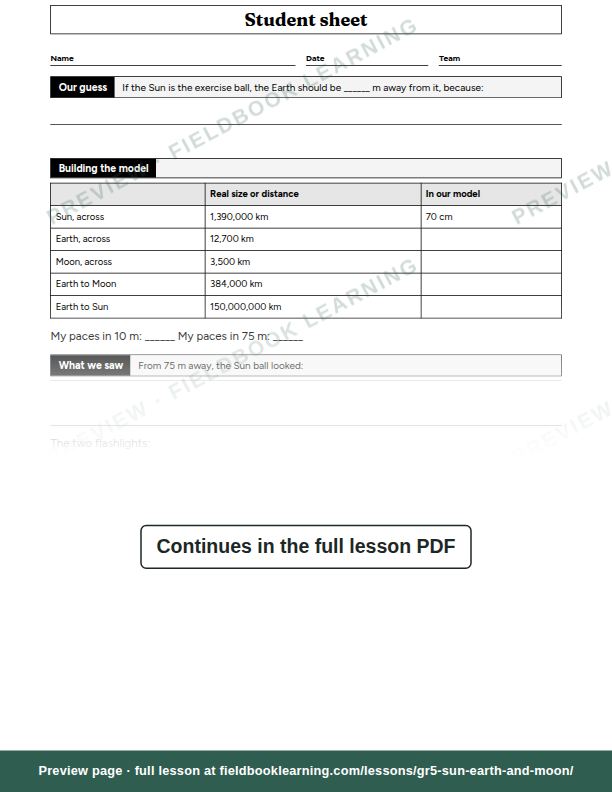
On the student sheet
- Our guess
- Building the model
- What we saw
- Answer to Wanjiru
- Try it at home
US Letter, prints cleanly in black and white. The student sheet is on its own page, ready to photocopy.
Free with an account (any 3 lessons), or US$19 / C$25 for all 5 lessons in this unit.
What students show by the end
- Builds a scale model
- Uses evidence
- Explains brightness
From the lesson’s rubric, which scores each one as not yet, getting there or got it.
Questions teachers ask
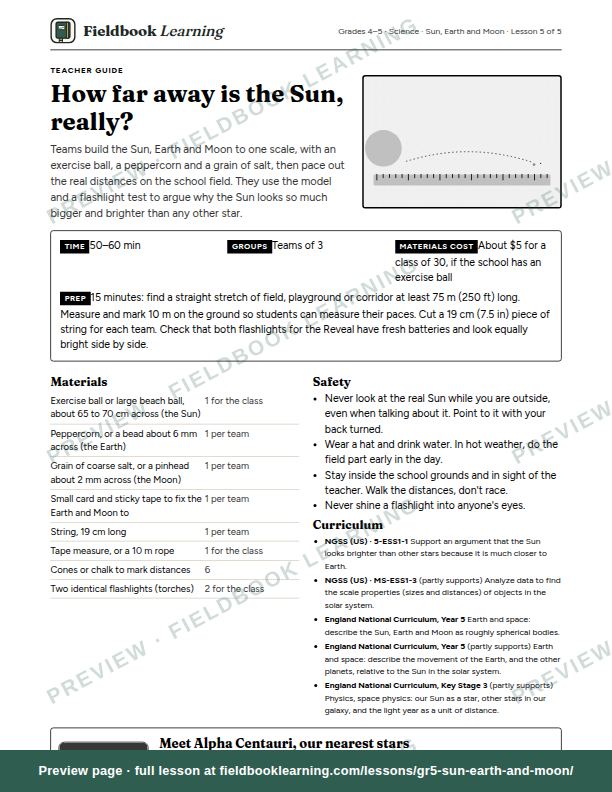
How long does “How far away is the Sun, really?” take?
50–60 min. Group size: teams of 3.
How much prep does it need?
15 minutes: find a straight stretch of field, playground or corridor at least 75 m (250 ft) long. Measure and mark 10 m on the ground so students can measure their paces. Cut a 19 cm (7.5 in) piece of string for each team. Check that both flashlights for the Reveal have fresh batteries and look equally bright side by side.
What materials do I need?
Exercise ball or large beach ball, about 65 to 70 cm across (the Sun); peppercorn, or a bead about 6 mm across (the Earth); grain of coarse salt, or a pinhead about 2 mm across (the Moon); small card and sticky tape to fix the Earth and Moon to; string, 19 cm long; tape measure, or a 10 m rope; and 2 more. Cost: about $5 for a class of 30, if the school has an exercise ball.
Which curriculum standards does it cover?
NGSS (US): 5-ESS1-1 and MS-ESS1-3 (partly). It also matches England National Curriculum, Year 5 and England National Curriculum, Key Stage 3.
What’s in the lesson PDF?
A teacher guide that walks you through predict, hunt, reveal, act, background for the teacher and assessment, then a student sheet (“Our guess”, “Building the model”, “What we saw”, “Answer to Wanjiru” and “Try it at home”) on its own page, ready to photocopy. It’s US Letter and prints cleanly in black and white.
Can I try it for free?
Yes. A free account includes any 3 full lessons of your choice, and this can be one of them. After that, this unit is US$19 (C$25) for all 5 lessons, yours to keep, or every lesson is US$79 (C$109) a year.