 Preview · the opening mission
Read this to the class:
In December, Priya moved from Singapore to London. On her first school day, the Sun hadn't come up by 8 o'clock in the morning, and it set before 4 in the afternoon. Back in Singapore, she says, the Sun comes up at about 7 every day of the year and sets at about 7, and it's always warm. Her new classmate Oliver has an explanation: "It's winter here because we're further from the Sun." But it's summer in Cape Town right now. Your team's job: find out what really causes the seasons, and why Singapore hardly has any.
Teams of three, with three jobs that rotate between parts: Light holder (holds the flashlight or the ball), Counter (counts squares or watches the stickers), Recorder (writes and graphs).
Look inside the PDF
Sample pages, stamped “preview”. The download is the clean, full lesson.
In the full lesson PDF
- Predict (5–10 min)
- Hunt (20 min)
- Reveal (10–15 min)
- Act (10 min)
- Background for the teacher
- Assessment
- Student sheet
- Worksheet: Label the seasons
On the student sheet
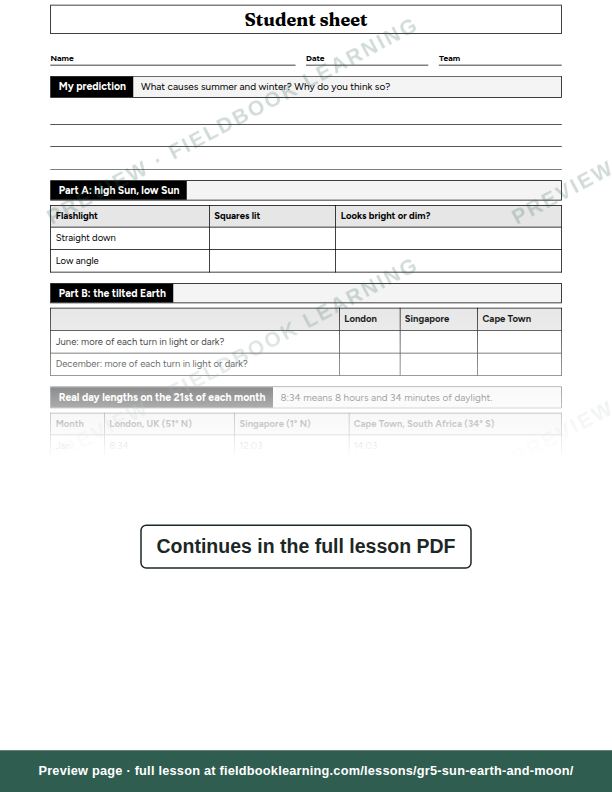
- My prediction
- Part A: high Sun, low Sun
- Part B: the tilted Earth
- Real day lengths on the 21st of each month
- Graph it
- Welcome guide
- Label the seasons
US Letter, prints cleanly in black and white. The student sheet is on its own page, ready to photocopy.
Free with an account (any 3 lessons), or US$19 / C$25 for all 5 lessons in this unit.
What students show by the end
- Uses models fairly
- Reads day-length data
- Explains seasons
From the lesson’s rubric, which scores each one as not yet, getting there or got it.
Questions teachers ask
How long does “Why are there seasons, and why do some places barely have them?” take?
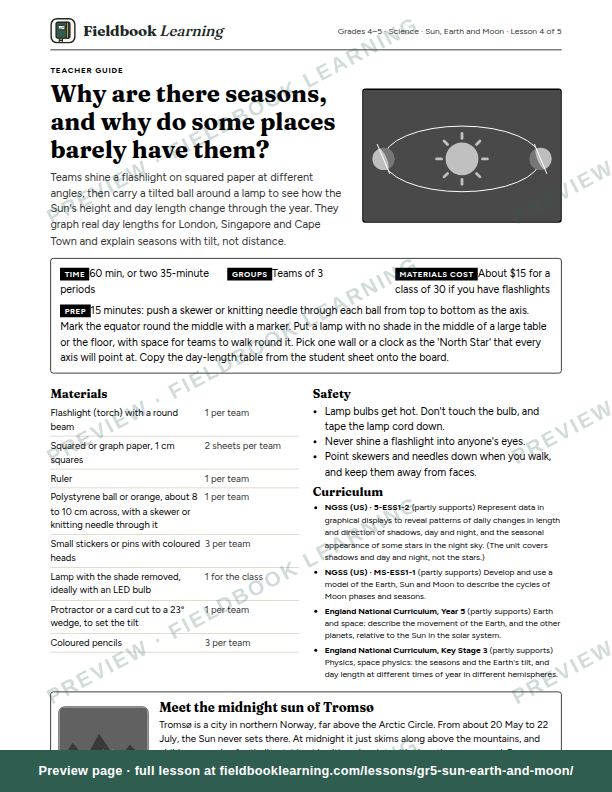
60 min, or two 35-minute periods. Group size: teams of 3.
How much prep does it need?
15 minutes: push a skewer or knitting needle through each ball from top to bottom as the axis. Mark the equator round the middle with a marker. Put a lamp with no shade in the middle of a large table or the floor, with space for teams to walk round it. Pick one wall or a clock as the 'North Star' that every axis will point at. Copy the day-length table from the student sheet onto the board.
What materials do I need?
Flashlight (torch) with a round beam; squared or graph paper, 1 cm squares; ruler; polystyrene ball or orange, about 8 to 10 cm across, with a skewer or knitting needle through it; small stickers or pins with coloured heads; lamp with the shade removed, ideally with an LED bulb; and 2 more. Cost: about $15 for a class of 30 if you have flashlights.
Which curriculum standards does it cover?
NGSS (US): 5-ESS1-2 (partly) and MS-ESS1-1 (partly). It also matches England National Curriculum, Year 5 and England National Curriculum, Key Stage 3.
What’s in the lesson PDF?
A teacher guide that walks you through predict, hunt, reveal, act, background for the teacher and assessment, then a student sheet (“My prediction”; “Part A: high Sun, low Sun”; “Part B: the tilted Earth”; “Real day lengths on the 21st of each month”; “Graph it”; “Welcome guide” and “Label the seasons”) on its own page, ready to photocopy. It’s US Letter and prints cleanly in black and white.
Can I try it for free?
Yes. A free account includes any 3 full lessons of your choice, and this can be one of them. After that, this unit is US$19 (C$25) for all 5 lessons, yours to keep, or every lesson is US$79 (C$109) a year.