 Preview · the opening mission
Read this to the class:
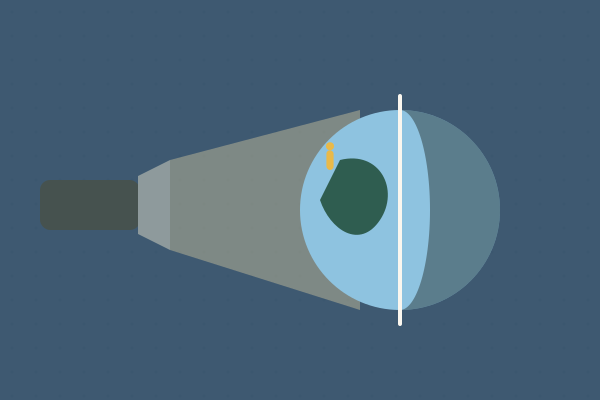
Amira lives in Calgary, Canada. At half past seven in the morning she sits down to breakfast and video-calls her cousin Daniel in Singapore. The sun is pouring through Amira's kitchen window. But Daniel is in his pyjamas, and the sky behind him is black. "It's half past nine at night here," he yawns. "I have to go to bed." Amira's little brother asks, "Did the Sun go to Singapore first? Or did it go to sleep there?" Nobody at the table can explain it. Your team's job: build a model that shows why it can be morning in one place and night in another, at the very same moment.
Teams of three, with three jobs that rotate after each round: Sun keeper (holds the flashlight still), Earth turner (turns the ball), Recorder (writes what the team sees).
Look inside the PDF
Sample pages, stamped “preview”. The download is the clean, full lesson.
In the full lesson PDF
- Predict (5–10 min)
- Hunt (20 min)
- Reveal (10–15 min)
- Act (10 min)
- Background for the teacher
- Assessment
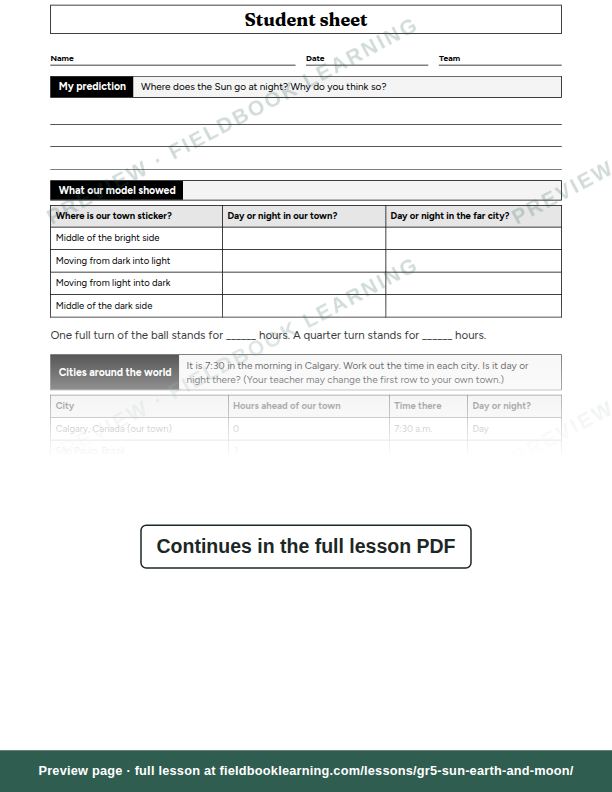
- Student sheet
On the student sheet
- My prediction
- What our model showed
- Cities around the world
- Draw it
- A good time to call
US Letter, prints cleanly in black and white. The student sheet is on its own page, ready to photocopy.
Free with an account (any 3 lessons), or US$19 / C$25 for all 5 lessons in this unit.
What students show by the end
- Uses the model
- Explains day and night
- Uses time zones
From the lesson’s rubric, which scores each one as not yet, getting there or got it.
Questions teachers ask
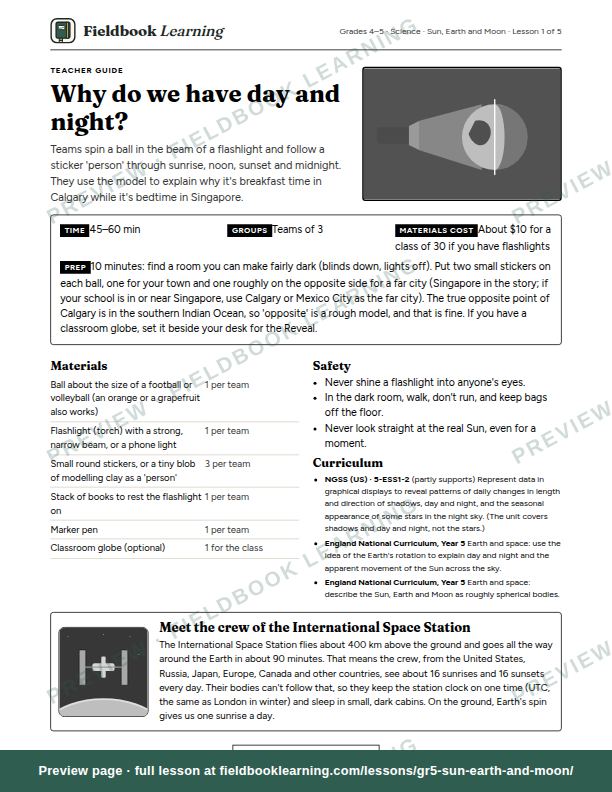
How long does “Why do we have day and night?” take?
45–60 min. Group size: teams of 3.
How much prep does it need?
10 minutes: find a room you can make fairly dark (blinds down, lights off). Put two small stickers on each ball, one for your town and one roughly on the opposite side for a far city (Singapore in the story; if your school is in or near Singapore, use Calgary or Mexico City as the far city). The true opposite point of Calgary is in the southern Indian Ocean, so 'opposite' is a rough model, and that is fine. If you have a classroom globe, set it beside your desk for the Reveal.
What materials do I need?
Ball about the size of a football or volleyball (an orange or a grapefruit also works); flashlight (torch) with a strong, narrow beam, or a phone light; small round stickers, or a tiny blob of modelling clay as a 'person'; stack of books to rest the flashlight on; marker pen; classroom globe (optional). Cost: about $10 for a class of 30 if you have flashlights.
Which curriculum standards does it cover?
NGSS (US): 5-ESS1-2 (partly). It also matches England National Curriculum, Year 5.
What’s in the lesson PDF?
A teacher guide that walks you through predict, hunt, reveal, act, background for the teacher and assessment, then a student sheet (“My prediction”, “What our model showed”, “Cities around the world”, “Draw it” and “A good time to call”) on its own page, ready to photocopy. It’s US Letter and prints cleanly in black and white.
Can I try it for free?
Yes. A free account includes any 3 full lessons of your choice, and this can be one of them. After that, this unit is US$19 (C$25) for all 5 lessons, yours to keep, or every lesson is US$79 (C$109) a year.