 Preview · the opening mission
Read this to the class:
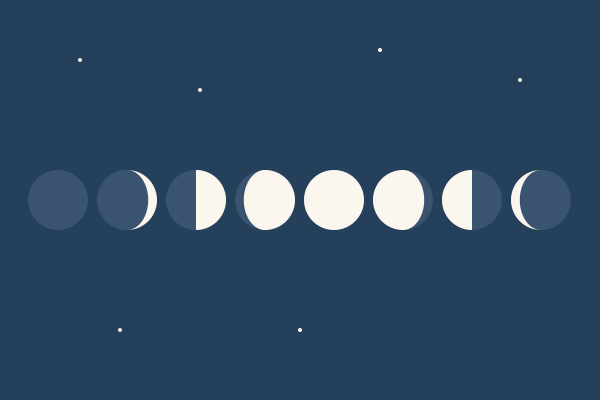
Last week, Lucía in Mexico City saw a thin silver Moon after sunset, like a fingernail. A week later it was a half. Then it was round and bright, rising as she went to bed. Her friend Sam told her, "That's Earth's shadow covering bits of the Moon." Lucía isn't sure. If it's a shadow, why is the dark part so neat, and why does the Moon sometimes show up in the daytime? Your team's job: build a model that makes the Moon's shapes appear, and test whether Earth's shadow is the cause.
Pairs or teams of three, with three jobs that rotate after each turn: Earth (the person turning, whose head is the Earth), Spotter (stands behind Earth and says what shape they see), Recorder (draws each shape).
Look inside the PDF
Sample pages, stamped “preview”. The download is the clean, full lesson.
In the full lesson PDF
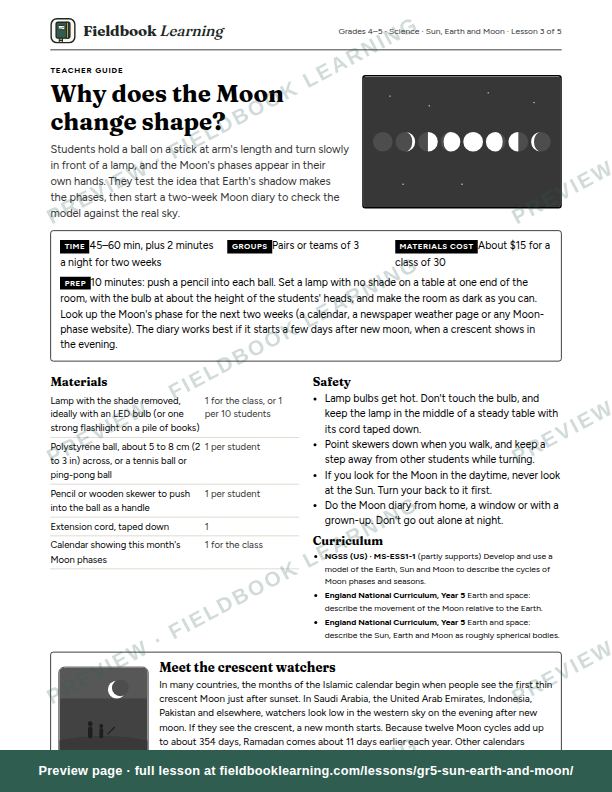
- Predict (5–10 min)
- Hunt (20 min)
- Reveal (10–15 min)
- Act (10 min)
- Background for the teacher
- Assessment
- Student sheet
- Worksheet: Label the Moon's phases
- Worksheet: My Moon diary
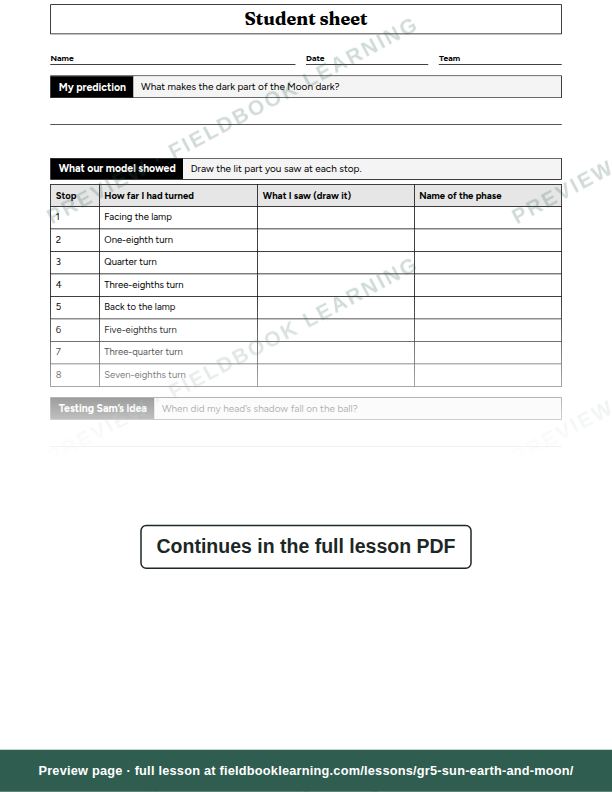
On the student sheet
- My prediction
- What our model showed
- Testing Sam's idea
- Note to Lucía
- Label the Moon's phases
- My Moon diary
US Letter, prints cleanly in black and white. The student sheet is on its own page, ready to photocopy.
Free with an account (any 3 lessons), or US$19 / C$25 for all 5 lessons in this unit.
What students show by the end
- Uses the model
- Explains phases
- Tests an idea with evidence
From the lesson’s rubric, which scores each one as not yet, getting there or got it.
Questions teachers ask
How long does “Why does the Moon change shape?” take?
45–60 min, plus 2 minutes a night for two weeks. Group size: pairs or teams of 3.
How much prep does it need?
10 minutes: push a pencil into each ball. Set a lamp with no shade on a table at one end of the room, with the bulb at about the height of the students' heads, and make the room as dark as you can. Look up the Moon's phase for the next two weeks (a calendar, a newspaper weather page or any Moon-phase website). The diary works best if it starts a few days after new moon, when a crescent shows in the evening.
What materials do I need?
Lamp with the shade removed, ideally with an LED bulb (or one strong flashlight on a pile of books); polystyrene ball, about 5 to 8 cm (2 to 3 in) across, or a tennis ball or ping-pong ball; pencil or wooden skewer to push into the ball as a handle; extension cord, taped down; calendar showing this month's Moon phases. Cost: about $15 for a class of 30.
Which curriculum standards does it cover?
NGSS (US): MS-ESS1-1 (partly). It also matches England National Curriculum, Year 5.
What’s in the lesson PDF?
A teacher guide that walks you through predict, hunt, reveal, act, background for the teacher and assessment, then a student sheet (“My prediction”, “What our model showed”, “Testing Sam's idea”, “Note to Lucía”, “Label the Moon's phases” and “My Moon diary”) on its own page, ready to photocopy. It’s US Letter and prints cleanly in black and white.
Can I try it for free?
Yes. A free account includes any 3 full lessons of your choice, and this can be one of them. After that, this unit is US$19 (C$25) for all 5 lessons, yours to keep, or every lesson is US$79 (C$109) a year.