Sun, Earth and Moon
Why it's breakfast time in Calgary and bedtime in Singapore, why your shadow swings round the stick, why the Moon changes shape and why some places barely have seasons. Students build models with balls and lamps, track real shadows and read real sky data from cities around the world.
Or try any 3 lessons free with an account.
Already bought it? Download the whole unit as one printable workbook: cover, contents, curriculum connections, every lesson, readings, practice pages, a unit test and an answer key, in black and white.
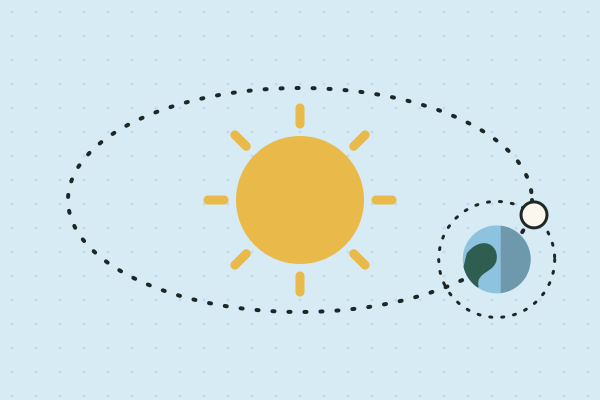
5 lessons in this unit
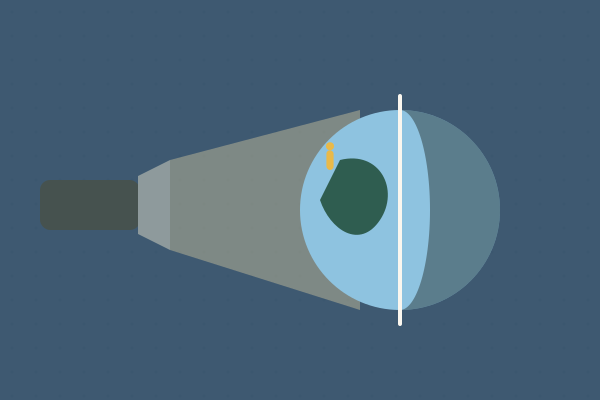 Lesson 1 · 45–60 minWhy do we have day and night?Teams spin a ball in the beam of a flashlight and follow a sticker 'person' through sunrise, noon, sunset and midnight. They use the model to explain why it's breakfast time in Calgary while it's bedtime in Singapore.
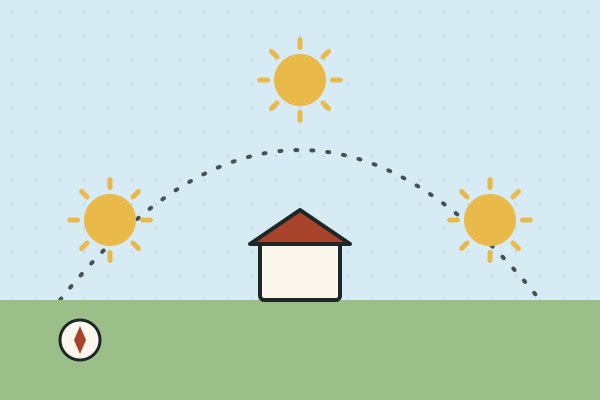 Lesson 2 · 45–60 min, plus 5 minutes once an hour across the school dayDoes the Sun really move across the sky?Teams set up a shadow stick in the schoolyard and mark the tip of its shadow across the day, then graph its length and direction. They use the pattern to explain the Sun's path across the sky as the Earth turning, and predict shadows in the other hemisphere.
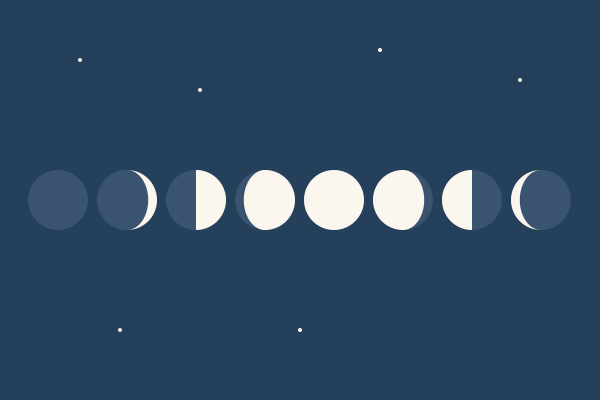 Lesson 3 · 45–60 min, plus 2 minutes a night for two weeksWhy does the Moon change shape?Students hold a ball on a stick at arm's length and turn slowly in front of a lamp, and the Moon's phases appear in their own hands. They test the idea that Earth's shadow makes the phases, then start a two-week Moon diary to check the model against the real sky.
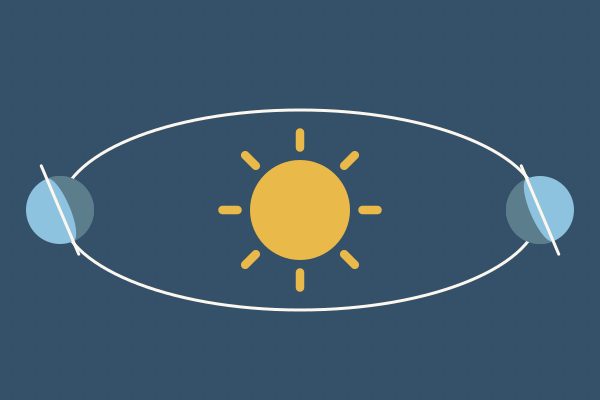 Lesson 4 · 60 min, or two 35-minute periodsWhy are there seasons, and why do some places barely have them?Teams shine a flashlight on squared paper at different angles, then carry a tilted ball around a lamp to see how the Sun's height and day length change through the year. They graph real day lengths for London, Singapore and Cape Town and explain seasons with tilt, not distance.
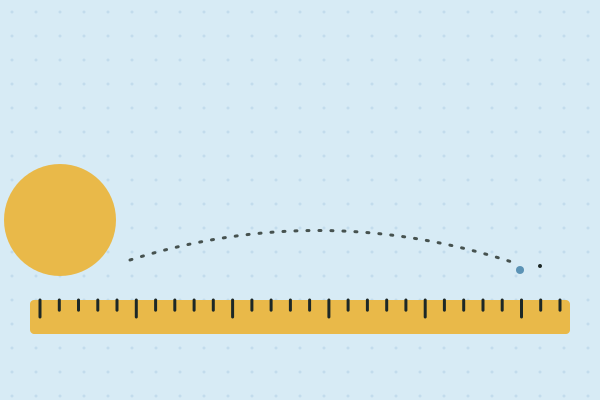 Lesson 5 · 50–60 minHow far away is the Sun, really?Teams build the Sun, Earth and Moon to one scale, with an exercise ball, a peppercorn and a grain of salt, then pace out the real distances on the school field. They use the model and a flashlight test to argue why the Sun looks so much bigger and brighter than any other star.
Materials for the whole unit · one list, lesson by lesson
Lesson 1: Why do we have day and night?
- Ball about the size of a football or volleyball (an orange or a grapefruit also works)1 per team
- Flashlight (torch) with a strong, narrow beam, or a phone light1 per team
- Small round stickers, or a tiny blob of modelling clay as a 'person'3 per team
- Stack of books to rest the flashlight on1 per team
- Marker pen1 per team
- Classroom globe (optional)1 for the class
About $10 for a class of 30 if you have flashlights
Lesson 2: Does the Sun really move across the sky?
- Metre stick or broom handle, standing upright in a bucket of sand (the class shadow stick)1 for the class
- Sheet of stiff card, A3 or larger, or the side of a cardboard box1 per team
- Pencil or 15 cm (6 in) stick, stood upright in a lump of modelling clay1 per team
- Small stones or tape to hold the card down4 per team
- Chalk and a pencil1 each per team
- Tape measure or metre stick for measuring shadows1 per team
- Compass or a phone with a compass app1 for the class
- Clock or watch1 per team
About $10 for a class of 30
Lesson 3: Why does the Moon change shape?
- Lamp with the shade removed, ideally with an LED bulb (or one strong flashlight on a pile of books)1 for the class, or 1 per 10 students
- Polystyrene ball, about 5 to 8 cm (2 to 3 in) across, or a tennis ball or ping-pong ball1 per student
- Pencil or wooden skewer to push into the ball as a handle1 per student
- Extension cord, taped down1
- Calendar showing this month's Moon phases1 for the class
About $15 for a class of 30
Lesson 4: Why are there seasons, and why do some places barely have them?
- Flashlight (torch) with a round beam1 per team
- Squared or graph paper, 1 cm squares2 sheets per team
- Ruler1 per team
- Polystyrene ball or orange, about 8 to 10 cm across, with a skewer or knitting needle through it1 per team
- Small stickers or pins with coloured heads3 per team
- Lamp with the shade removed, ideally with an LED bulb1 for the class
- Protractor or a card cut to a 23° wedge, to set the tilt1 per team
- Coloured pencils3 per team
About $15 for a class of 30 if you have flashlights
Lesson 5: How far away is the Sun, really?
- Exercise ball or large beach ball, about 65 to 70 cm across (the Sun)1 for the class
- Peppercorn, or a bead about 6 mm across (the Earth)1 per team
- Grain of coarse salt, or a pinhead about 2 mm across (the Moon)1 per team
- Small card and sticky tape to fix the Earth and Moon to1 per team
- String, 19 cm long1 per team
- Tape measure, or a 10 m rope1 for the class
- Cones or chalk to mark distances6
- Two identical flashlights (torches)2 for the class
About $5 for a class of 30, if the school has an exercise ball
Students spin a ball in front of a flashlight to find out why it’s morning in one city and night in another. They track a shadow stick across a school day, act out the Moon’s phases with a ball on a stick and keep a two-week Moon diary. Then they tilt a model Earth around a lamp, graph day length in London, Singapore and Cape Town, and pace out the Sun, Earth and Moon to scale on the school field.
By the end, students can explain day and night with a spinning Earth, describe the Sun’s path and their shadow wherever they live, explain Moon phases without blaming Earth’s shadow, explain seasons with tilt rather than distance, and say why the Sun looks so much bigger and brighter than any other star.