Restless Earth: Fossils, Soils, Volcanoes and Plates
Press model fossils and read a cliff of layers, shake a jar of soil and watch it sort itself by grain size, plot real volcanoes and earthquakes on a world map to find the edges of Earth's plates, then move model plates and test a building on a shake table. Four hands-on lessons that build on Rocks and Erosion.
Or try any 3 lessons free with an account.
Already bought it? Download the whole unit as one printable workbook: cover, contents, curriculum connections, every lesson, readings, practice pages, a unit test and an answer key, in black and white.
4 lessons in this unit
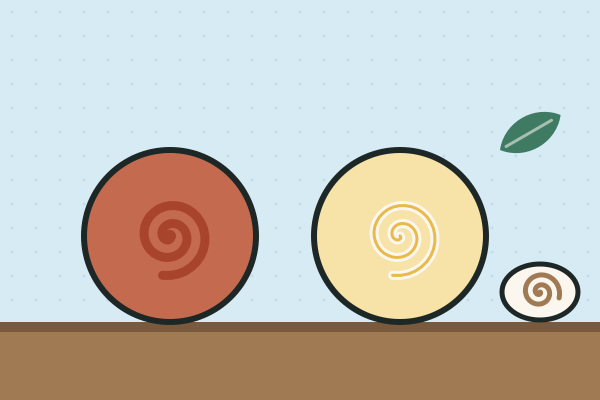 Lesson 1 · 55–70 minHow do fossils form, and what can they tell us?Teams press shells and leaves into clay to make a mould and a salt-dough cast, build a cliff of coloured layers with a different model fossil in each, and swap cliffs to work out which layer is oldest. They then read a cliff of real fossils and explain that a place once under the sea is now dry land.
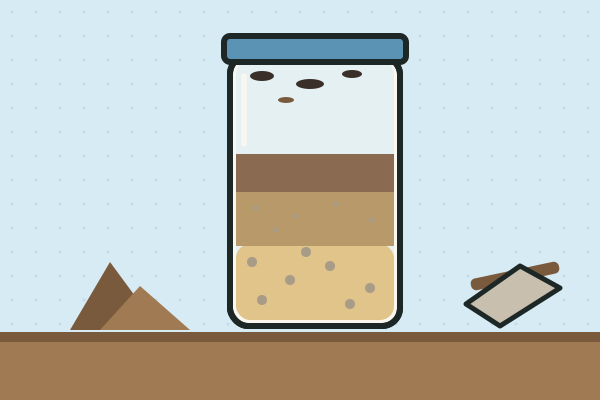 Lesson 2 · 45–55 min, plus two 5-minute checks laterWhat is soil made of?Teams shake a sample of soil in a jar of water, let it settle, and measure the layers of sand, silt and clay with floating plant bits on top. They rub the soil between their fingers to feel the grains, then use their results to choose the best soil for a garden bed.
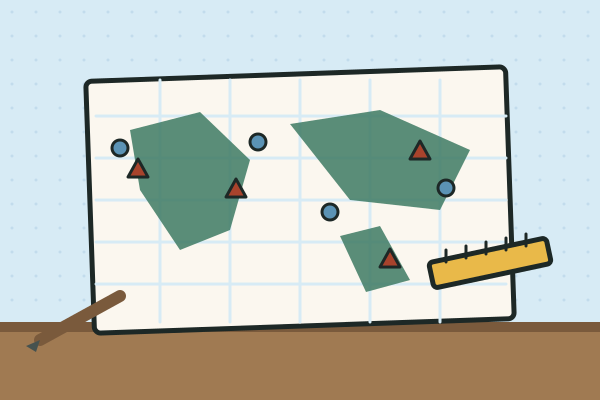 Lesson 3 · 50–60 minWhere do volcanoes and earthquakes happen?Teams plot twenty-two real volcanoes and earthquakes from a data table onto a world map using latitude and longitude. They join the dots, find the lines and rings they make, and use the pattern to say which of three cities is most likely to feel earthquakes.
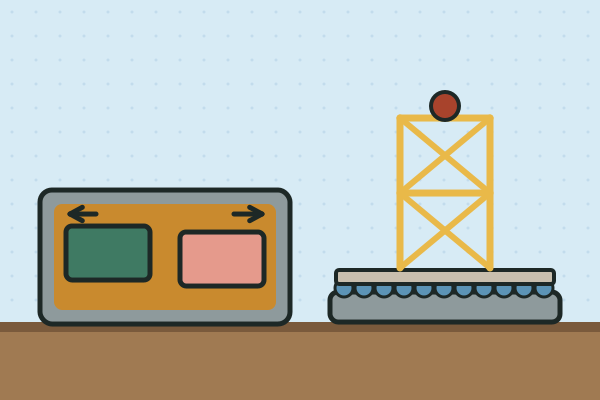 Lesson 4 · 80–90 min (easy to split over two periods)What do moving plates do, and can a building survive?Teams move two foam plates on a tray of syrup to pull them apart and push them together, then slide sandpaper blocks to feel an earthquake build and release. They design and test straw towers on a shake table, compare two designs, and explain how engineers reduce earthquake damage.
Materials for the whole unit · one list, lesson by lesson
Lesson 1: How do fossils form, and what can they tell us?
- Modelling clay (oil-based, such as plasticine)100 g block per team
- Salt dough (flour, salt, water)about 200 g per team, in a sealed bag
- Things to press: seashell, leaf, key or coin3 per team
- Clear plastic cup, about 300 mL1 per team
- Four dry materials in different colours (craft sand, sand, rice, lentils, couscous)about 1 cup of each per 4 teams
- Small model fossils (shell, dried bean, pasta shape, bead)4 per team
- Spoon and tray or plate1 each per team
- Paper towels1 roll per 4 teams
About $20 for a class of 30
Lesson 2: What is soil made of?
- Clear plastic jar with a tight lid, about 500 mL to 1 L1 per team
- Clean garden topsoil or bagged topsoil1 to 2 cups per team
- Waterabout 500 mL per team
- Ruler in millimetres1 per team
- Permanent marker1 per team
- Magnifier1 per team
- Tray and paper towels1 tray per team
- Spoon1 per team
About $15 for a class of 30
Lesson 3: Where do volcanoes and earthquakes happen?
- World map with a grid, printed from the student sheet1 per student, plus 1 large copy for the wall
- Data table of 22 places (on the student sheet)1 per team
- Red and blue pencils or markers1 of each per student
- Ruler and pencil1 each per student
- Tracing paper or clear sheet (optional, for finding lines)1 per team
About $5 for a class of 30
Lesson 4: What do moving plates do, and can a building survive?
- Thick syrup (corn or golden), about 400 mL1 tray per team; reuse across classes
- Shallow tray or foil pan, about 20 cm square1 per team
- Craft foam, 8 × 15 cm2 pieces per team
- Wooden block or thick book faced with coarse sandpaper, plus a matching sandpaper sheet1 each per team
- Wide rubber band and ruler1 each per team
- Rimmed baking tray with 20 marbles and a 30 cm square of firm cardboard (the shake table)1 per team
- Straws, paper or plastic20 per team
- Masking tape1 m per team
- Modelling clay (a 20 g ball for the load)1 per team
About $35 for a class of 30, and most of it can be reused
Students press shells and leaves into clay to make moulds and casts of their own, build a cliff of coloured layers with a different “fossil” in each, and read a real-style cliff to decide which layer is oldest and what the place used to be. They shake soil in a jar of water, let it settle into sand, silt and clay, and measure the layers. They plot twenty-two real volcanoes and earthquakes on a world map, and the dots draw the edges of Earth’s plates. Finally they pull, push and slide model plates and build straw towers to test on a shake table.
By the end, students can explain that a fossil is evidence of ancient life that formed only under rare conditions, that in undisturbed layers the oldest are at the bottom, that soil is broken rock mixed with the remains of living things and sorts by grain size when it settles, that most earthquakes and volcanoes happen along the edges of plates that move a few centimetres a year, and that engineers reduce earthquake damage with strong, braced and flexible designs. It follows Rocks and Erosion, and it uses no heat and no plaster: clay, salt dough, jars, foam, straws and a printed map.