 Preview · the opening mission
Read this to the class:
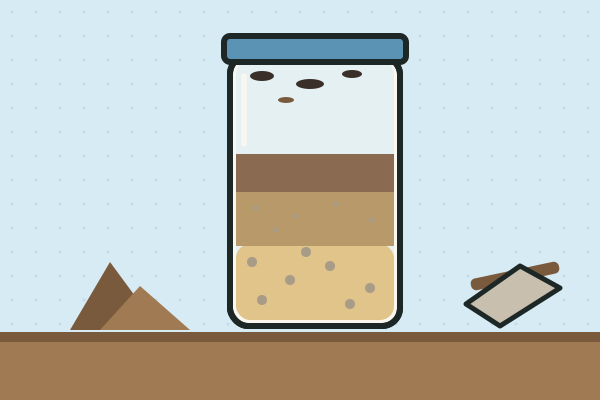
Dev's family is building a vegetable bed behind their apartment block. The builder offers them two heaps: a gritty yellow one and a dark crumbly one. "Which one grows tomatoes?" Dev asks. His mum shrugs. "They both look like dirt." Dev frowns. "Dirt is just dirt. Isn't it?" Your team's job: find out what is really in soil, and use your evidence to choose.
Teams of three, with rotating jobs: Shaker (fills and shakes the jar), Measurer (uses the ruler) and Recorder (writes and draws).
Look inside the PDF
Sample pages, stamped “preview”. The download is the clean, full lesson.
In the full lesson PDF
- Predict (5–10 min)
- Hunt (20 min)
- Reveal (10–15 min)
- Act (10 min)
- Background for the teacher
- Assessment
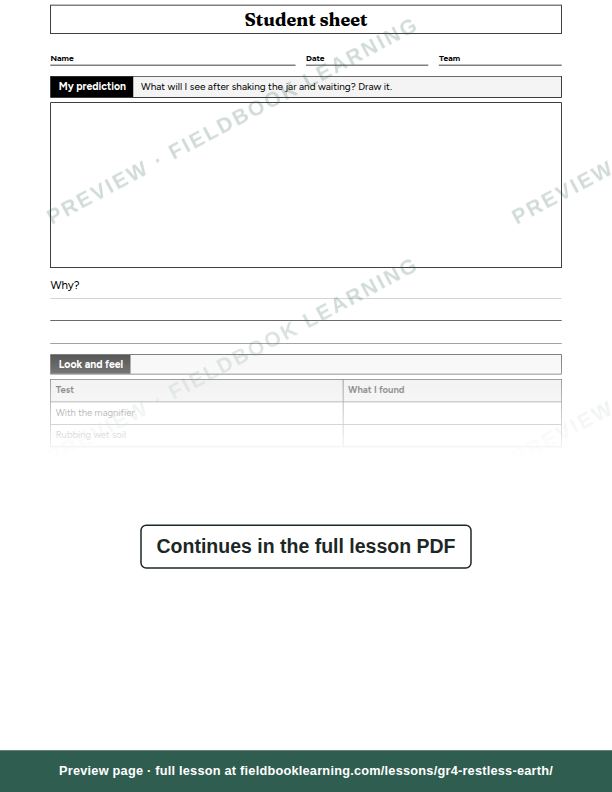
- Student sheet
- Worksheet: Label it
- Worksheet: Try it at home
On the student sheet
- My prediction
- Look and feel
- The jar
- What stayed the same?
- A recommendation for Dev's family
- Exit ticket
- Label it
- Try it at home
US Letter, prints cleanly in black and white. The student sheet is on its own page, ready to photocopy.
Free with an account (any 3 lessons), or US$19 / C$25 for all 4 lessons in this unit.
What students show by the end
- Names soil ingredients
- Reads the jar
- Uses evidence
From the lesson’s rubric, which scores each one as not yet, getting there or got it.
Questions teachers ask
How long does “What is soil made of?” take?
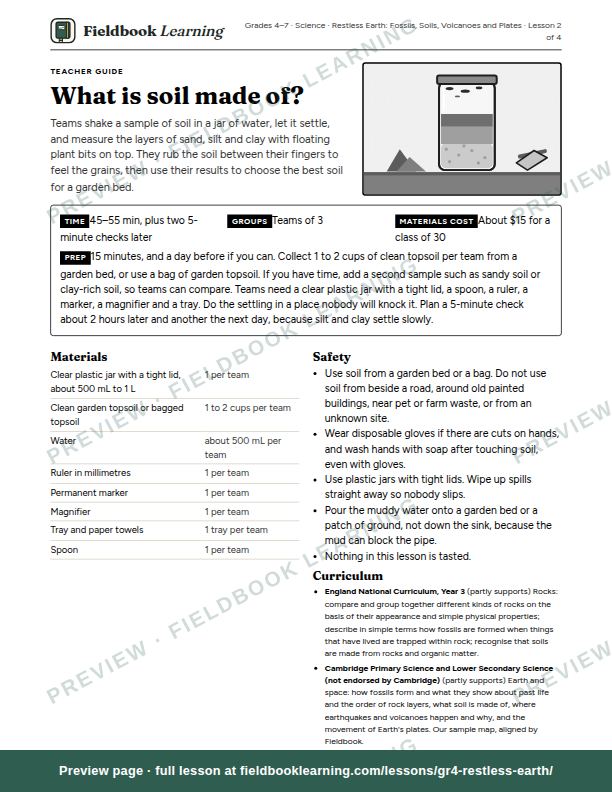
45–55 min, plus two 5-minute checks later. Group size: teams of 3.
How much prep does it need?
15 minutes, and a day before if you can. Collect 1 to 2 cups of clean topsoil per team from a garden bed, or use a bag of garden topsoil. If you have time, add a second sample such as sandy soil or clay-rich soil, so teams can compare. Teams need a clear plastic jar with a tight lid, a spoon, a ruler, a marker, a magnifier and a tray. Do the settling in a place nobody will knock it. Plan a 5-minute check about 2 hours later and another the next day, because silt and clay settle slowly.
What materials do I need?
Clear plastic jar with a tight lid, about 500 mL to 1 L; clean garden topsoil or bagged topsoil; water; ruler in millimetres; permanent marker; magnifier; and 2 more. Cost: about $15 for a class of 30.
Which curriculum standards does it cover?
It matches England National Curriculum, Year 3 and Cambridge Primary Science and Lower Secondary Science (not endorsed by Cambridge).
What’s in the lesson PDF?
A teacher guide that walks you through predict, hunt, reveal, act, background for the teacher and assessment, then a student sheet (“My prediction”, “Look and feel”, “The jar”, “What stayed the same?”, “A recommendation for Dev's family”, “Exit ticket”, “Label it” and “Try it at home”) on its own page, ready to photocopy. It’s US Letter and prints cleanly in black and white.
Can I try it for free?
Yes. A free account includes any 3 full lessons of your choice, and this can be one of them. After that, this unit is US$19 (C$25) for all 4 lessons, yours to keep, or every lesson is US$79 (C$109) a year.