 Preview · the opening mission
Read this to the class:
Amara is walking with her uncle, far from any sea. A new road has cut a deep slice out of the hillside, and the rock inside is striped like a layer cake. In the middle stripe Amara spots a spiral the size of her palm, with ridges like a seashell. "A shell? Up here?" The stripe above holds a bone-white tooth, and the stripe below holds something like a small armoured bug. "Each stripe is a page," her uncle says. "Let's read the book." Your team's job: make your own model fossils, then read a cliff and work out what happened here.
Teams of three, with rotating jobs: Maker (presses and shapes the clay and dough), Reader (reads the cliff and the cards aloud) and Recorder (writes and draws).
Look inside the PDF
Sample pages, stamped “preview”. The download is the clean, full lesson.
In the full lesson PDF
- Predict (5–10 min)
- Hunt (25 min)
- Reveal (10–15 min)
- Act (10 min)
- Background for the teacher
- Assessment
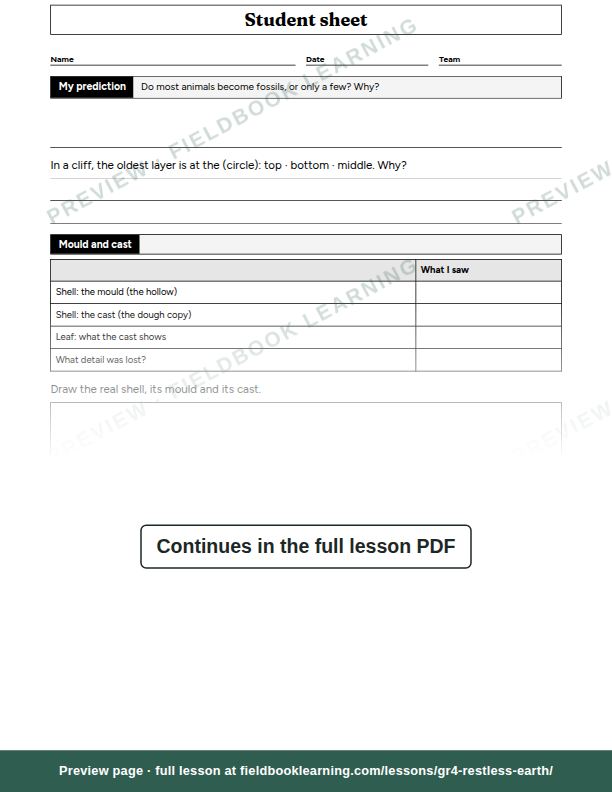
- Student sheet
- Worksheet: Label it
- Worksheet: Try it at home
On the student sheet
- My prediction
- Mould and cast
- Our cup cliff
- The road cliff
- A note to the farmer
- Exit ticket
- Label it
- Try it at home
US Letter, prints cleanly in black and white. The student sheet is on its own page, ready to photocopy.
Free with an account (any 3 lessons), or US$19 / C$25 for all 4 lessons in this unit.
What students show by the end
- Describes a fossil
- Reads layers
- Explains rarity
From the lesson’s rubric, which scores each one as not yet, getting there or got it.
Questions teachers ask
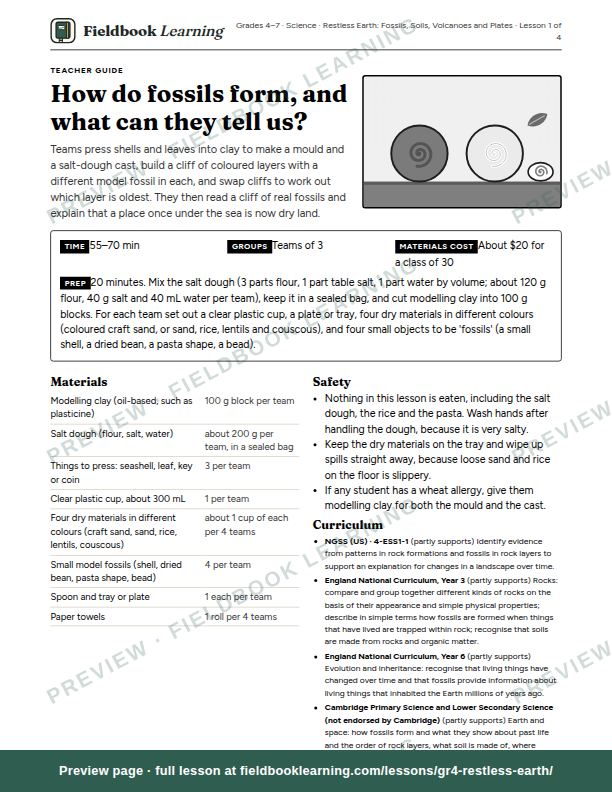
How long does “How do fossils form, and what can they tell us?” take?
55–70 min. Group size: teams of 3.
How much prep does it need?
20 minutes. Mix the salt dough (3 parts flour, 1 part table salt, 1 part water by volume; about 120 g flour, 40 g salt and 40 mL water per team), keep it in a sealed bag, and cut modelling clay into 100 g blocks. For each team set out a clear plastic cup, a plate or tray, four dry materials in different colours (coloured craft sand, or sand, rice, lentils and couscous), and four small objects to be 'fossils' (a small shell, a dried bean, a pasta shape, a bead).
What materials do I need?
Modelling clay (oil-based, such as plasticine); salt dough (flour, salt, water); things to press; clear plastic cup, about 300 mL; four dry materials in different colours (craft sand, sand, rice, lentils, couscous); small model fossils (shell, dried bean, pasta shape, bead); and 2 more. Cost: about $20 for a class of 30.
Which curriculum standards does it cover?
NGSS (US): 4-ESS1-1 (partly). It also matches England National Curriculum, Year 3; England National Curriculum, Year 6 and Cambridge Primary Science and Lower Secondary Science (not endorsed by Cambridge).
What’s in the lesson PDF?
A teacher guide that walks you through predict, hunt, reveal, act, background for the teacher and assessment, then a student sheet (“My prediction”, “Mould and cast”, “Our cup cliff”, “The road cliff”, “A note to the farmer”, “Exit ticket”, “Label it” and “Try it at home”) on its own page, ready to photocopy. It’s US Letter and prints cleanly in black and white.
Can I try it for free?
Yes. A free account includes any 3 full lessons of your choice, and this can be one of them. After that, this unit is US$19 (C$25) for all 4 lessons, yours to keep, or every lesson is US$79 (C$109) a year.