 Preview · the opening mission
Read this to the class:
Lena lives in a city on a plate boundary. Last week a small earthquake rattled the pictures off her classroom wall and made the lights swing. "Why does the ground shake?" she asks her teacher. "And why did our school stay up when the old bakery next door cracked?" Your team's job: model how plates move, then design a tower that can survive a quake.
Teams of three, with rotating jobs: Builder (handles the materials), Shaker (runs the tests the same way every time) and Recorder (counts and writes).
Look inside the PDF
Sample pages, stamped “preview”. The download is the clean, full lesson.
In the full lesson PDF
- Predict (5–10 min)
- Hunt (45 min)
- Reveal (10–15 min)
- Act (10 min)
- Background for the teacher
- Assessment
- Student sheet
- Worksheet: Label it
- Worksheet: Try it at home
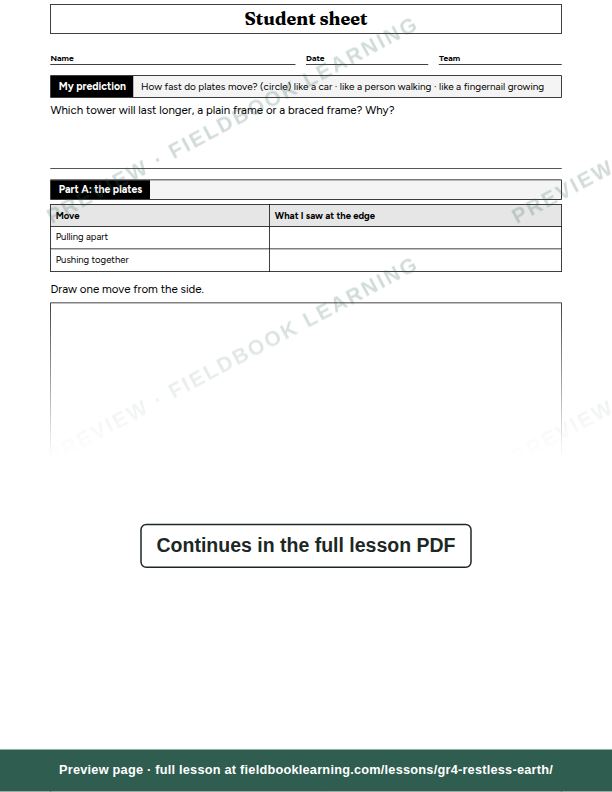
On the student sheet
- My prediction
- Part A: the plates
- Part B: the rubber band
- Part C: the shake table
- A note to the city council
- Exit ticket
- Label it
- Try it at home
US Letter, prints cleanly in black and white. The student sheet is on its own page, ready to photocopy.
Free with an account (any 3 lessons), or US$19 / C$25 for all 4 lessons in this unit.
What students show by the end
- Describes plate motion
- Explains earthquakes
- Tests and compares designs
From the lesson’s rubric, which scores each one as not yet, getting there or got it.
Questions teachers ask
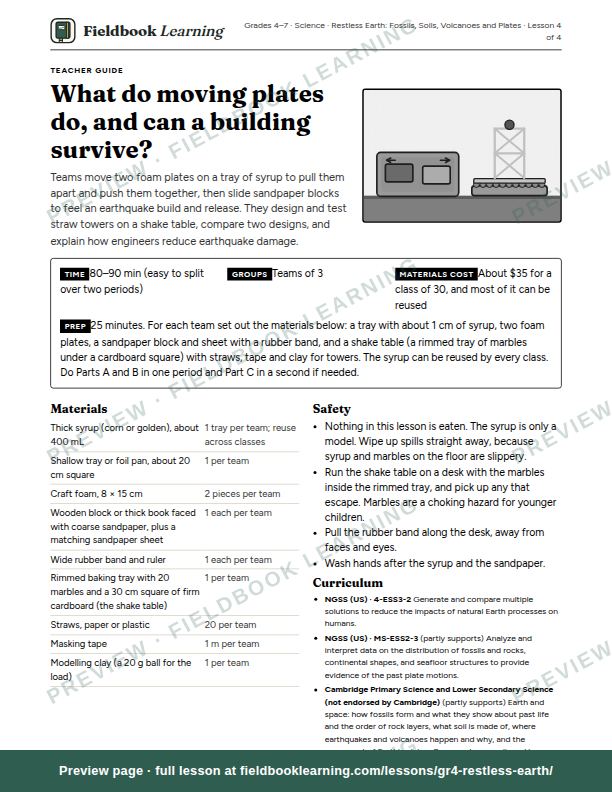
How long does “What do moving plates do, and can a building survive?” take?
80–90 min (easy to split over two periods). Group size: teams of 3.
How much prep does it need?
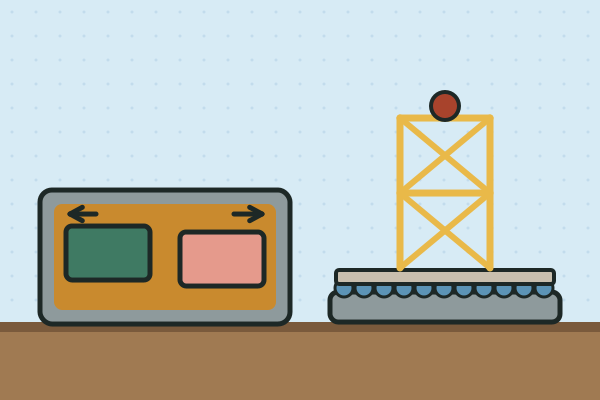
25 minutes. For each team set out the materials below: a tray with about 1 cm of syrup, two foam plates, a sandpaper block and sheet with a rubber band, and a shake table (a rimmed tray of marbles under a cardboard square) with straws, tape and clay for towers. The syrup can be reused by every class. Do Parts A and B in one period and Part C in a second if needed.
What materials do I need?
Thick syrup (corn or golden), about 400 mL; shallow tray or foil pan, about 20 cm square; craft foam, 8 × 15 cm; wooden block or thick book faced with coarse sandpaper, plus a matching sandpaper sheet; wide rubber band and ruler; rimmed baking tray with 20 marbles and a 30 cm square of firm cardboard (the shake table); and 3 more. Cost: about $35 for a class of 30, and most of it can be reused.
Which curriculum standards does it cover?
NGSS (US): 4-ESS3-2 and MS-ESS2-3 (partly). It also matches Cambridge Primary Science and Lower Secondary Science (not endorsed by Cambridge).
What’s in the lesson PDF?
A teacher guide that walks you through predict, hunt, reveal, act, background for the teacher and assessment, then a student sheet (“My prediction”, “Part A: the plates”, “Part B: the rubber band”, “Part C: the shake table”, “A note to the city council”, “Exit ticket”, “Label it” and “Try it at home”) on its own page, ready to photocopy. It’s US Letter and prints cleanly in black and white.
Can I try it for free?
Yes. A free account includes any 3 full lessons of your choice, and this can be one of them. After that, this unit is US$19 (C$25) for all 4 lessons, yours to keep, or every lesson is US$79 (C$109) a year.