 Preview · the opening mission
This lesson teaches science and English together (CLIL: content and language integrated learning). It is written for students learning English at about CEFR A2–B1.
| Students will… | |
|---|---|
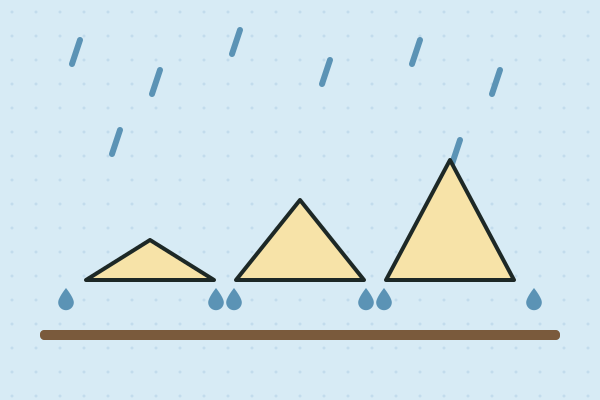
| Science | Test how the shape of a hat changes where rain goes and how much shade it gives, using a fair test, and choose the best design with evidence. |
| Language: words | Use the key words: rain, sun, shade, wet, dry, cone, steep, flat, wide, measure, compare. |
| Language: speaking | Predict with a reason: I think the ___ hat will keep the head driest because ___. Compare: The steep hat is drier than the flat hat. |
| Language: writing | Write a short recommendation using should and because, with a measurement. |
Before the lesson: teach the key words with the real objects: spray water (rain), shine the lamp (sun), point to the shadow (shade). Show a real nón lá or a photo. The Key words worksheet has English and Vietnamese, with a space to draw each word.
Look inside the PDF
Sample pages, stamped “preview”. The download is the clean, full lesson.
In the full lesson PDF
- Mission (5 min)
- Predict (5 min)
- Hunt (25 min)
- Reveal (10–15 min)
- Act (10 min)
- Background for the teacher
- Assessment
- Student sheet
- Worksheet: Key words
- Worksheet: Talk about it
- Worksheet: Label the hats
- Worksheet: Try it at home
On the student sheet
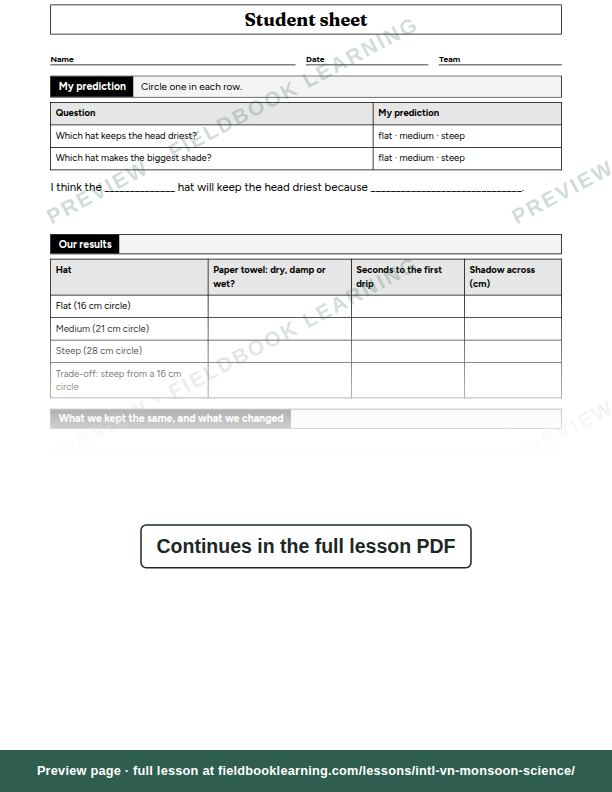
- My prediction
- Our results
- What we kept the same, and what we changed
- My recommendation to Minh's aunt
- Exit ticket
- Key words
- Talk about it
- Label the hats
- Try it at home
US Letter, prints cleanly in black and white. The student sheet is on its own page, ready to photocopy.
Free with an account (any 3 lessons), or US$19 / C$25 for all 1 lessons in this unit.
What students show by the end
- Runs a fair test
- Explains with shape
- Uses evidence to design
From the lesson’s rubric, which scores each one as not yet, getting there or got it.
Questions teachers ask
How long does “How does a nón lá keep a rice farmer dry?” take?
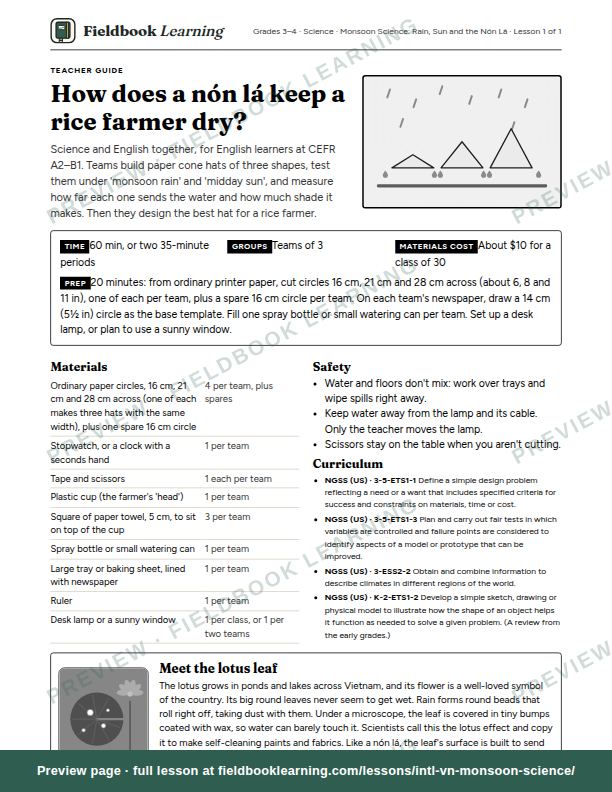
60 min, or two 35-minute periods. Group size: teams of 3.
How much prep does it need?
20 minutes: from ordinary printer paper, cut circles 16 cm, 21 cm and 28 cm across (about 6, 8 and 11 in), one of each per team, plus a spare 16 cm circle per team. On each team's newspaper, draw a 14 cm (5½ in) circle as the base template. Fill one spray bottle or small watering can per team. Set up a desk lamp, or plan to use a sunny window.
What materials do I need?
Ordinary paper circles, 16 cm, 21 cm and 28 cm across (one of each makes three hats with the same width), plus one spare 16 cm circle; stopwatch, or a clock with a seconds hand; tape and scissors; plastic cup (the farmer's 'head'); square of paper towel, 5 cm, to sit on top of the cup; spray bottle or small watering can; and 3 more. Cost: about $10 for a class of 30.
Which curriculum standards does it cover?
NGSS (US): 3-5-ETS1-1, 3-5-ETS1-3, 3-ESS2-2 and K-2-ETS1-2.
What’s in the lesson PDF?
A teacher guide that walks you through mission, predict, hunt, reveal, act, background for the teacher and assessment, then a student sheet (“My prediction”; “Our results”; “What we kept the same, and what we changed”; “My recommendation to Minh's aunt”; “Exit ticket”; “Key words”; “Talk about it”; “Label the hats” and “Try it at home”) on its own page, ready to photocopy. It’s US Letter and prints cleanly in black and white.
Can I try it for free?
Yes. A free account includes any 3 full lessons of your choice, and this can be one of them. After that, this unit is US$19 (C$25) for all 1 lessons, yours to keep, or every lesson is US$79 (C$109) a year.