 Preview · the opening mission
Read this to the class:
On a dark night a barn owl sits on a fence post above a field of long grass. Deep in the grass, a mouse scurries along a hidden path. The owl turns its head, listens, and drops straight onto it. It never saw the mouse at all. Your team's job: test an owl ear for yourself, then invent a sensor inspired by an animal.
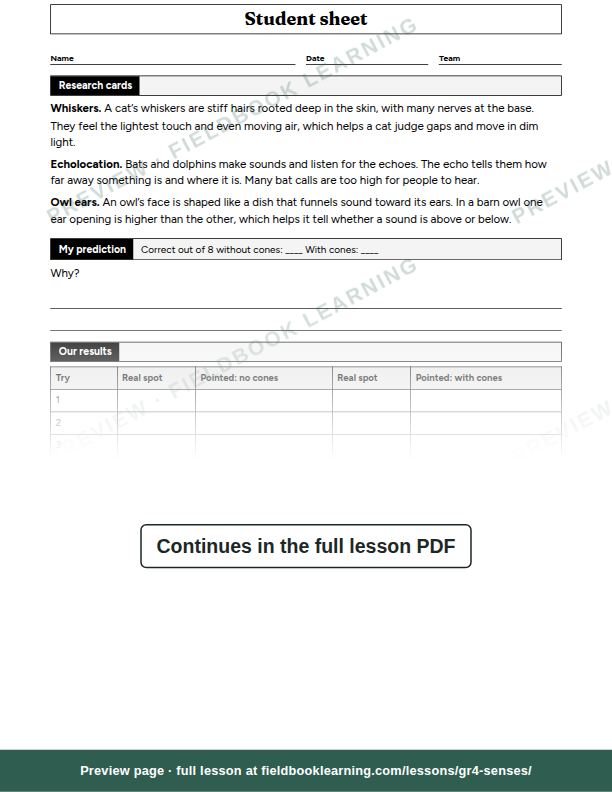
Teams of three, with three jobs that rotate: Listener (sits with eyes closed), Sound Maker (makes the soft sound), Recorder (marks where the sound was and where the Listener pointed).
Look inside the PDF
Sample pages, stamped “preview”. The download is the clean, full lesson.
In the full lesson PDF
- Predict (5–10 min)
- Hunt (20 min)
- Reveal (10–15 min)
- Act (10 min)
- Background for the teacher
- Assessment
- Student sheet
On the student sheet
- Research cards
- My prediction
- Our results
- Claim, evidence, reasoning
- Our invention
- Exit ticket
US Letter, prints cleanly in black and white. The student sheet is on its own page, ready to photocopy.
Free with an account (any 3 lessons), or US$19 / C$25 for all 4 lessons in this unit.
What students show by the end
- Fair test and CER
- Structure and function
- Defines a design problem
From the lesson’s rubric, which scores each one as not yet, getting there or got it.
Questions teachers ask
How long does “How do animals sense what we can't?” take?
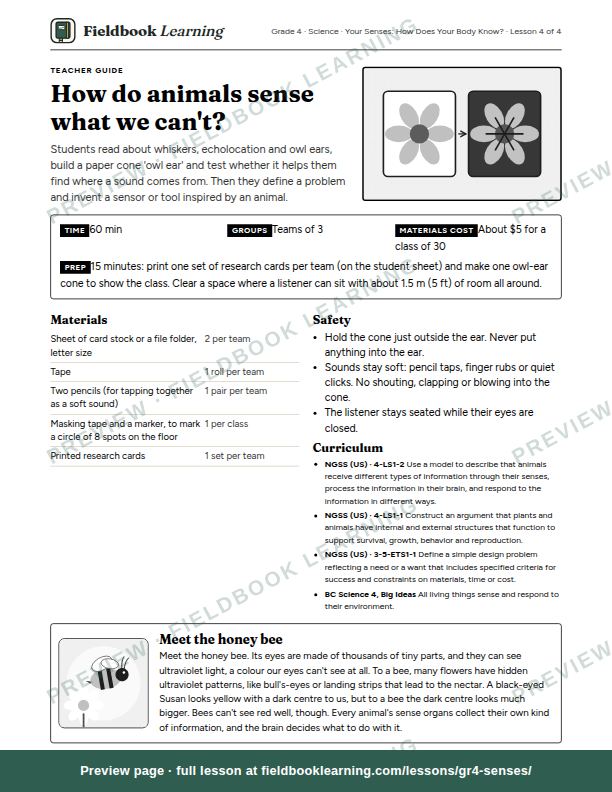
60 min. Group size: teams of 3.
How much prep does it need?
15 minutes: print one set of research cards per team (on the student sheet) and make one owl-ear cone to show the class. Clear a space where a listener can sit with about 1.5 m (5 ft) of room all around.
What materials do I need?
Sheet of card stock or a file folder, letter size; tape; two pencils (for tapping together as a soft sound); masking tape and a marker, to mark a circle of 8 spots on the floor; printed research cards. Cost: about $5 for a class of 30.
Which curriculum standards does it cover?
NGSS (US): 4-LS1-2, 4-LS1-1 and 3-5-ETS1-1. It also matches BC Science 4, Big Ideas.
What’s in the lesson PDF?
A teacher guide that walks you through predict, hunt, reveal, act, background for the teacher and assessment, then a student sheet (“Research cards”; “My prediction”; “Our results”; “Claim, evidence, reasoning”; “Our invention” and “Exit ticket”) on its own page, ready to photocopy. It’s US Letter and prints cleanly in black and white.
Can I try it for free?
Yes. A free account includes any 3 full lessons of your choice, and this can be one of them. After that, this unit is US$19 (C$25) for all 4 lessons, yours to keep, or every lesson is US$79 (C$109) a year.