 Preview · the opening mission
Read this to the class:
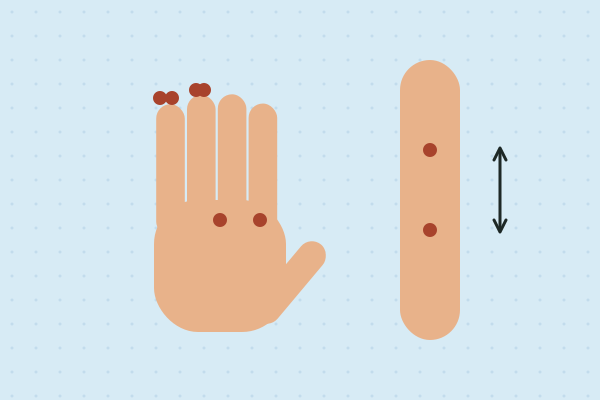
A girl is learning to read braille, the raised-dot writing many people who are blind read with their fingers. Each letter is a pattern of tiny bumps a few millimetres apart. Her little brother asks, "Why not read with your elbow? It's bigger." She laughs, then wonders: is the fingertip really better? Your team's job: find out which parts of your skin can feel the smallest details.
Teams of three, with three jobs that rotate: Tester (makes the touches), Feeler (closes their eyes and reports), Recorder (writes the results and keeps the order of touches).
Look inside the PDF
Sample pages, stamped “preview”. The download is the clean, full lesson.
In the full lesson PDF
- Predict (5–10 min)
- Hunt (20 min)
- Reveal (10–15 min)
- Act (10 min)
- Background for the teacher
- Assessment
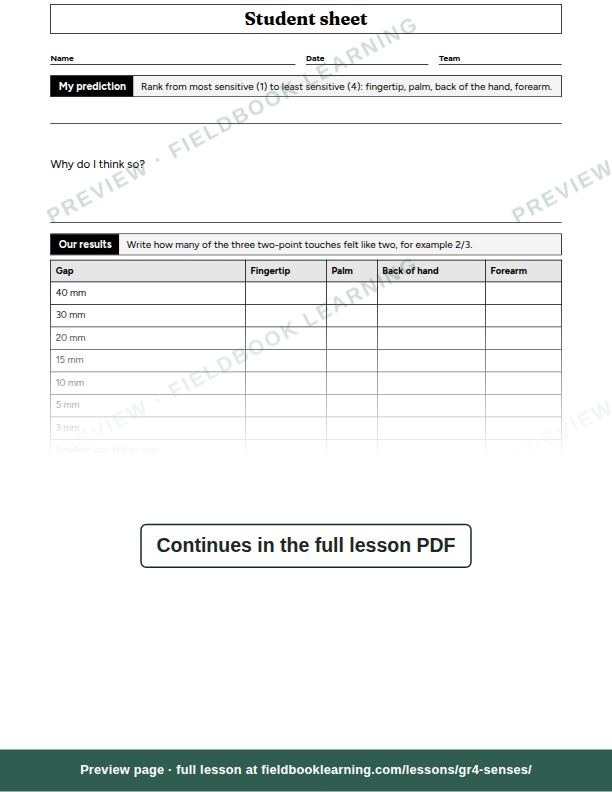
- Student sheet
On the student sheet
- My prediction
- Our results
- What we kept the same, and what we changed
- Claim, evidence, reasoning
- A note to the brother
- Exit ticket
US Letter, prints cleanly in black and white. The student sheet is on its own page, ready to photocopy.
Free with an account (any 3 lessons), or US$19 / C$25 for all 4 lessons in this unit.
What students show by the end
- Carries out a fair test
- Uses evidence
- Explains with receptors
From the lesson’s rubric, which scores each one as not yet, getting there or got it.
Questions teachers ask
How long does “Where is your skin most sensitive?” take?
45–60 min. Group size: teams of 3.
How much prep does it need?
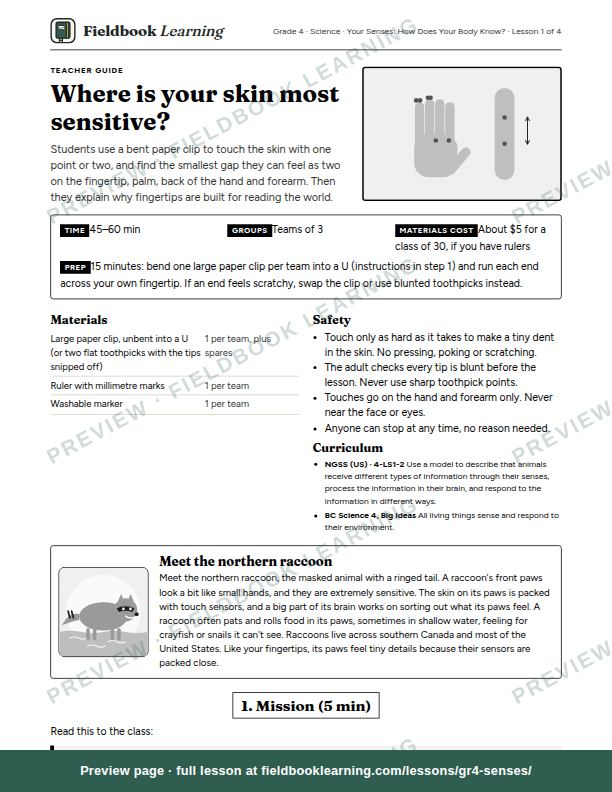
15 minutes: bend one large paper clip per team into a U (instructions in step 1) and run each end across your own fingertip. If an end feels scratchy, swap the clip or use blunted toothpicks instead.
What materials do I need?
Large paper clip, unbent into a U (or two flat toothpicks with the tips snipped off); ruler with millimetre marks; washable marker. Cost: about $5 for a class of 30, if you have rulers.
Which curriculum standards does it cover?
NGSS (US): 4-LS1-2. It also matches BC Science 4, Big Ideas.
What’s in the lesson PDF?
A teacher guide that walks you through predict, hunt, reveal, act, background for the teacher and assessment, then a student sheet (“My prediction”; “Our results”; “What we kept the same, and what we changed”; “Claim, evidence, reasoning”; “A note to the brother” and “Exit ticket”) on its own page, ready to photocopy. It’s US Letter and prints cleanly in black and white.
Can I try it for free?
Yes. A free account includes any 3 full lessons of your choice, and this can be one of them. After that, this unit is US$19 (C$25) for all 4 lessons, yours to keep, or every lesson is US$79 (C$109) a year.