 Preview · the opening mission
Read this to the class:
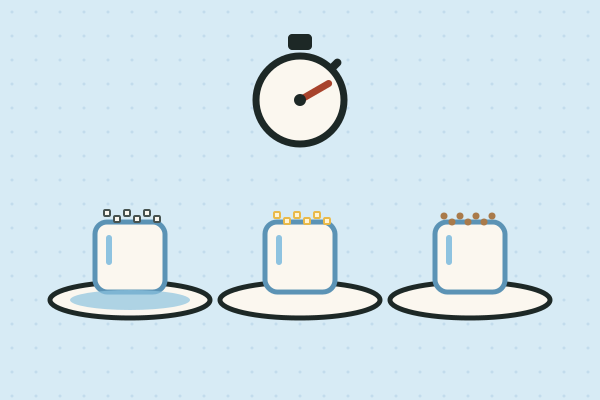
It snowed all night, and then the temperature dropped. By morning the sidewalk outside the school was a sheet of ice. The caretaker has a bag of salt, the kitchen has a bag of sugar, and the playground has a sandbox. A parent says, "Just use whatever's handy. It all works the same." Your team's job: find out which one really melts ice fastest.
Teams of three, with jobs that rotate each lesson: Lead (handles the ice and the spoon), Timer (watches the clock and calls the checks), Recorder (writes, draws and measures).
No snow where you are? You don't need any. Everything here runs on ice from a freezer. Tell the story as happening in a cold country, or start from a question closer to home: why do people making ice cream by hand pack salt around the ice? The road-crew task in Act still works, because salting roads is a real job wherever winters freeze.
Look inside the PDF
Sample pages, stamped “preview”. The download is the clean, full lesson.
In the full lesson PDF
- Predict (5–10 min)
- Hunt (20 min)
- Reveal (10–15 min)
- Act (10 min)
- Background for the teacher
- Assessment
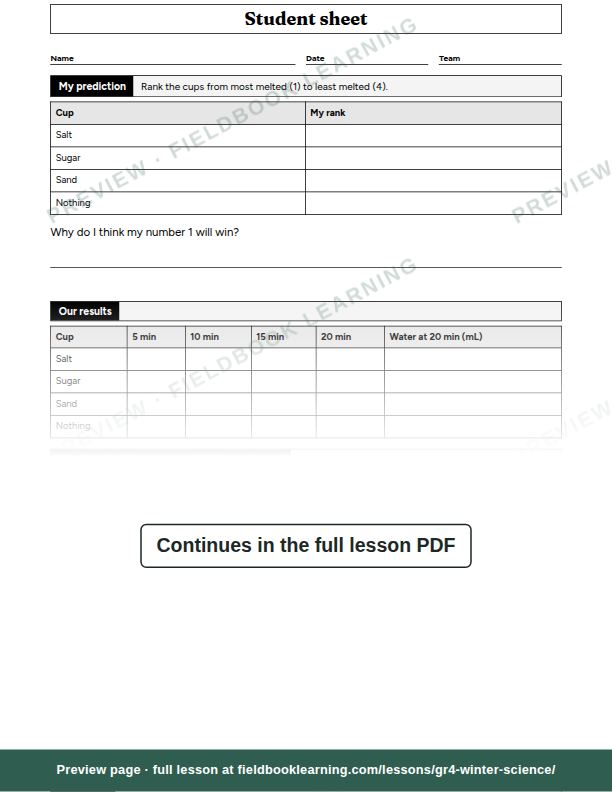
- Student sheet
On the student sheet
- My prediction
- Our results
- What we kept the same, and what we changed
- A note to the road crew
- Exit ticket
US Letter, prints cleanly in black and white. The student sheet is on its own page, ready to photocopy.
Free with an account (any 3 lessons), or US$19 / C$25 for all 4 lessons in this unit.
What students show by the end
- Plans a fair test
- Uses evidence
- Explains with science
From the lesson’s rubric, which scores each one as not yet, getting there or got it.
Questions teachers ask
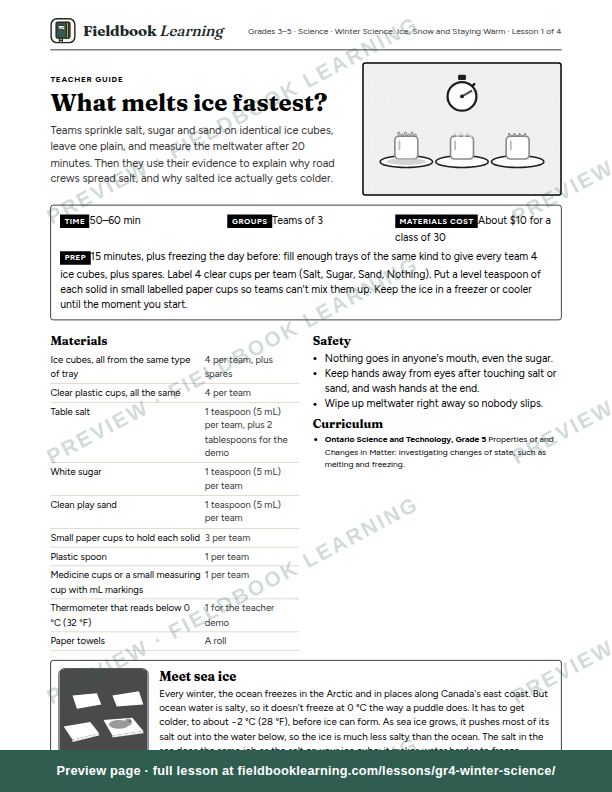
How long does “What melts ice fastest?” take?
50–60 min. Group size: teams of 3.
How much prep does it need?
15 minutes, plus freezing the day before: fill enough trays of the same kind to give every team 4 ice cubes, plus spares. Label 4 clear cups per team (Salt, Sugar, Sand, Nothing). Put a level teaspoon of each solid in small labelled paper cups so teams can't mix them up. Keep the ice in a freezer or cooler until the moment you start.
What materials do I need?
Ice cubes, all from the same type of tray; clear plastic cups, all the same; table salt; white sugar; clean play sand; small paper cups to hold each solid; and 4 more. Cost: about $10 for a class of 30.
Which curriculum standards does it cover?
It matches Ontario Science and Technology, Grade 5.
What’s in the lesson PDF?
A teacher guide that walks you through predict, hunt, reveal, act, background for the teacher and assessment, then a student sheet (“My prediction”; “Our results”; “What we kept the same, and what we changed”; “A note to the road crew” and “Exit ticket”) on its own page, ready to photocopy. It’s US Letter and prints cleanly in black and white.
Can I try it for free?
Yes. A free account includes any 3 full lessons of your choice, and this can be one of them. After that, this unit is US$19 (C$25) for all 4 lessons, yours to keep, or every lesson is US$79 (C$109) a year.