 Preview · the opening mission
Read this to the class:
In the middle of winter, a harp seal slides off the ice into water that is colder than the inside of a fridge. She swims for half an hour, climbs out, and lies on the ice in the wind. A person in that water would be in danger in minutes. On the other side of the world, in Antarctica, a crowd of emperor penguins stands pressed together in a blizzard. Your team's job: find out how animals stay warm where we couldn't.
Teams of three, with rotating jobs: Lead (handles the glove or the cups), Timer (counts the seconds and minutes), Recorder (writes and draws).
No snow where you are? The ice-water tubs need only ice from a freezer or a bag of ice from a shop. The same ideas explain animals in hot places too: the thick wool on a camel's back slows the desert sun's heat getting in, and a fennec fox's huge ears let extra heat out.
Look inside the PDF
Sample pages, stamped “preview”. The download is the clean, full lesson.
In the full lesson PDF
- Predict (5–10 min)
- Hunt (20 min)
- Reveal (10–15 min)
- Act (10 min)
- Background for the teacher
- Assessment
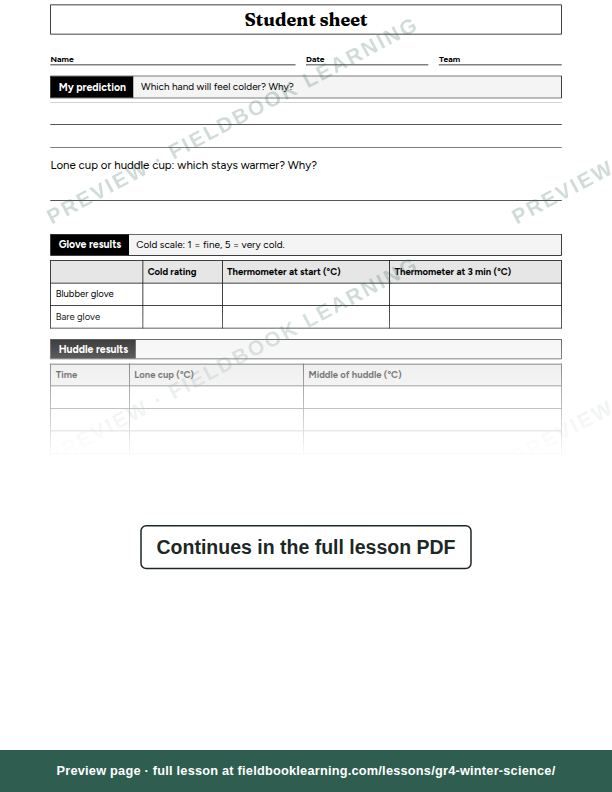
- Student sheet
On the student sheet
- My prediction
- Glove results
- Huddle results
- My winter animal
- Exit ticket
US Letter, prints cleanly in black and white. The student sheet is on its own page, ready to photocopy.
Free with an account (any 3 lessons), or US$19 / C$25 for all 4 lessons in this unit.
What students show by the end
- Describes results
- Explains insulation
- Argues with evidence
From the lesson’s rubric, which scores each one as not yet, getting there or got it.
Questions teachers ask
How long does “How do animals stay warm in winter?” take?
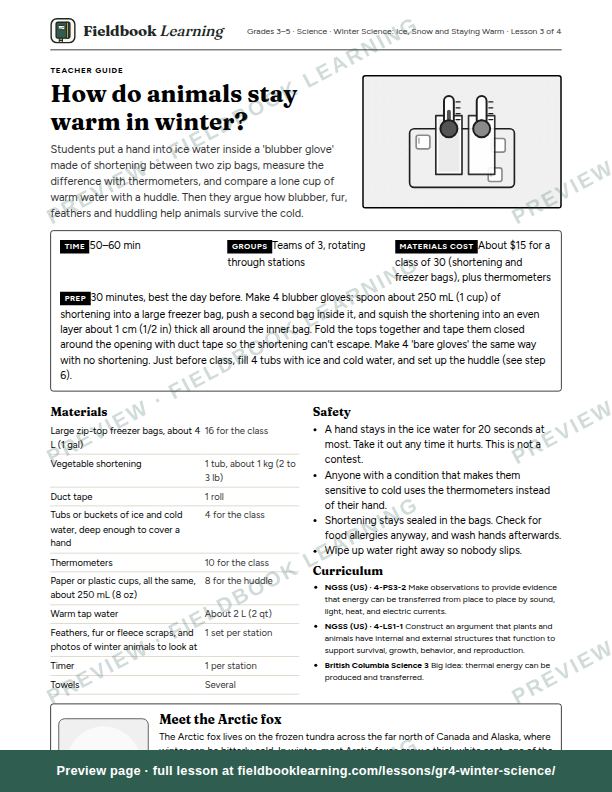
50–60 min. Group size: teams of 3, rotating through stations.
How much prep does it need?
30 minutes, best the day before. Make 4 blubber gloves: spoon about 250 mL (1 cup) of shortening into a large freezer bag, push a second bag inside it, and squish the shortening into an even layer about 1 cm (1/2 in) thick all around the inner bag. Fold the tops together and tape them closed around the opening with duct tape so the shortening can't escape. Make 4 'bare gloves' the same way with no shortening. Just before class, fill 4 tubs with ice and cold water, and set up the huddle (see step 6).
What materials do I need?
Large zip-top freezer bags, about 4 L (1 gal); vegetable shortening; duct tape; tubs or buckets of ice and cold water, deep enough to cover a hand; thermometers; paper or plastic cups, all the same, about 250 mL (8 oz); and 4 more. Cost: about $15 for a class of 30 (shortening and freezer bags), plus thermometers.
Which curriculum standards does it cover?
NGSS (US): 4-PS3-2 and 4-LS1-1. It also matches British Columbia Science 3.
What’s in the lesson PDF?
A teacher guide that walks you through predict, hunt, reveal, act, background for the teacher and assessment, then a student sheet (“My prediction”, “Glove results”, “Huddle results”, “My winter animal” and “Exit ticket”) on its own page, ready to photocopy. It’s US Letter and prints cleanly in black and white.
Can I try it for free?
Yes. A free account includes any 3 full lessons of your choice, and this can be one of them. After that, this unit is US$19 (C$25) for all 4 lessons, yours to keep, or every lesson is US$79 (C$109) a year.