 Preview · the opening mission
Read this to the class:
On a cold January night, a small brown vole is nowhere to be seen. The air above the field is −20 °C (−4 °F). Snow covers everything. A grouse flies down and dives straight into a snowbank. A child watching from the window asks, "Won't they freeze in there? Snow is cold!" Your team's job: find out whether snow makes things colder or keeps them warmer.
Teams of three, with rotating jobs: Lead (handles the jars and the den), Timer (watches the clock), Recorder (writes and draws).
Look inside the PDF
Sample pages, stamped “preview”. The download is the clean, full lesson.
In the full lesson PDF
- Predict (5–10 min)
- Hunt (20 min)
- Reveal (10–15 min)
- Act (10 min)
- Background for the teacher
- Assessment
- Student sheet
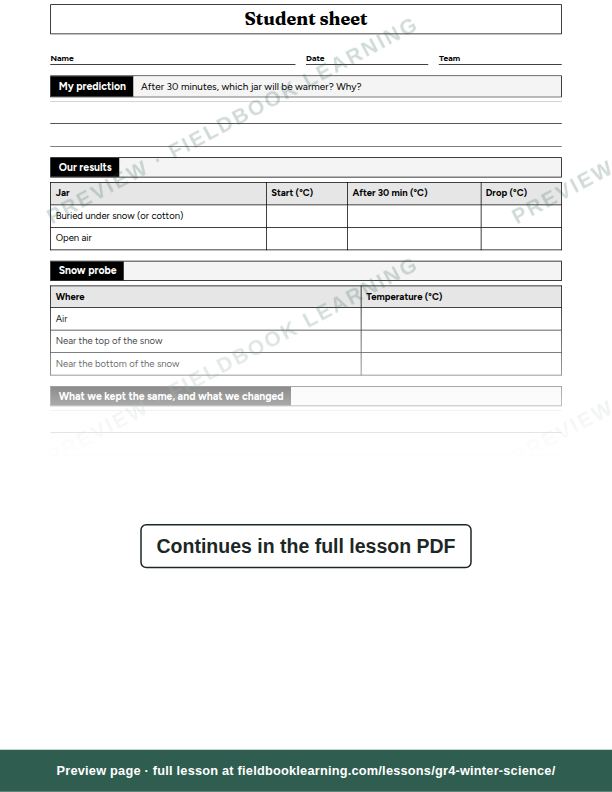
On the student sheet
- My prediction
- Our results
- Snow probe
- What we kept the same, and what we changed
- An answer for the child at the window
- Cutaway of a snowy field
- Exit ticket
US Letter, prints cleanly in black and white. The student sheet is on its own page, ready to photocopy.
Free with an account (any 3 lessons), or US$19 / C$25 for all 4 lessons in this unit.
What students show by the end
- Collects data
- Uses evidence
- Explains insulation
From the lesson’s rubric, which scores each one as not yet, getting there or got it.
Questions teachers ask
How long does “Can snow keep things warm?” take?
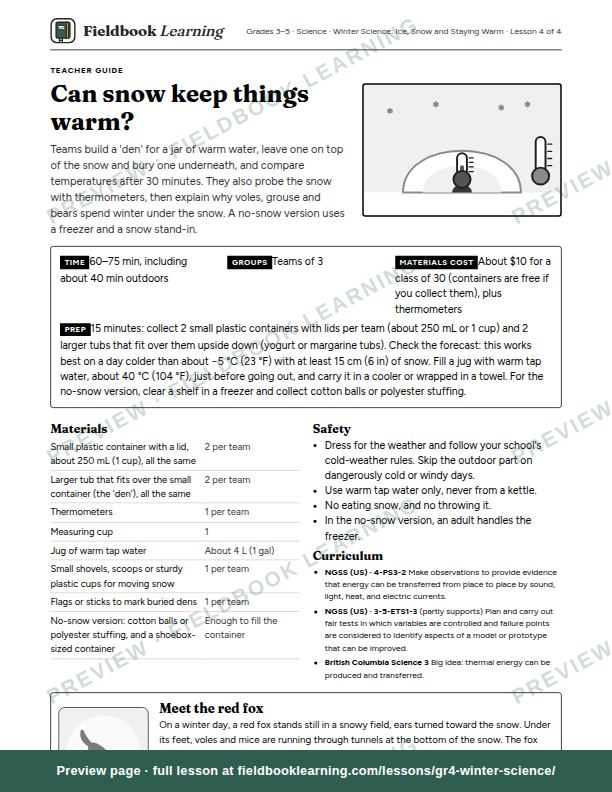
60–75 min, including about 40 min outdoors. Group size: teams of 3.
How much prep does it need?
15 minutes: collect 2 small plastic containers with lids per team (about 250 mL or 1 cup) and 2 larger tubs that fit over them upside down (yogurt or margarine tubs). Check the forecast: this works best on a day colder than about −5 °C (23 °F) with at least 15 cm (6 in) of snow. Fill a jug with warm tap water, about 40 °C (104 °F), just before going out, and carry it in a cooler or wrapped in a towel. For the no-snow version, clear a shelf in a freezer and collect cotton balls or polyester stuffing.
What materials do I need?
Small plastic container with a lid, about 250 mL (1 cup), all the same; larger tub that fits over the small container (the 'den'), all the same; thermometers; measuring cup; jug of warm tap water; small shovels, scoops or sturdy plastic cups for moving snow; and 2 more. Cost: about $10 for a class of 30 (containers are free if you collect them), plus thermometers.
Which curriculum standards does it cover?
NGSS (US): 4-PS3-2 and 3-5-ETS1-3 (partly). It also matches British Columbia Science 3.
What’s in the lesson PDF?
A teacher guide that walks you through predict, hunt, reveal, act, background for the teacher and assessment, then a student sheet (“My prediction”; “Our results”; “Snow probe”; “What we kept the same, and what we changed”; “An answer for the child at the window”; “Cutaway of a snowy field” and “Exit ticket”) on its own page, ready to photocopy. It’s US Letter and prints cleanly in black and white.
Can I try it for free?
Yes. A free account includes any 3 full lessons of your choice, and this can be one of them. After that, this unit is US$19 (C$25) for all 4 lessons, yours to keep, or every lesson is US$79 (C$109) a year.