 Preview · the opening mission
Read this to the class:
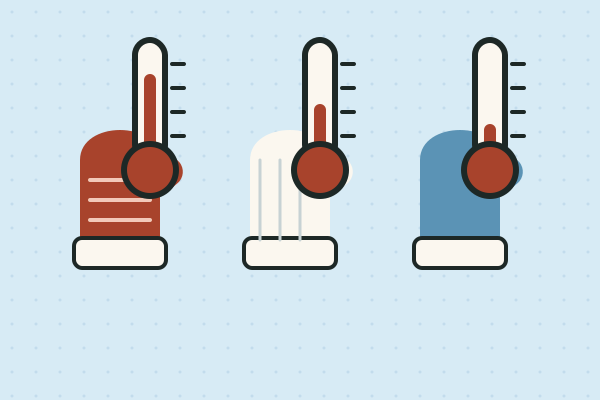
At recess, a Grade 4 student came in with red, stinging fingers. "My mittens are useless," he said. His friend had fuzzy wool mittens, someone else had thin cotton gloves, and one kid said runners get wrapped in shiny silver blankets after a race, so foil must be the warmest of all. Your team's job: test which material keeps a "hand" warmest.
Teams of three, with rotating jobs: Lead (wraps the jar and reads the thermometer), Timer (calls out every 5 minutes), Recorder (writes the readings).
No snow where you are? Nothing here needs cold weather. If mittens mean little to your class, ask the question the other way round too: which wrap would keep an ice pop frozen longest on a hot day? A good wrap slows heat moving in either direction, out of a warm hand or into a cold treat.
Look inside the PDF
Sample pages, stamped “preview”. The download is the clean, full lesson.
In the full lesson PDF
- Predict (5–10 min)
- Hunt (20 min)
- Reveal (10–15 min)
- Act (10 min)
- Background for the teacher
- Assessment
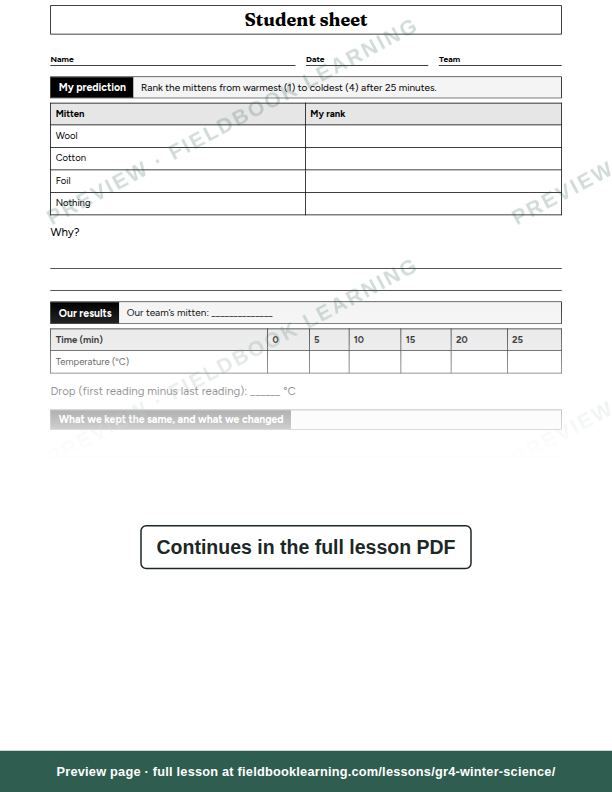
- Student sheet
On the student sheet
- My prediction
- Our results
- What we kept the same, and what we changed
- Advice for cold fingers
- Our better mitten
- Exit ticket
US Letter, prints cleanly in black and white. The student sheet is on its own page, ready to photocopy.
Free with an account (any 3 lessons), or US$19 / C$25 for all 4 lessons in this unit.
What students show by the end
- Collects data carefully
- Uses evidence
- Explains insulation
From the lesson’s rubric, which scores each one as not yet, getting there or got it.
Questions teachers ask
How long does “Which mitten keeps a hand warmest?” take?
50–60 min. Group size: teams of 3.
How much prep does it need?
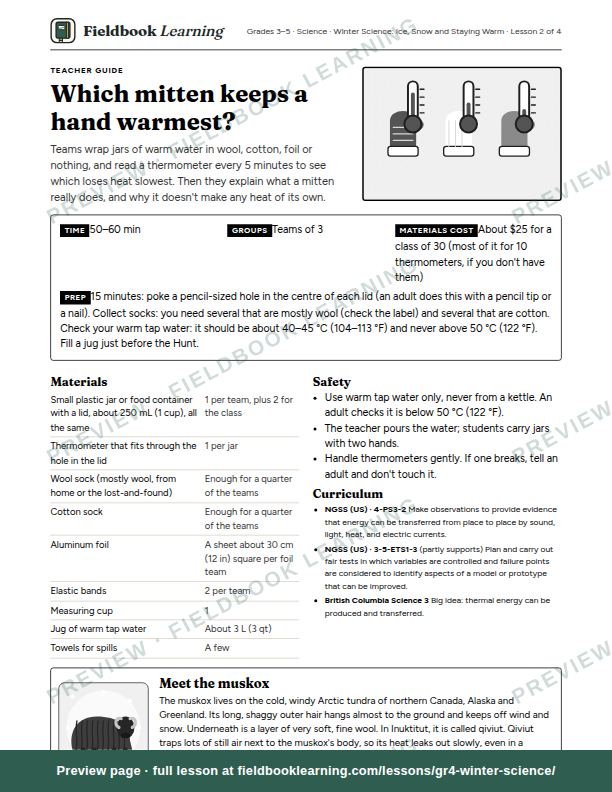
15 minutes: poke a pencil-sized hole in the centre of each lid (an adult does this with a pencil tip or a nail). Collect socks: you need several that are mostly wool (check the label) and several that are cotton. Check your warm tap water: it should be about 40–45 °C (104–113 °F) and never above 50 °C (122 °F). Fill a jug just before the Hunt.
What materials do I need?
Small plastic jar or food container with a lid, about 250 mL (1 cup), all the same; thermometer that fits through the hole in the lid; wool sock (mostly wool, from home or the lost-and-found); cotton sock; aluminum foil; elastic bands; and 3 more. Cost: about $25 for a class of 30 (most of it for 10 thermometers, if you don't have them).
Which curriculum standards does it cover?
NGSS (US): 4-PS3-2 and 3-5-ETS1-3 (partly). It also matches British Columbia Science 3.
What’s in the lesson PDF?
A teacher guide that walks you through predict, hunt, reveal, act, background for the teacher and assessment, then a student sheet (“My prediction”; “Our results”; “What we kept the same, and what we changed”; “Advice for cold fingers”; “Our better mitten” and “Exit ticket”) on its own page, ready to photocopy. It’s US Letter and prints cleanly in black and white.
Can I try it for free?
Yes. A free account includes any 3 full lessons of your choice, and this can be one of them. After that, this unit is US$19 (C$25) for all 4 lessons, yours to keep, or every lesson is US$79 (C$109) a year.