 Preview · the opening mission
Read this to the class:
An elephant is more than 100 times heavier than you. Its cells are about the same size as yours. It just has far more of them. A whale, a mouse and a maple tree are the same: more cells, not bigger ones. Your team's job: find out why living things don't just grow one giant cell.
Teams of three, with rotating jobs: Cutter (lifts and cuts the cubes), Measurer (uses the ruler), Recorder (writes and calculates).
Look inside the PDF
Sample pages, stamped “preview”. The download is the clean, full lesson.
In the full lesson PDF
- Predict (5–10 min)
- Hunt (20 min)
- Reveal (10–15 min)
- Act (10 min)
- Background for the teacher
- Assessment
- Student sheet
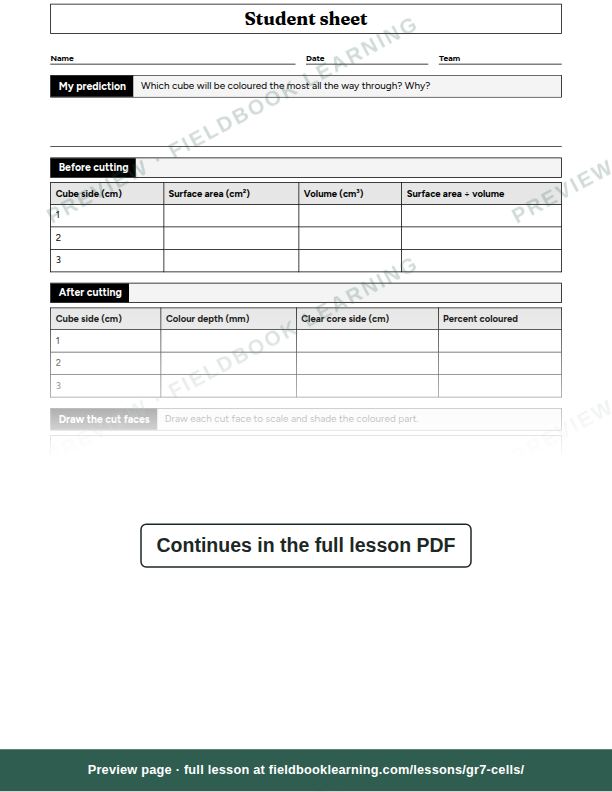
On the student sheet
- My prediction
- Before cutting
- After cutting
- Draw the cut faces
- Design note: one cell or many?
- Exit ticket
US Letter, prints cleanly in black and white. The student sheet is on its own page, ready to photocopy.
Free with an account (any 3 lessons), or US$19 / C$25 for all 4 lessons in this unit.
What students show by the end
- Measures and calculates
- Explains the pattern
- Applies it with CER
From the lesson’s rubric, which scores each one as not yet, getting there or got it.
Questions teachers ask
How long does “Why are you made of many small cells, not one big one?” take?
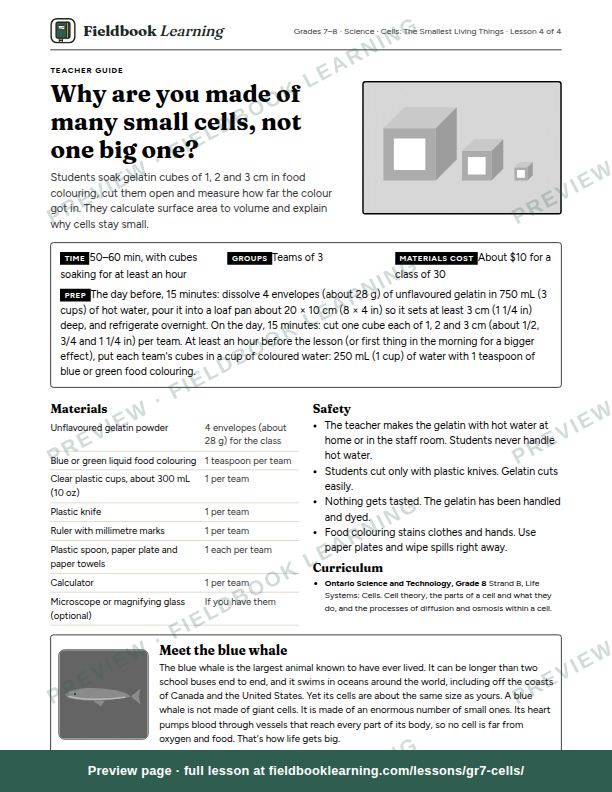
50–60 min, with cubes soaking for at least an hour. Group size: teams of 3.
How much prep does it need?
The day before, 15 minutes: dissolve 4 envelopes (about 28 g) of unflavoured gelatin in 750 mL (3 cups) of hot water, pour it into a loaf pan about 20 × 10 cm (8 × 4 in) so it sets at least 3 cm (1 1/4 in) deep, and refrigerate overnight. On the day, 15 minutes: cut one cube each of 1, 2 and 3 cm (about 1/2, 3/4 and 1 1/4 in) per team. At least an hour before the lesson (or first thing in the morning for a bigger effect), put each team's cubes in a cup of coloured water: 250 mL (1 cup) of water with 1 teaspoon of blue or green food colouring.
What materials do I need?
Unflavoured gelatin powder; blue or green liquid food colouring; clear plastic cups, about 300 mL (10 oz); plastic knife; ruler with millimetre marks; plastic spoon, paper plate and paper towels; and 2 more. Cost: about $10 for a class of 30.
Which curriculum standards does it cover?
It matches Ontario Science and Technology, Grade 8.
What’s in the lesson PDF?
A teacher guide that walks you through predict, hunt, reveal, act, background for the teacher and assessment, then a student sheet (“My prediction”, “Before cutting”, “After cutting”, “Draw the cut faces”, “Design note: one cell or many?” and “Exit ticket”) on its own page, ready to photocopy. It’s US Letter and prints cleanly in black and white.
Can I try it for free?
Yes. A free account includes any 3 full lessons of your choice, and this can be one of them. After that, this unit is US$19 (C$25) for all 4 lessons, yours to keep, or every lesson is US$79 (C$109) a year.