 Preview · the opening mission
Read this to the class:
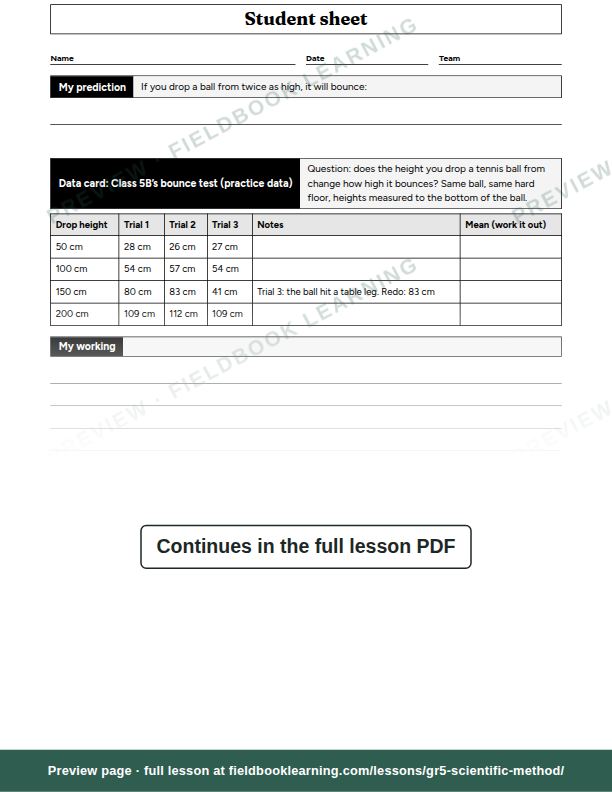
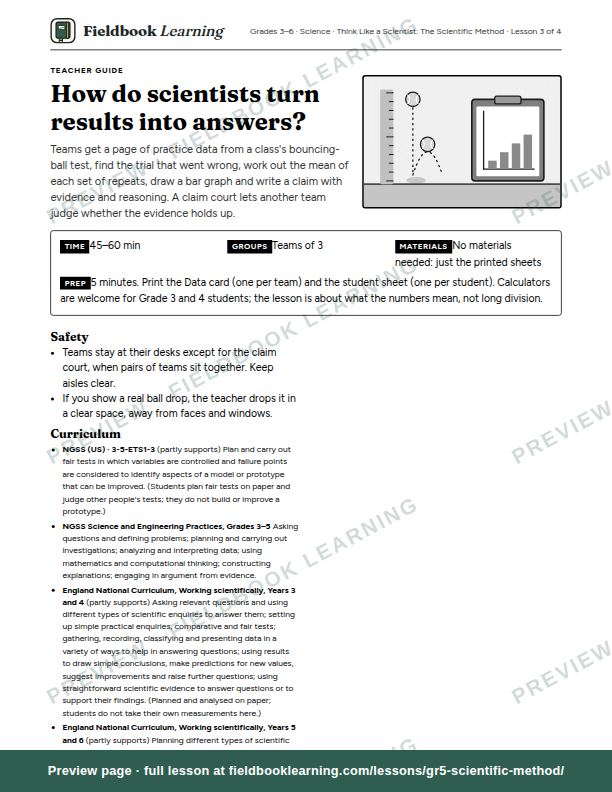
Class 5B planned a fair test, just like the one you planned last lesson: does the height you drop a tennis ball from change how high it bounces? They dropped the same ball onto the same hard floor from four heights, three times each, and wrote down every bounce. Then they got stuck. "We have twelve numbers," said Amira. "Which one is the answer?" Your team's job: turn Class 5B's twelve numbers into one clear answer, and convince another team it's right.
Teams of three, with three rotating jobs: Calculator (does the sums), Grapher (draws the bars), Lawyer (presents the team's claim in the claim court).
Look inside the PDF
Sample pages, stamped “preview”. The download is the clean, full lesson.
In the full lesson PDF
8 printable pages
- Predict (5–10 min)
- Hunt (20 min)
- Reveal (10–15 min)
- Act (10 min)
- Background for the teacher
- Assessment
- Student sheet
- Worksheet: Label it
- Worksheet: Try it at home
On the student sheet
- My prediction
- Data card: Class 5B's bounce test (practice data)
- My working
- Bar graph
- Claim, evidence, reasoning
- Claim court checklist (for the judging team)
- Exit ticket
- Label it
- Try it at home
US Letter, prints cleanly in black and white. The student sheet is on its own page, ready to photocopy.
Free with an account (any 3 lessons), or US$19 for all 4 lessons in this unit.
What students show by the end
- Handles the data
- Graphs it
- Argues from evidence
From the lesson’s rubric, which scores each one as not yet, getting there or got it.
Questions teachers ask
How long does “How do scientists turn results into answers?” take?
45–60 min. Group size: teams of 3.
How much prep does it need?
5 minutes. Print the Data card (one per team) and the student sheet (one per student). Calculators are welcome for Grade 3 and 4 students; the lesson is about what the numbers mean, not long division.
What materials do I need?
None. No materials needed: just the printed sheets.
Which curriculum standards does it cover?
NGSS (US): 3-5-ETS1-3 (partly). It also matches NGSS Science and Engineering Practices, Grades 3–5; England National Curriculum, Working scientifically, Years 3 and 4; England National Curriculum, Working scientifically, Years 5 and 6 and Cambridge Primary Science (not endorsed by Cambridge).
What’s in the lesson PDF?
A teacher guide that walks you through predict, hunt, reveal, act, background for the teacher and assessment, then a student sheet (“My prediction”; “Data card: Class 5B's bounce test (practice data)”; “My working”; “Bar graph”; “Claim, evidence, reasoning”; “Claim court checklist (for the judging team)”; “Exit ticket”; “Label it” and “Try it at home”) on its own page, ready to photocopy. It’s US Letter and prints cleanly in black and white.
Can I try it for free?
Yes. A free account includes any 3 full lessons of your choice, and this can be one of them. After that, this unit is US$19 for all 4 lessons, yours to keep, or every lesson is US$199 a year.