 Preview · the opening mission
Read this to the class:
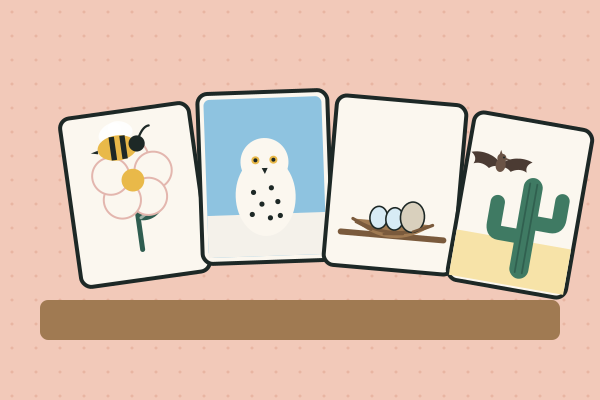
A nature film crew has filmed sixteen pairs of living things on four continents and three oceans. The editor wants to group the clips into five episodes, one for each way that living things affect each other. "Is the cuckoo a predator or something else? Are the lion and the hyena enemies or rivals?" Your team's job: sort every pair, and find out whether some kinds of relationship happen only in some places.
Teams of three, with jobs that rotate after every four cards: Reader (reads the card aloud), Sorter (places it), Checker (asks "who gains, who loses?").
Look inside the PDF
Sample pages, stamped “preview”. The download is the clean, full lesson.
In the full lesson PDF
8 printable pages
- Predict (5 min)
- Hunt (25 min)
- Reveal (10–15 min)
- Act (10 min)
- Background for the teacher
- Assessment
- Student sheet
- Worksheet: Interaction cards
- Worksheet: Label it
- Worksheet: Try it at home
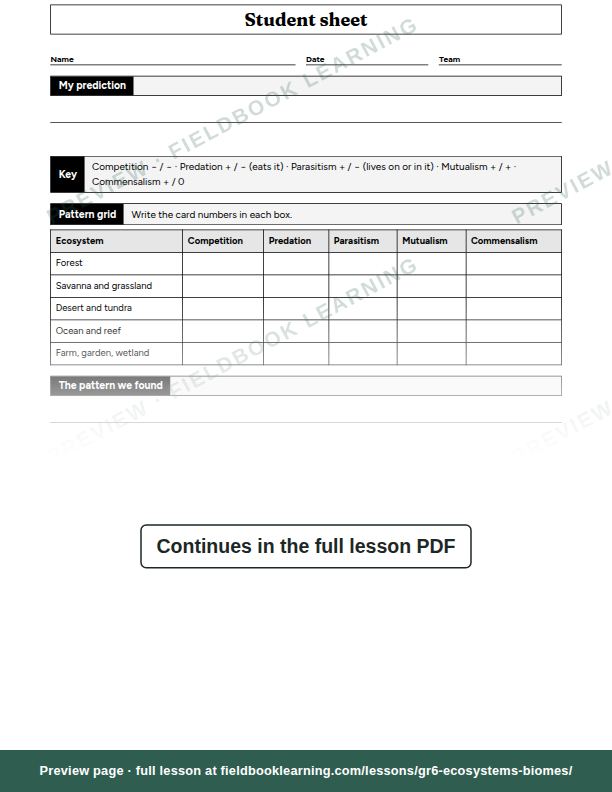
On the student sheet
- My prediction
- Key
- Pattern grid
- The pattern we found
- Prediction for a deep-sea vent
- Interaction cards
- Label it
- Try it at home
US Letter, prints cleanly in black and white. The student sheet is on its own page, ready to photocopy.
Free with an account (any 3 lessons), or US$19 for all 4 lessons in this unit.
What students show by the end
- Classifies interactions
- Finds the pattern
- Predicts
From the lesson’s rubric, which scores each one as not yet, getting there or got it.
Questions teachers ask
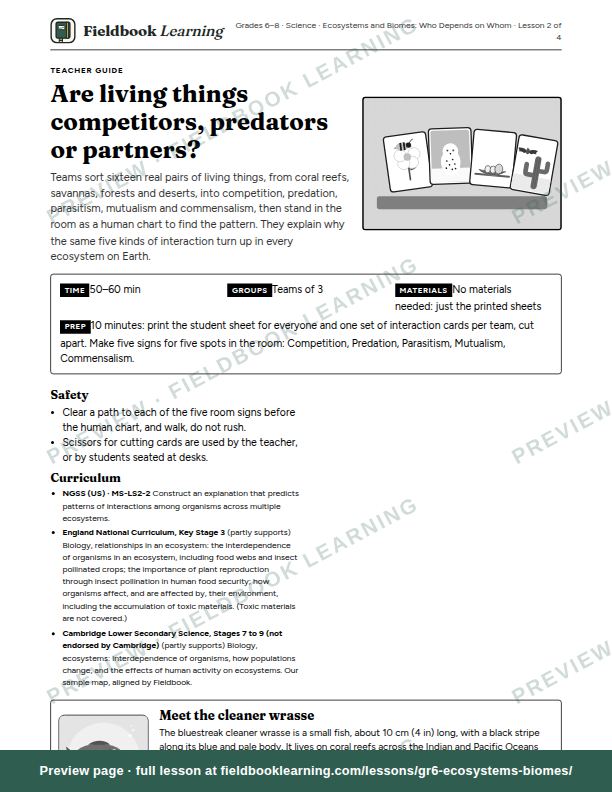
How long does “Are living things competitors, predators or partners?” take?
50–60 min. Group size: teams of 3.
How much prep does it need?
10 minutes: print the student sheet for everyone and one set of interaction cards per team, cut apart. Make five signs for five spots in the room: Competition, Predation, Parasitism, Mutualism, Commensalism.
What materials do I need?
None. No materials needed: just the printed sheets.
Which curriculum standards does it cover?
NGSS (US): MS-LS2-2. It also matches England National Curriculum, Key Stage 3 and Cambridge Lower Secondary Science, Stages 7 to 9 (not endorsed by Cambridge).
What’s in the lesson PDF?
A teacher guide that walks you through predict, hunt, reveal, act, background for the teacher and assessment, then a student sheet (“My prediction”, “Key”, “Pattern grid”, “The pattern we found”, “Prediction for a deep-sea vent”, “Interaction cards”, “Label it” and “Try it at home”) on its own page, ready to photocopy. It’s US Letter and prints cleanly in black and white.
Can I try it for free?
Yes. A free account includes any 3 full lessons of your choice, and this can be one of them. After that, this unit is US$19 for all 4 lessons, yours to keep, or every lesson is US$199 a year.