 Preview · the opening mission
Read this to the class:
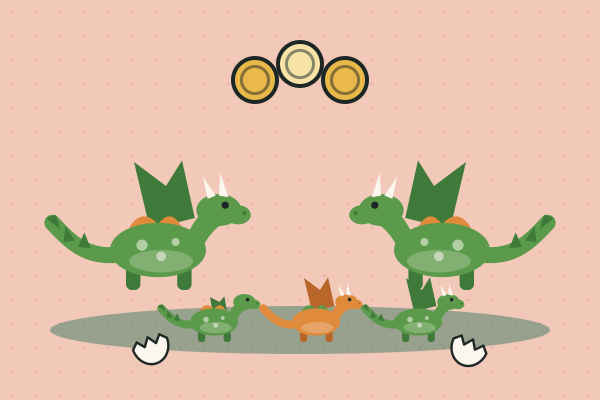
Two green dragons, each with horns, spikes and spots, have a clutch of eggs. When the eggs hatch, the keepers get a surprise. One baby has no horns. One is orange. No two babies look quite the same, and none is an exact copy of either parent. Then one of the parents does something odd: it grows a bud, and the bud becomes a baby that is identical to it. Your team's job: find out why the hatchlings are all different, but the bud is a perfect copy.
Teams of three, with jobs that rotate after each baby: Flipper (flips the coin cards), Recorder (writes the letters), Artist (draws the baby from the trait key).
Look inside the PDF
Sample pages, stamped “preview”. The download is the clean, full lesson.
In the full lesson PDF
9 printable pages
- Predict (5–10 min)
- Hunt (20 min)
- Reveal (10–15 min)
- Act (10 min)
- Background for the teacher
- Assessment
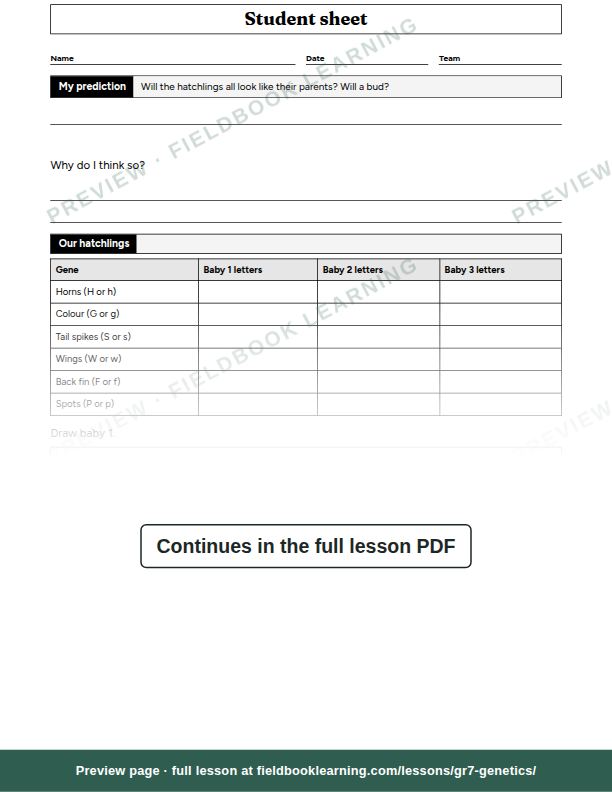
- Student sheet
- Worksheet: Dragon coin cards
- Worksheet: Label it
- Worksheet: Try it at home
On the student sheet
- My prediction
- Our hatchlings
- Our buds
- Answer to the dragon keepers
- Exit ticket
- Dragon coin cards
- Label it
- Try it at home
US Letter, prints cleanly in black and white. The student sheet is on its own page, ready to photocopy.
Free with an account (any 3 lessons), or US$19 for all 4 lessons in this unit.
What students show by the end
- Uses gene words
- Explains variation
- Compares reproduction
From the lesson’s rubric, which scores each one as not yet, getting there or got it.
Questions teachers ask
How long does “Why do you look like your family, but not exactly?” take?
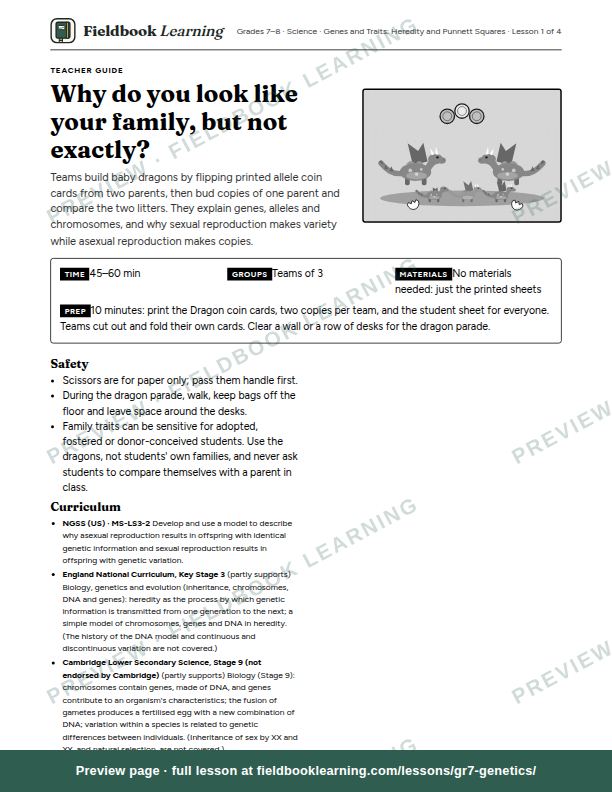
45–60 min. Group size: teams of 3.
How much prep does it need?
10 minutes: print the Dragon coin cards, two copies per team, and the student sheet for everyone. Teams cut out and fold their own cards. Clear a wall or a row of desks for the dragon parade.
What materials do I need?
None. No materials needed: just the printed sheets.
Which curriculum standards does it cover?
NGSS (US): MS-LS3-2. It also matches England National Curriculum, Key Stage 3 and Cambridge Lower Secondary Science, Stage 9 (not endorsed by Cambridge).
What’s in the lesson PDF?
A teacher guide that walks you through predict, hunt, reveal, act, background for the teacher and assessment, then a student sheet (“My prediction”, “Our hatchlings”, “Our buds”, “Answer to the dragon keepers”, “Exit ticket”, “Dragon coin cards”, “Label it” and “Try it at home”) on its own page, ready to photocopy. It’s US Letter and prints cleanly in black and white.
Can I try it for free?
Yes. A free account includes any 3 full lessons of your choice, and this can be one of them. After that, this unit is US$19 for all 4 lessons, yours to keep, or every lesson is US$199 a year.