 Preview · the opening mission
Read this to the class:
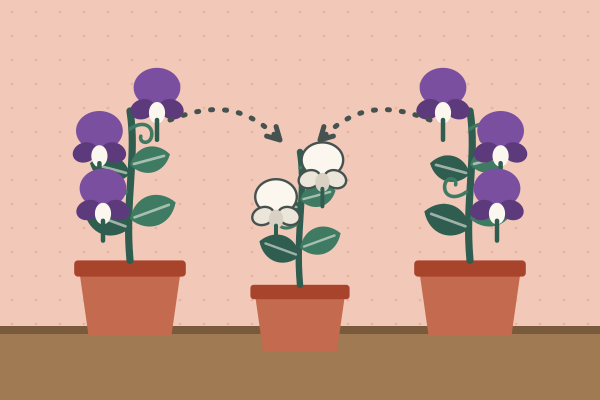
In the 1850s, in a monastery garden in Brno, Gregor Mendel crossed pea plants with purple flowers and plants with white flowers. Every one of the offspring had purple flowers. The white seemed to have vanished. But when he let those purple-flowered offspring fertilise themselves, white flowers came back in the next generation, about one plant in four. Your team's job: find out where the white was hiding, and predict what any cross of pea plants will give.
Teams of three, with three jobs that rotate after each cross: Plant 1 and Plant 2 (hold the allele slips) and Recorder (writes each offspring).
Look inside the PDF
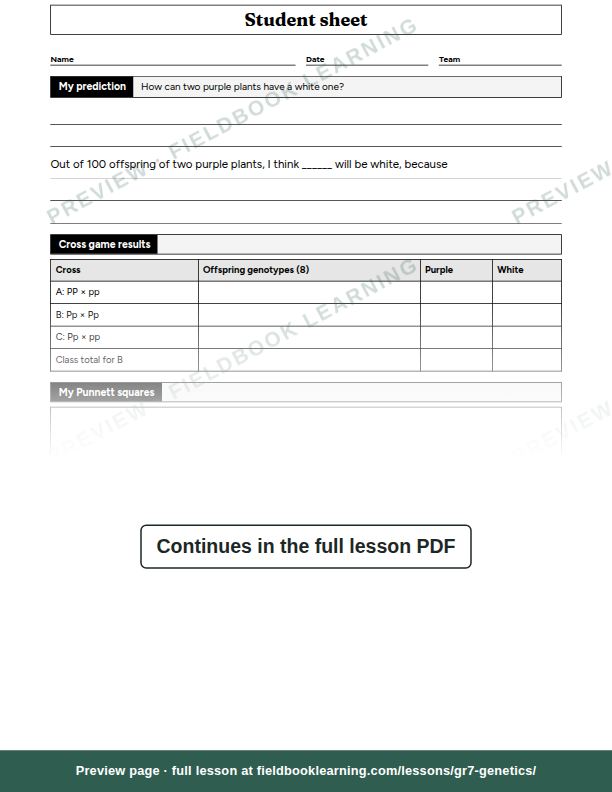
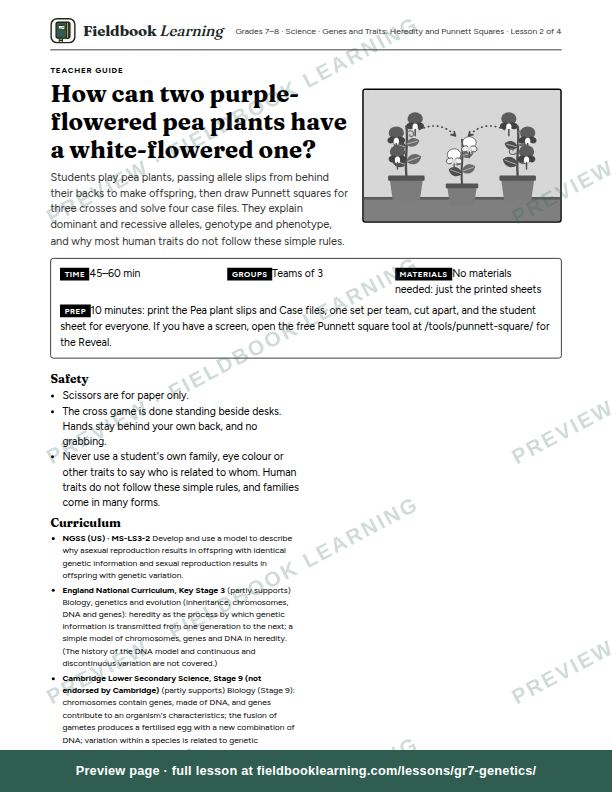
Sample pages, stamped “preview”. The download is the clean, full lesson.
In the full lesson PDF
10 printable pages
- Predict (5–10 min)
- Hunt (20 min)
- Reveal (10–15 min)
- Act (10 min)
- Background for the teacher
- Assessment
- Student sheet
- Worksheet: Pea plant slips and case files
- Worksheet: Label it
- Worksheet: Try it at home
On the student sheet
- My prediction
- Cross game results
- My Punnett squares
- Note to the gardener
- Exit ticket
- Pea plant slips and case files
- Label it
- Try it at home
US Letter, prints cleanly in black and white. The student sheet is on its own page, ready to photocopy.
Free with an account (any 3 lessons), or US$19 for all 4 lessons in this unit.
What students show by the end
- Uses the vocabulary
- Builds Punnett squares
- Reasons with chance
From the lesson’s rubric, which scores each one as not yet, getting there or got it.
Questions teachers ask
How long does “How can two purple-flowered pea plants have a white-flowered one?” take?
45–60 min. Group size: teams of 3.
How much prep does it need?
10 minutes: print the Pea plant slips and Case files, one set per team, cut apart, and the student sheet for everyone. If you have a screen, open the free Punnett square tool at /tools/punnett-square/ for the Reveal.
What materials do I need?
None. No materials needed: just the printed sheets.
Which curriculum standards does it cover?
NGSS (US): MS-LS3-2. It also matches England National Curriculum, Key Stage 3 and Cambridge Lower Secondary Science, Stage 9 (not endorsed by Cambridge).
What’s in the lesson PDF?
A teacher guide that walks you through predict, hunt, reveal, act, background for the teacher and assessment, then a student sheet (“My prediction”, “Cross game results”, “My Punnett squares”, “Note to the gardener”, “Exit ticket”, “Pea plant slips and case files”, “Label it” and “Try it at home”) on its own page, ready to photocopy. It’s US Letter and prints cleanly in black and white.
Can I try it for free?
Yes. A free account includes any 3 full lessons of your choice, and this can be one of them. After that, this unit is US$19 for all 4 lessons, yours to keep, or every lesson is US$199 a year.