Fraction Circles
Drag fraction pie pieces onto a whole circle to build, compare and add fractions. See when pieces make a whole, and when they spill into a mixed number.
Fraction Circles · free from Fieldbook Learning
How to use it
The tray holds fraction pie pieces from one whole down to twelfths, each denominator in its own colour. Drag a piece onto a plate, or click a piece in the tray to choose it and then click a plate (or its Add button) as many times as you like. Pieces snap edge to edge around the circle, starting at the top. Click a piece on a plate to take it off, or use Clear. With a keyboard, Tab to a piece and press Enter to choose it, then Tab to a plate's Add button; pieces on a plate can be removed with Enter or Delete.
Each plate shows its total as a simplified fraction and writes out the addition with a common denominator. When a plate holds more than one whole, the extra pieces carry on around a second circle, and the total is also shown as a mixed number. Switch the labels to decimals or percents (rounded where they repeat, like 0.333 for one third) or hide them so students judge by size alone. Compare two plates puts plates A and B side by side with <, = or > between them. The equivalent fractions challenge asks you to cover an outlined amount, such as 3/4, using only one size of piece, then checks your answer and keeps score.
The math: fractions as parts of a whole
A fraction circle is one whole cut into equal parts. The denominator says how many equal pieces make the whole; the numerator says how many you have. Three quarters is three of the pieces you get when you cut the circle into four. Because the whole is always the same circle, a bigger denominator means more cuts, so each piece is smaller: 1/12 is much thinner than 1/3, even though 12 is bigger than 3. This is the idea students most often get backwards, and the pie pieces make it easy to see.
Equivalent fractions cover exactly the same part of the circle. Two quarters fill the same space as one half, and six eighths fill the same space as three quarters, so 3/4 = 6/8. Cutting every piece into two smaller equal pieces doubles both the numerator and the denominator without changing the amount.
Adding fractions with unlike denominators works the same way. You cannot add 1/2 and 1/3 by counting pieces, because the pieces are different sizes. Rename both with pieces that fit each one: sixths. Then 1/2 + 1/3 = 3/6 + 2/6 = 5/6. When the total is more than one whole, like 3/4 + 1/2 = 5/4, the plate fills one circle and spills a quarter onto the next: one and one quarter.
- How many different ways can you fill one whole plate using two sizes of piece?
- Which is bigger, 2/3 or 3/5? Build both and compare before you calculate.
- Why can you cover 1/2 with tenths but not 1/3?
- Put 1/2 + 1/3 + 1/4 on a plate. Is it more or less than one whole?
Free to use, no account needed. It runs in your browser: nothing you type, and no sound from your microphone, is sent to Fieldbook.
Hands-on lessons to pair with Fraction Circles
Ready-to-teach units, each lesson a printable teacher guide and student sheet. Your first three lessons are free.
Measure It: Length, Time and Mass in the Real World
Whose foot is the right ruler? How long is a minute, really? Is a kilogram of feathers lighter than a kilogram of rocks? Four lessons where students measure length, time and mass with real tools, then use their own data to settle an argument.

Data Detectives
How fast are our reflexes? Which graph is telling the truth? Do taller people really have bigger hands? Three lessons where students collect their own measurements and find out what numbers can and can't tell you.
Evidence Lab
How do you know something is true? Students test a claim with their own measurements, find out why one result is never enough, and learn to tell strong evidence from weak.
Three full lessons, free
Make a free account and download any three Fieldbook lessons, from any grade or subject, as printable PDFs. No card needed.
More free classroom tools
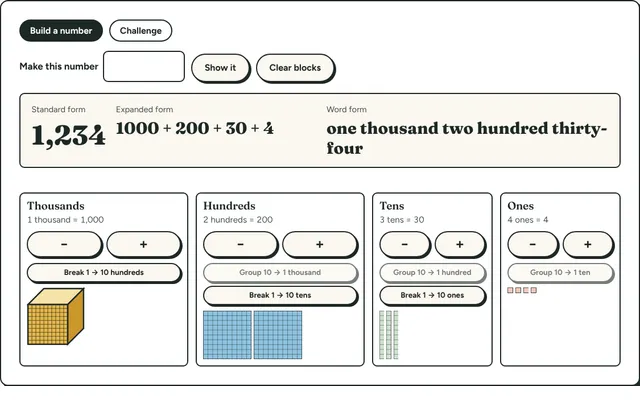
Place Value Blocks
Build any number from ones, tens, hundreds and thousands blocks, trade ten for one, and see it written in standard, expanded and word form.
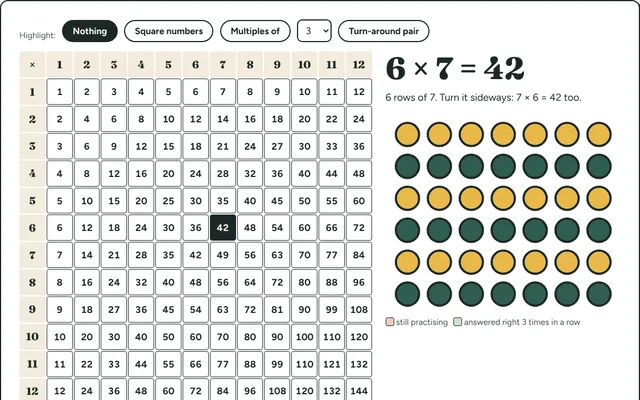
Times Table Trainer
Explore the multiplication grid as arrays and patterns, then practise the facts you pick with a quick quiz that tracks which ones still need work.
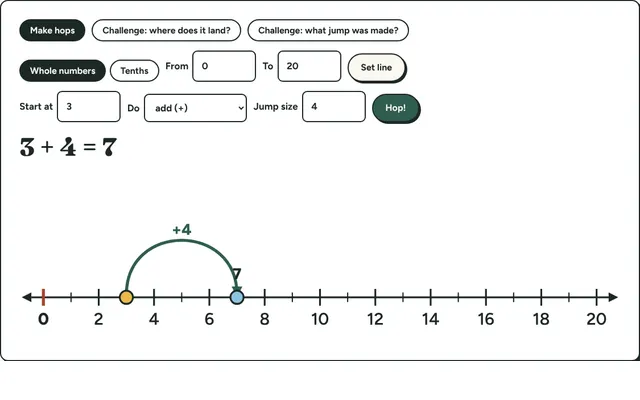
Number Line Hops
Show addition, subtraction and skip counting as jumps along a number line, with whole numbers, negatives or decimals.
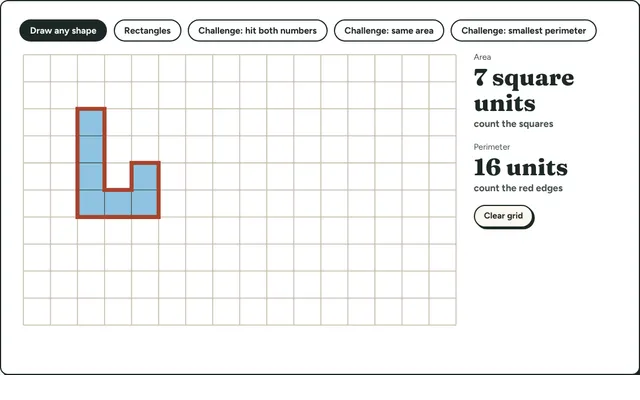
Area and Perimeter Builder
Draw shapes on a square grid and watch the area and perimeter count up. Challenges ask for shapes with the same area but different perimeters.
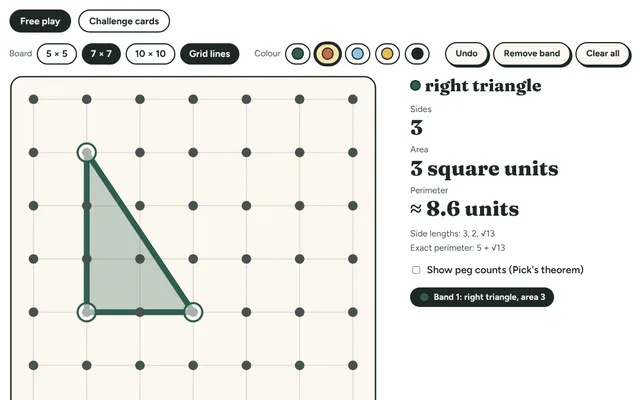
Geoboard
Stretch rubber bands between pegs to make shapes, then see each shape's area and perimeter. Copy shapes from the challenge cards or make your own.
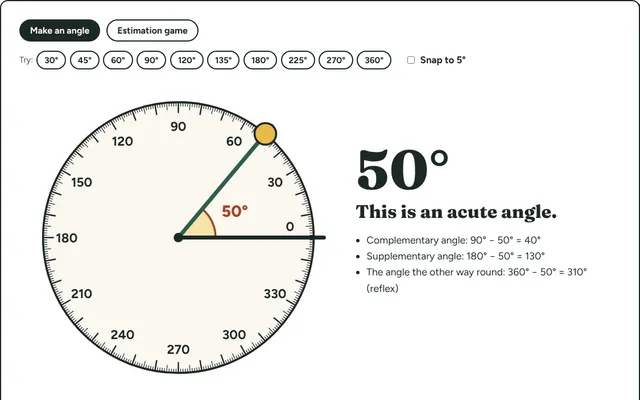
Angle Maker
Turn a ray around an on-screen protractor to make and measure angles, name them acute, right, obtuse or reflex, then estimate angles in a game.