Times Table Trainer
Explore the multiplication grid as arrays and patterns, then practise the facts you pick with a quick quiz that tracks which ones still need work.
still practising answered right 3 times in a row
Quiz
Facts to practise
How to use it
Point at or click any square in the grid to see that fact as an array of dots: rows times columns. Use the highlight buttons to look for patterns. The quiz has no timer: pick the tables to practise and answer at your own speed. Every answer is remembered on this device, the grid colours each fact you have tried, and missed facts go on the Facts to practise list until you get them right three times in a row.
The math: multiplication is equal groups
7 × 4 means 7 groups of 4, or an array with 7 rows of 4. Turn the array sideways and it becomes 4 rows of 7, with the same number of dots. That is the commutative property (a × b = b × a), and it halves the number of facts to learn: the grid is a mirror image across its diagonal.
The diagonal holds the square numbers (1, 4, 9, 16...), whose arrays are squares. Multiples of a number form stripes down a column and along a row. Students can build hard facts from easy ones: 7 × 8 is 7 × 4 doubled, and 9 × 6 is 10 × 6 take away one 6.
- Which numbers appear the most times in the grid? Why?
- Highlight the multiples of 4. Are they all multiples of 2 too?
- Why does every row of 5s end in 0 or 5?
Free to use, no account needed. It runs in your browser: nothing you type, and no sound from your microphone, is sent to Fieldbook.
Hands-on lessons to pair with Times Table Trainer
Ready-to-teach units, each lesson a printable teacher guide and student sheet. Your first three lessons are free.
Measure It: Length, Time and Mass in the Real World
Whose foot is the right ruler? How long is a minute, really? Is a kilogram of feathers lighter than a kilogram of rocks? Four lessons where students measure length, time and mass with real tools, then use their own data to settle an argument.

Data Detectives
How fast are our reflexes? Which graph is telling the truth? Do taller people really have bigger hands? Three lessons where students collect their own measurements and find out what numbers can and can't tell you.
Evidence Lab
How do you know something is true? Students test a claim with their own measurements, find out why one result is never enough, and learn to tell strong evidence from weak.
Three full lessons, free
Make a free account and download any three Fieldbook lessons, from any grade or subject, as printable PDFs. No card needed.
More free classroom tools
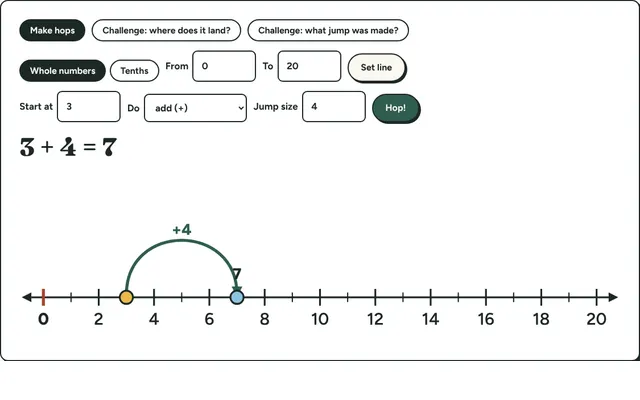
Number Line Hops
Show addition, subtraction and skip counting as jumps along a number line, with whole numbers, negatives or decimals.
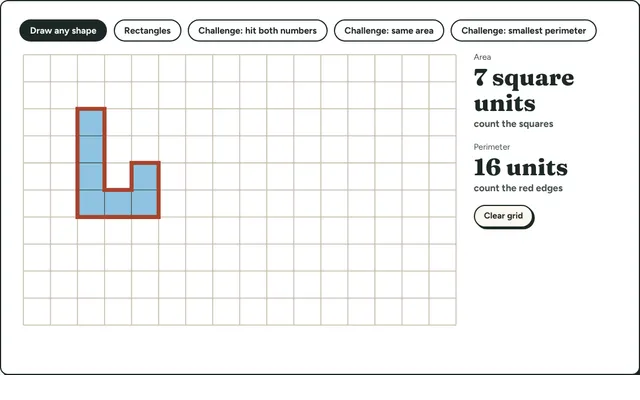
Area and Perimeter Builder
Draw shapes on a square grid and watch the area and perimeter count up. Challenges ask for shapes with the same area but different perimeters.
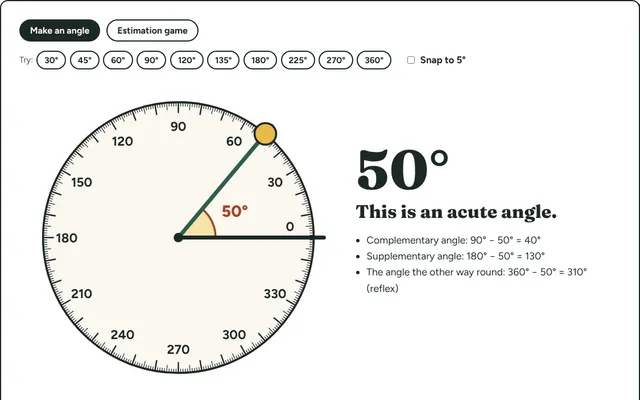
Angle Maker
Turn a ray around an on-screen protractor to make and measure angles, name them acute, right, obtuse or reflex, then estimate angles in a game.
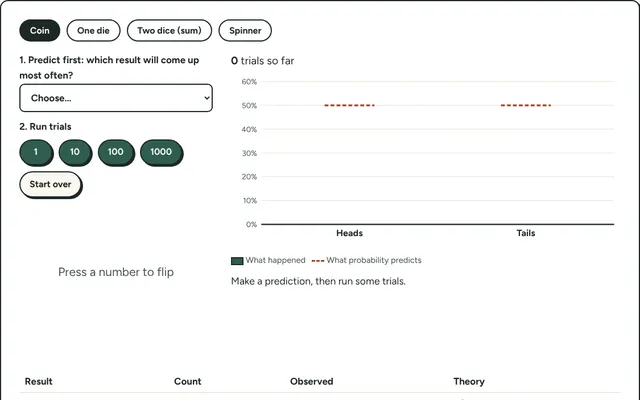
Probability Lab
Flip coins, roll dice or spin a spinner hundreds of times and compare what happened with what probability predicts.
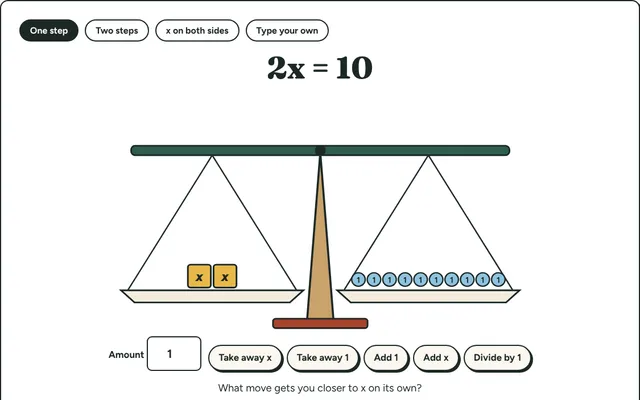
Equation Balance
Solve equations on a balance scale: do the same thing to both sides until x stands alone. Step-by-step algebra for grades 6 to 8.
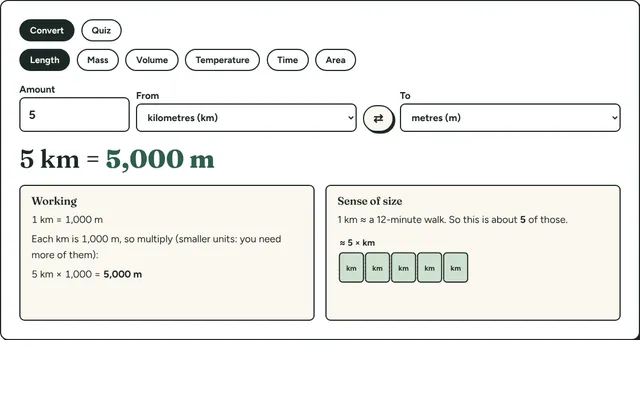
Measurement Converter
Convert length, mass, volume, temperature and time between metric and imperial units, with the working shown and a sense-of-size picture for each.