Lever Lab
Put weights on a seesaw and balance it. Discover the law of the lever (weight times distance) by experiment, then solve balance puzzles.
Left side: weight × distance
Right side: weight × distance
Three kinds of lever
Yellow triangle: fulcrum (the pivot). Green box: load. Red arrow: effort (your push or pull).
How to use it
Pick a weight, then tap a peg to hang it there (pegs are numbered 1 to 6 from the middle). Tap Remove and then a peg to take its top weight off. The beam tips toward the side with the bigger turning effect. In Balance puzzles, the grey weights are fixed: add one weight on the right to balance the beam, then press Check.
Keyboard: Tab to a peg and press Enter or Space.
The law of the lever
A weight's turning effect (scientists call it a moment, or torque) is its weight times its distance from the fulcrum. A seesaw balances when the turning effects on both sides are equal: 2 kg at peg 6 (2 × 6 = 12) balances 3 kg at peg 4 (3 × 4 = 12) or 4 kg spread over peg 3. That is why a small child far from the middle can balance a big adult sitting close in.
Levers trade distance for force. Push far from the fulcrum and a small force can lift a big load close to it, but your end moves farther. Real moments use force in newtons (N·m); here we use kilograms and peg numbers to keep the arithmetic simple, which gives the same balance answers.
- Ask: how many different ways can you balance 3 kg at peg 4 using only one weight? (12 = 2 × 6 = 3 × 4.)
- Ask: which class of lever is a door handle? A stapler? A hockey stick?
Free to use, no account needed. It runs in your browser: nothing you type, and no sound from your microphone, is sent to Fieldbook.
Hands-on lessons to pair with Lever Lab
Ready-to-teach units, each lesson a printable teacher guide and student sheet. Your first three lessons are free.
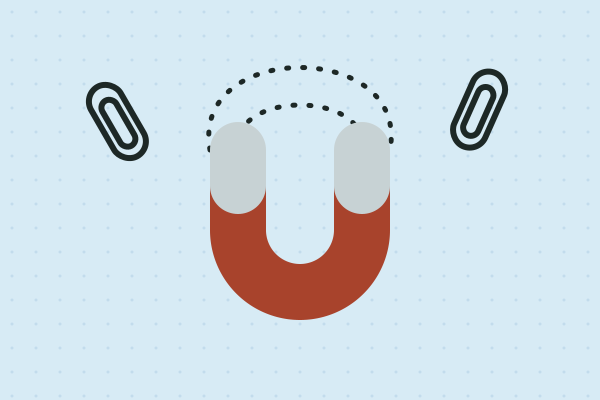
Pushes, Pulls and Magnets
Why a rolling ball always stops, whether a magnet can pull through a table, and how far a paper clip will jump. Three lessons on the pushes and pulls that start, stop and steer things.
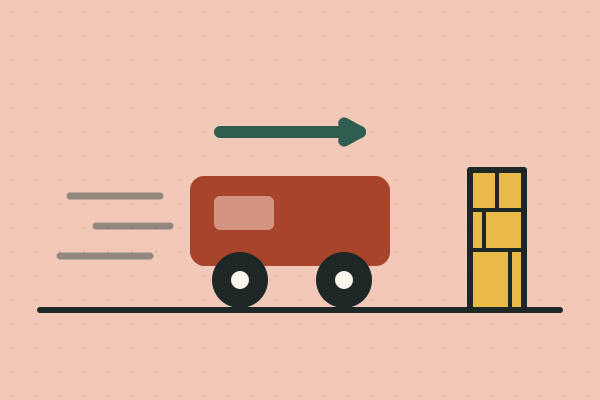
Forces and Motion: Crash, Push and Stop
Why you lurch forward when the bus brakes, how fast a toy car really goes, why heavier carts hit harder, and how to build a crumple zone that saves an egg. Four lessons on inertia, speed, mass and stopping safely.

Build It, Launch It
Egg drops, paper planes and balloon rockets, done properly at home. Three engineering challenges where kids build, test, fix and explain the pushes and pulls behind what happened.
Three full lessons, free
Make a free account and download any three Fieldbook lessons, from any grade or subject, as printable PDFs. No card needed.
More free classroom tools
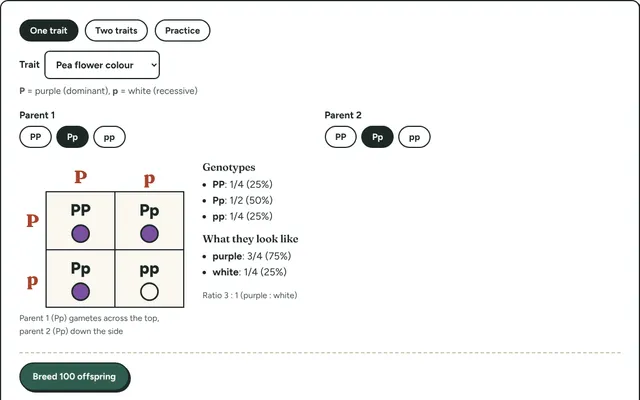
Punnett Squares
Cross two parents and see every possible offspring, with the ratios of genotypes and traits, plus a breeding simulator to test the prediction.
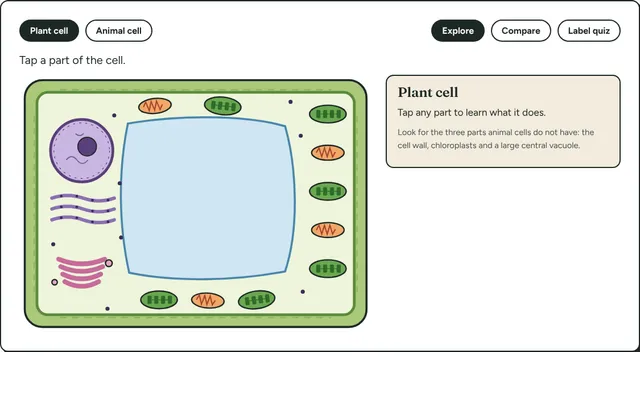
Cell Explorer
Tap the parts of a plant cell and an animal cell to learn what each one does, then compare the two and quiz yourself.
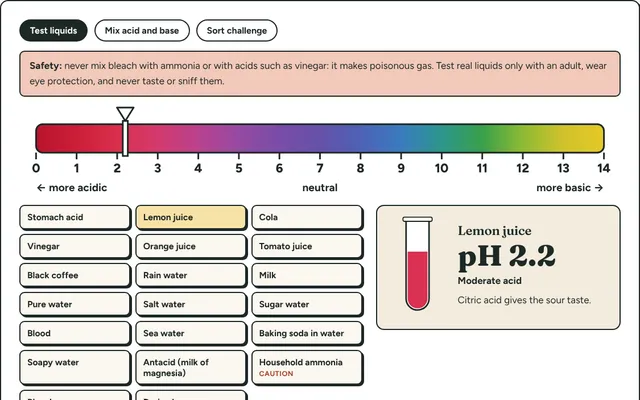
pH Scale Explorer
Test household liquids on a pH scale with a cabbage-juice indicator colour, from lemon juice to bleach, and mix acids and bases to see neutralisation.
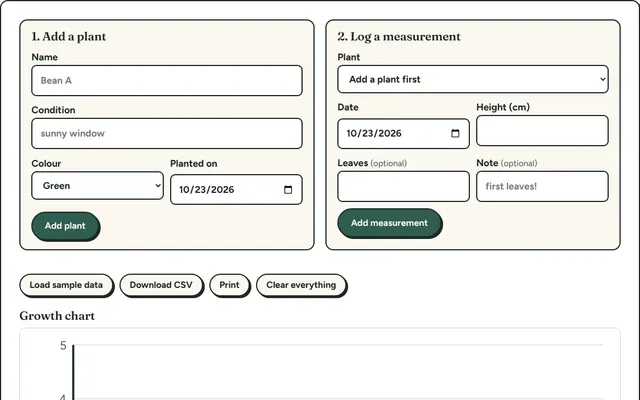
Plant Growth Journal
Log your class plants' height every few days and get a growth chart that compares plants or conditions. Saved on your device, ready to print.
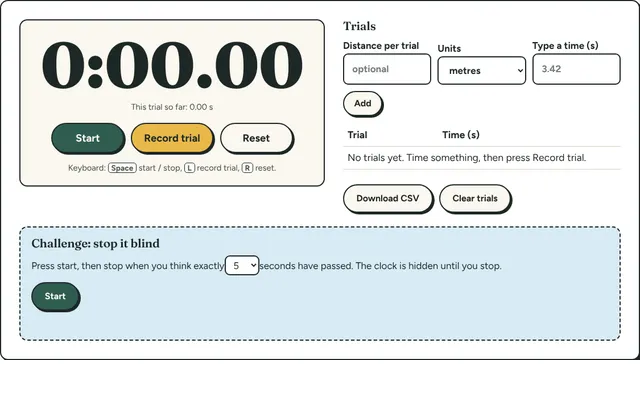
Lab Stopwatch
A big stopwatch with lap times for experiments: time several trials, see the average and spread, and download the results.
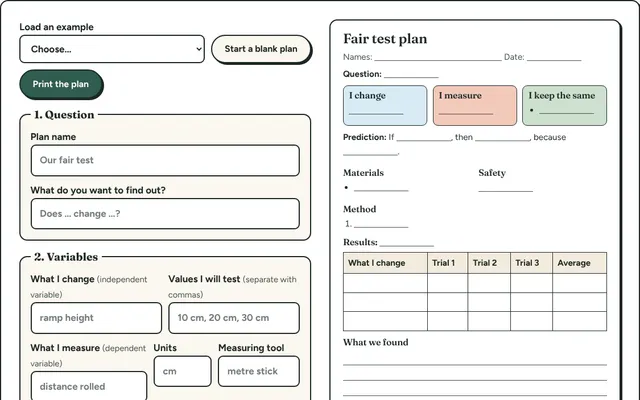
Fair Test Planner
Plan an experiment step by step: question, variables to change, measure and keep the same, prediction and method. Prints as a one-page plan.