Sound Wave Lab
Play a tone, change its pitch and loudness, and watch the wave change shape. Includes a live microphone wave view to see your own voice.
How to use it
Press Play tone, then slide the pitch and loudness and watch the drawing. Start the volume low on a classroom speaker. The drawing always shows the same short slice of time (10 milliseconds), so a higher pitch squeezes more waves into it, and a louder sound makes them taller. Try the wave shapes: they have the same pitch but a different sound quality (timbre).
Turn on the microphone and hum, whistle or sing to see your own voice. The browser will ask permission first. The game plays two notes; start on Easy and move to Hard once students are confident.
The science of sound
Every sound starts with something vibrating: a guitar string, a speaker cone, your vocal cords. The vibration pushes on the air, sending squeezed and stretched regions out in all directions as a wave. When it reaches your ear, it makes your eardrum vibrate too.
Frequency is how many vibrations happen each second, measured in hertz (Hz). More vibrations per second means a higher pitch. Doubling the frequency raises a note by one octave, so 440 Hz and 880 Hz are both an A. Amplitude is how big the vibration is: bigger vibrations sound louder. Young people can usually hear from about 20 Hz to 20,000 Hz; the top of that range drops as we get older, and dogs can hear much higher sounds than we can. Sound travels through air at about 343 metres per second.
- Find the lowest and highest pitch everyone in the class can hear on your speakers.
- Hum a low note and a high note into the microphone. Which drawing has more waves?
- Why does a big drum sound lower than a small one?
Free to use, no account needed. It runs in your browser: nothing you type, and no sound from your microphone, is sent to Fieldbook.
Hands-on lessons to pair with Sound Wave Lab
Ready-to-teach units, each lesson a printable teacher guide and student sheet. Your first three lessons are free.
Sound: Can You See a Sound?
Can you see a sound? Young scientists make rice dance on a drum, talk through a string telephone and build a rubber-band guitar to find out that every sound starts with something shaking.
Your Senses: How Does Your Body Know?
Map the most sensitive spots on your skin, find the blind spot in each eye, lose the flavour of a jelly bean by pinching your nose, and build an owl ear. Four lessons on how senses gather information and the brain makes sense of it.
Power Up: Where Electricity Comes From
Where does the electricity in our classroom come from, and why is it made differently in different places? Students trace the wires, build a wind machine that does real work, and weigh up solar power like an energy planner.
Three full lessons, free
Make a free account and download any three Fieldbook lessons, from any grade or subject, as printable PDFs. No card needed.
More free classroom tools
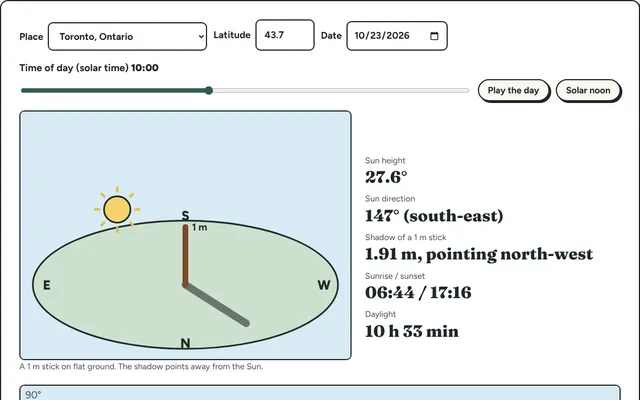
Sun and Shadow
Move through the day and the year to see where the Sun is in the sky, how long a stick's shadow is, and how many hours of daylight any latitude gets.
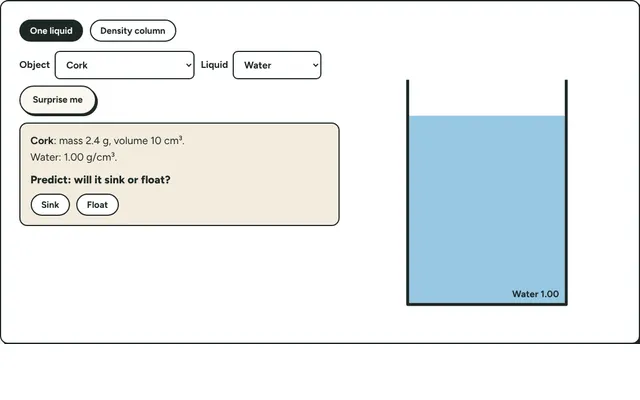
Sink or Float
Drop objects into water, oil, salt water or syrup. Predict first, then see what sinks and floats and why, using mass, volume and density.
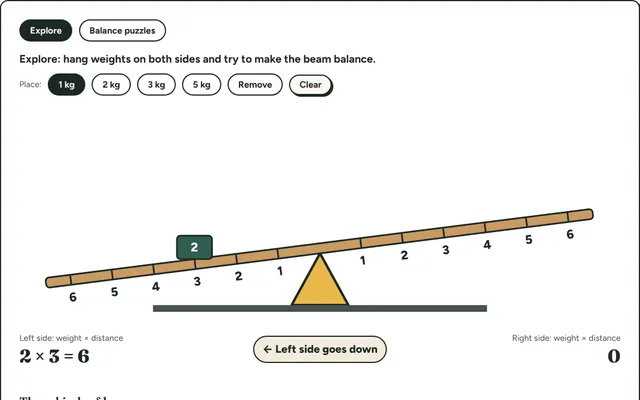
Lever Lab
Put weights on a seesaw and balance it. Discover the law of the lever (weight times distance) by experiment, then solve balance puzzles.
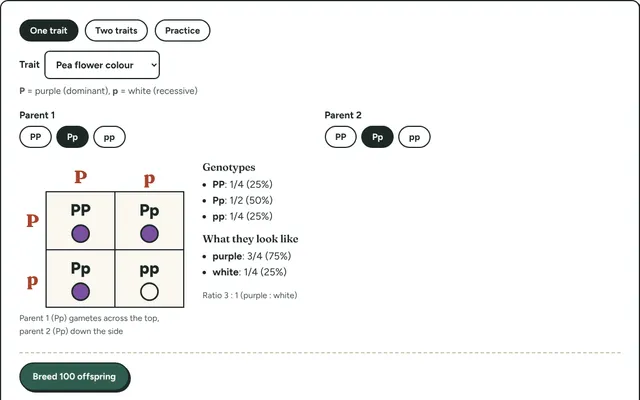
Punnett Squares
Cross two parents and see every possible offspring, with the ratios of genotypes and traits, plus a breeding simulator to test the prediction.
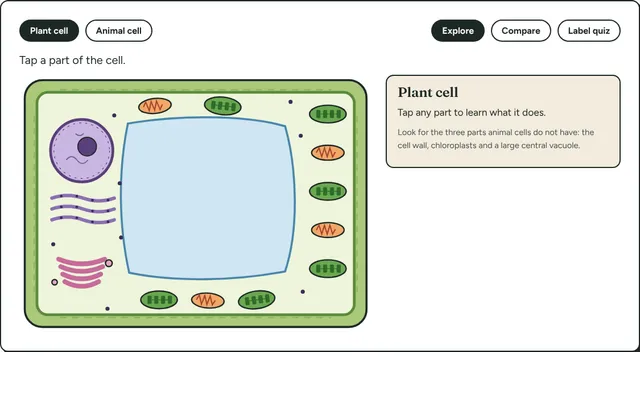
Cell Explorer
Tap the parts of a plant cell and an animal cell to learn what each one does, then compare the two and quiz yourself.
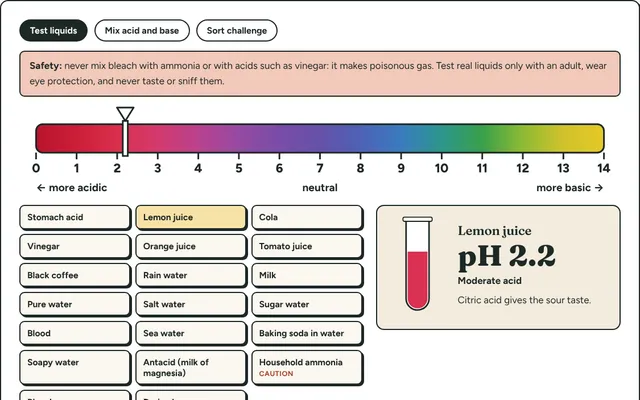
pH Scale Explorer
Test household liquids on a pH scale with a cabbage-juice indicator colour, from lemon juice to bleach, and mix acids and bases to see neutralisation.